
If you’ve landed here because you snore, wake up tired, breathe through your mouth, or you’re worried about your child’s sleep and jaw development, you’re in the right place. At Aligned Orthodontics on South Pearl Street, Dr. Amanda Vanderstelt is a board-certified orthodontist who makes sure your airway is taken care of, not just your teeth. She works with adults and kids across Denver and the surrounding neighborhoods to figure out whether breathing and jaw structure are part of what’s going on, and what to do about it.
Most of what’s covered on this page comes from the questions she gets every week in consultations. Honest answers, no pressure, no overselling.
About your orthodontist
Dr. Amanda Vanderstelt
Board-certified orthodontist · Airway-focused training · Owner, Aligned Orthodontics
Dr. Vanderstelt is currently undergoing the same MARPE adult palate expansion treatment she recommends to her own patients. When you ask her what it actually feels like to wear an expander as an adult, she’s not guessing.
More about Dr. VandersteltWho Airway Orthodontics Is For
Airway-focused orthodontic care is worth looking into if you or your child is dealing with mouth breathing, snoring, restless sleep, narrow jaws, crowded teeth, clenching, grinding, or any signs of sleep-disordered breathing.
The point of an evaluation isn’t to diagnose sleep apnea from an orthodontic visit. That’s a medical diagnosis that comes from a sleep study.
The point is to figure out whether jaw structure, palate width, or tongue posture are contributing to what you’re experiencing, and whether orthodontic treatment is part of the right answer.
Self check
Is this you, or your child?
Tick whatever sounds familiar. If three or more apply, an airway evaluation is worth scheduling.
You ticked 0 of 8.
Book an Airway EvaluationWhat an Airway Orthodontist Actually Does
Traditional orthodontics often starts with tooth alignment. Airway-focused orthodontics looks at a second question alongside that one: is the jaw developed enough to support nasal breathing, good tongue posture, and a clear airway?
Those two questions sound similar. They’re not. A person can have perfectly straight teeth and a narrow upper jaw that crowds the tongue back into the airway at night. They can also have crowded teeth that look cosmetic but actually point to underdeveloped jaws and a restricted airway underneath.
An airway-focused workup looks at:
- The size and shape of the upper and lower jaw
- How the tongue rests in the mouth, both awake and during sleep
- The shape of the nasal airway and whether you’re breathing through your nose or your mouth
- The soft tissue in the throat, including tonsils and adenoids in kids
- Bite, crowding, and whether previous treatment may have narrowed the arch
That evaluation uses a 3D CBCT scan, intraoral scans, photos, and a thorough history. It’s the same kind of workup that gets done before MARPE, jaw surgery, or any expansion treatment, and it’s what tells us whether airway is actually part of your case or whether it’s something simpler.
At a glance
Airway-focused vs. traditional orthodontics
What “Airway-Focused” Doesn’t Mean
A quick honest note. There is real debate inside orthodontics about how far the airway connection goes, what the evidence shows, and which patients benefit from airway-focused care versus standard orthodontic treatment. Dr. Vanderstelt’s approach is to take the question seriously without overpromising. If your case is straightforward and a standard plan is the right answer, she’ll tell you. If breathing and jaw development are part of the picture, that gets addressed too. Either way, the goal is honest guidance, not a sales pitch for a specific treatment.
Signs You May Benefit From an Airway Evaluation (Adults)
Most adults don’t connect their daily symptoms to their jaw or airway. These are the patterns that tend to show up together:
- Loud snoring, gasping, or holding your breath in your sleep
- Waking up tired no matter how long you slept
- Daytime fatigue, brain fog, or trouble focusing
- Morning headaches or jaw tension
- Clenching or grinding your teeth at night
- Dry mouth or sore throat in the morning
- Mouth breathing during the day, especially when concentrating or exercising
- A high, narrow roof of the mouth, or teeth that crowded back even after braces as a kid
- TMJ pain or facial tension
None of these on their own confirms an airway problem. Together, especially with a sleep study showing flow limitation or apnea, they often point to a jaw and airway that didn’t develop with enough room. That’s where orthodontic treatment can help. For more on how airway-focused care affects sleep, see how airway-focused orthodontics can improve sleep quality.
From the MARPE journey
An orthodontist with her own palate expander
Dr. Vanderstelt is going through the same MARPE treatment she recommends to her adult patients. The series documents what it actually feels like, from day one through the full treatment.
Watch the full seriesTreatments for Adults at Aligned Orthodontics
MARPE (mini-screw assisted rapid palatal expander). Widens the upper jaw in adults whose palatal suture has matured, without surgery in most cases. It opens up nasal airway volume, makes more room for the tongue, and corrects narrow arches. Dr. Vanderstelt is currently undergoing MARPE treatment herself, which means she can answer just about anything you want to know about what it actually feels like. See all of our orthodontic treatments.
Jaw surgery (orthognathic surgery). For cases where MARPE isn’t enough or the jaw needs forward movement as well as widening. Done in coordination with an oral surgeon. Not the right answer for every patient, but the right answer for some, and we’ll be honest about which group you fall into.
Broadening arch forms with braces or aligners. Doesn’t change airway volume directly, but creates more room for the tongue to rest forward instead of falling back during sleep. Often used in combination with other treatments.
Coordinated care. Airway problems usually involve more than the jaw. Referrals to ENT, sleep medicine, and myofunctional therapy are part of how this practice works when they’re needed.
Adult airway consult
Get real answers about your airway
A 60-minute consultation with Dr. Vanderstelt includes a 3D CBCT scan, a full airway review, and an honest treatment plan. Not every adult needs treatment. The point is to find out.
Book Your ConsultationSigns Your Child May Benefit From an Airway Evaluation
Most parents don’t know that snoring, mouth breathing, and restless sleep in kids can be early signs that the jaw and airway aren’t developing the way they should. These often get treated as separate issues when they can actually point back to the same root cause.
Common signs to watch for:
- Mouth breathing, awake or asleep
- Snoring or noisy breathing at night
- Restless sleep, frequent waking, or bedwetting beyond an appropriate age
- Dark circles under the eyes
- Trouble focusing or hyperactivity during the day
- A long, narrow face or recessed chin
- Crowded baby teeth, narrow palate, or crossbite
- Teeth grinding at night
The American Association of Orthodontists recommends a first orthodontic visit by age 7. For airway specifically, an evaluation can be useful earlier if symptoms are already showing up. Snoring, mouth breathing, restless sleep, or noticeable changes in jaw or face shape in a child as young as 3 or 4 are worth a look. Jaw growth slows around ages 12 to 13, and patterns that are easy to guide early get harder to fully change later. The goal isn’t to treat every kid. It’s to catch the kids who genuinely need help while there’s still a wide window to do something about it.
Treatments for Kids
Palatal expansion (RPE). Widens the upper jaw before the palatal suture has fused. Improves nasal breathing, makes room for the tongue, and gives erupting teeth somewhere to go. Read more about jaw expanders for kids and adults.
Facemask therapy. Gently brings the upper jaw forward when needed. Used in growing kids whose upper jaw is positioned too far back.
Orthopedic appliances. Guide jaw growth and create airway space during the years when the face is still developing.
Coordinated care with ENT and myofunctional therapy. Tonsils, adenoids, tongue posture, and breathing patterns all factor in. When something needs to be addressed outside orthodontics first, we’ll say so.
If you’re a parent looking for more on this, Dr. Vanderstelt put together a free guide called Breathe Well, Grow Well that walks through what to watch for, why it matters, and what early orthodontics can do. Request a copy here.
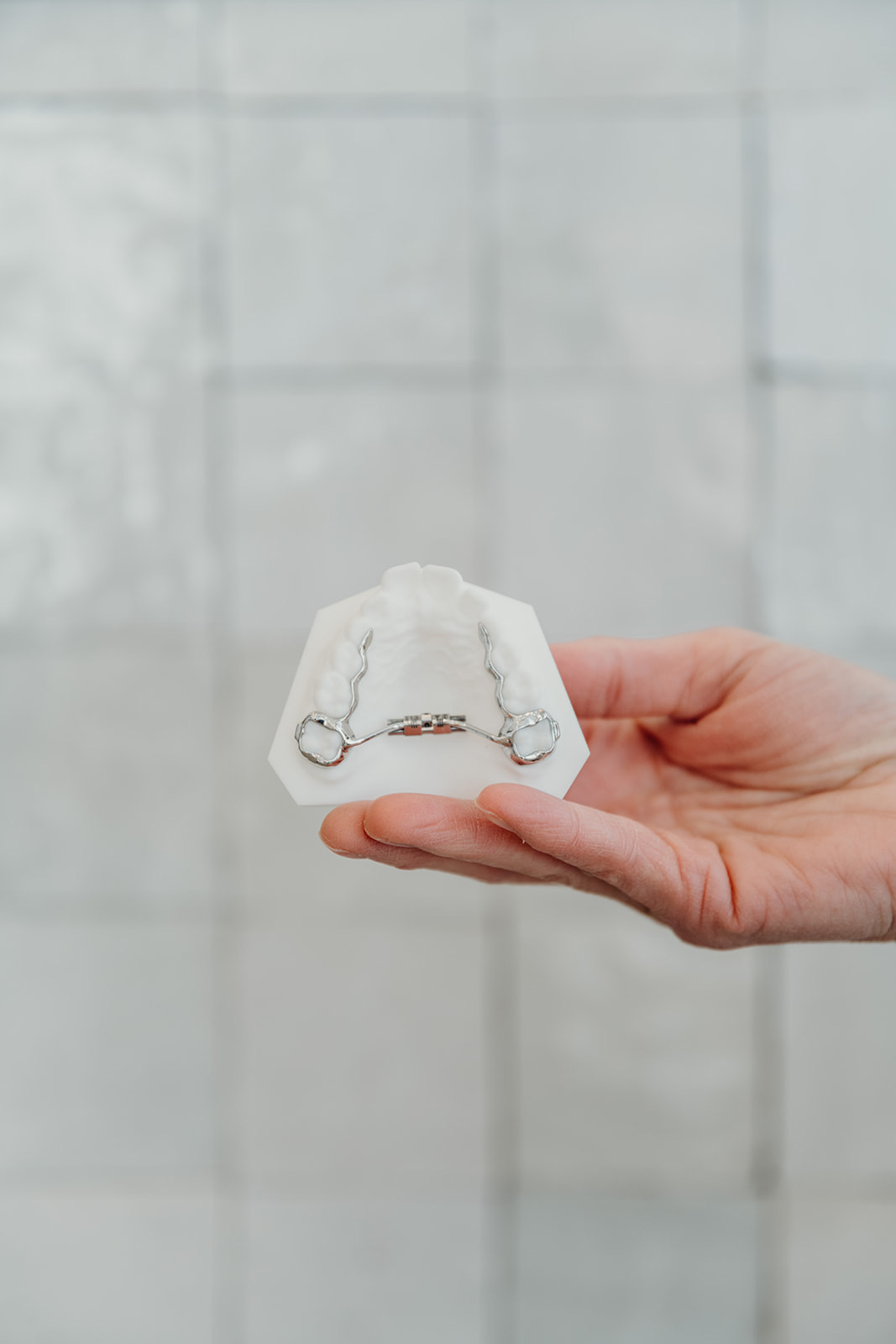
What an RPE looks like
A traditional palatal expander, up close
The metal bands cement over the back molars on each side of the upper jaw. The screw mechanism in the middle widens the palate gradually over several months, opening the suture between the two halves of the upper jaw.
In kids and teens whose palatal suture hasn’t fully fused, this is enough to create real expansion. For adults whose suture has matured, MARPE adds mini-screws anchored into the bone to achieve the same result.
What Happens After an Airway Evaluation
If airway and jaw development are part of your case, we walk you through a clear next step. Depending on what we find, that might mean expansion (RPE for kids and teens, MARPE for adults), orthodontic treatment to correct bite and create tongue room, or coordinating with ENT or sleep medicine before any orthodontic treatment starts.
Not everyone needs treatment right away. Some patients we monitor over time, especially growing kids. Some don’t need orthodontic treatment at all. The plan is built around your anatomy and what’s actually going on, not a default recommendation that gets handed to every new patient.
What an Airway Consultation at Aligned Orthodontics Looks Like
A 60-minute appointment with Dr. Vanderstelt. We take 3D CBCT imaging, intraoral scans, and photos. She reviews your jaw structure, soft tissue, and airway, then walks you through what she sees and what your options are.
For adults, we ask for a sleep study less than one year old before the consult. You can get one through your primary care provider or through a service like GetHypnos.com. The reason is simple: a real sleep study tells us whether what you’re dealing with is mild flow limitation, moderate sleep apnea, or something else, and that changes the treatment plan.
For kids 13 and under, the airway consultation is complimentary. For kids 14 and older and adults, the consultation fee is confirmed at booking. Adult airway consultations include 3D CBCT imaging, intraoral scans, photos, a full review with Dr. Vanderstelt, and a personalized treatment plan.
You’ll leave with a clear understanding of whether airway is actually part of your case, what treatment would involve, what it costs, and whether to do it now, later, or not at all.
Your visit
What happens at your consultation
3D CBCT imaging
A low-radiation scan that shows the airway, jaw structure, and soft tissue in three dimensions. Not the same as a standard 2D x-ray.
Intraoral scan & photos
A digital scan of your teeth and bite, plus a set of clinical photos. No goop, no impressions, no gagging.
Review with Dr. Vanderstelt
She walks you through what she sees, what’s contributing to your symptoms, and what your real options look like.
A clear plan, or none
You leave with a personalized treatment plan, an honest recommendation to monitor, or a clear “you don’t need treatment.” All three are real outcomes.
Why Patients Choose Dr. Vanderstelt
She’s a board-certified orthodontist with training in airway-focused care. Board certification reflects a higher level of clinical rigor than the orthodontic license alone requires. The airway training is on top of that. More about Dr. Vanderstelt.
She’s personally undergoing MARPE. Dr. Vanderstelt is currently going through the same adult palate expansion treatment she recommends to her patients. That means when you ask her what it’s actually like, she’s not guessing.
3D CBCT airway analysis is included in every new-patient workup. Most general orthodontists don’t do CBCT scans on new patients. We do because you can’t make decisions about airway without seeing the airway. This kind of imaging shows airway volume and structure in a way standard 2D orthodontic records can’t.
Boutique practice on South Pearl Street. One office, one orthodontist, the same team every visit. We’re in Platt Park on South Pearl Street, walkable to Wash Park, and we see patients from across Denver including Cherry Creek, University Park, Bonnie Brae, Baker, Capitol Hill, the University of Denver area, and the surrounding metro. Families and adults come to us for airway evaluations, MARPE consultations, early orthodontic assessments, and palate expansion guidance.
Honest treatment recommendations. Some patients need MARPE. Some need braces. Some don’t need orthodontic treatment at all and we’ll tell them so. The goal is to do the right thing for the case in front of us, not to sell a specific treatment.
Frequently Asked Questions
What is an airway orthodontist?
An airway orthodontist evaluates how breathing, sleep, and jaw development relate to bite and tooth alignment, then plans treatment that addresses the root cause rather than just the appearance of the teeth. Dr. Vanderstelt is a board-certified orthodontist with airway-focused training serving adults and kids across Denver from her office on South Pearl Street.
Is airway orthodontics legitimate, or is it a marketing trend?
Both, honestly. The connection between jaw structure, tongue posture, and airway function is real and well-documented in the literature. The marketing around “airway orthodontics” as a brand has gotten ahead of the evidence in some corners of the field. The right way to handle this is to take the question seriously, use real diagnostic imaging, work with sleep medicine and ENT when warranted, and recommend treatment only when it’s actually indicated. That’s how this practice operates.
Am I too old for airway-focused orthodontic treatment?
No. Adult treatment is more limited than child treatment because the jaws are fully formed, but expansion, repositioning, and bite correction are all still possible. MARPE in particular is designed for adults whose palatal suture has fused. Dr. Vanderstelt is undergoing MARPE herself, which is well within the typical adult treatment window.
Is mouth breathing bad for kids?
Mouth breathing in kids can be a sign that something is affecting nasal airflow or jaw development. Over time, it can influence how the face grows, how the teeth come in, and how well a child sleeps. Not every kid who mouth breathes needs orthodontic treatment, but it’s worth an evaluation early to figure out whether the airway, tonsils, adenoids, or palate width are part of what’s going on.
Will airway orthodontics cure my sleep apnea?
Sometimes treatment significantly reduces or resolves sleep-disordered breathing. Sometimes it improves it but doesn’t eliminate it. Sometimes it’s not the right tool for the case. The honest answer depends on what’s causing the apnea, how severe it is, and what your jaw and airway anatomy actually look like on a CBCT scan. We don’t promise outcomes we can’t deliver.
Can an orthodontist diagnose sleep apnea?
No. Sleep apnea is a medical diagnosis that comes from a sleep study interpreted by a qualified provider. What an airway orthodontist can do is evaluate whether jaw structure, palate width, bite, tongue space, or facial growth patterns are contributing to restricted breathing, and coordinate with sleep medicine, ENT, or other providers when that’s needed. Diagnosis stays with your sleep doctor. Orthodontic treatment is one tool that can support the broader plan.
How much does an airway consultation cost?
Adult airway consultations have a flat fee that’s confirmed at booking. The visit includes 3D CBCT imaging, intraoral scans, photos, a full review with Dr. Vanderstelt, and a personalized treatment plan. Kids 13 and under are complimentary. We discuss treatment costs and payment plans during the consultation, since the right plan depends on the case.
What’s the difference between MARPE and traditional palate expansion?
A traditional rapid palatal expander (RPE) anchors to the teeth and works in kids and teens whose palatal suture hasn’t fully fused. MARPE uses small mini-screws anchored into the bone of the upper jaw, which lets it expand the palate in adults whose suture has matured. Both treatments widen the upper jaw, but MARPE is the version designed to work after growth is complete.
The research shows that MASPE/MARPE increases the nasal passageway opening more significantly than a tooth borne expander – for kids or teens who have airway issues this may be recommended over a traditional expander.
Do you take insurance for airway treatment?
Insurance coverage for airway and MARPE treatment is variable. Some plans cover orthodontic treatment regardless of the airway focus. Some cover sleep apnea treatment as a medical benefit. Some don’t cover either. We discuss specifics during the consultation and offer flexible payment plans.
Where is your office?
Aligned Orthodontics is at 1215 S Pearl St, Denver, CO 80210, in the Platt Park neighborhood on South Pearl Street near Wash Park. There’s free parking behind the building. We see patients from across Denver and the surrounding metro.
How do I book an airway evaluation?
Use the booking form on this page, give us a call, or schedule a consultation through our booking page. For adult airway consults, we’ll ask for a sleep study less than one year old before your visit. If you don’t have one yet, we’ll point you to a couple of options.
Book Your Airway Assessment
If something on this page sounded familiar, that’s worth following up on.
Whether you’re an adult who’s been mouth breathing for years or a parent watching your kid snore at night, an airway evaluation gives you real answers based on real imaging, not guesswork.
Platt Park neighborhood, on South Pearl Street near Wash Park