
Platt Park, Denver · Braces for kids, teens and adults
Braces in Denver: Cost, Process, and What to Expect
If you are thinking about braces in Denver, you probably have three questions running on a loop: what will this cost, what is the process actually like, and how do I choose the right Denver orthodontist?
At Aligned Orthodontics on South Pearl Street, Dr. Vanderstelt walks adults and families through all three every week. She is a board-certified orthodontist with training in airway-focused care, which means orthodontic treatment in Denver with her does not stop at straightening teeth. She looks at how your bite, your breathing, and your jaw work together, then builds a plan around the whole picture.
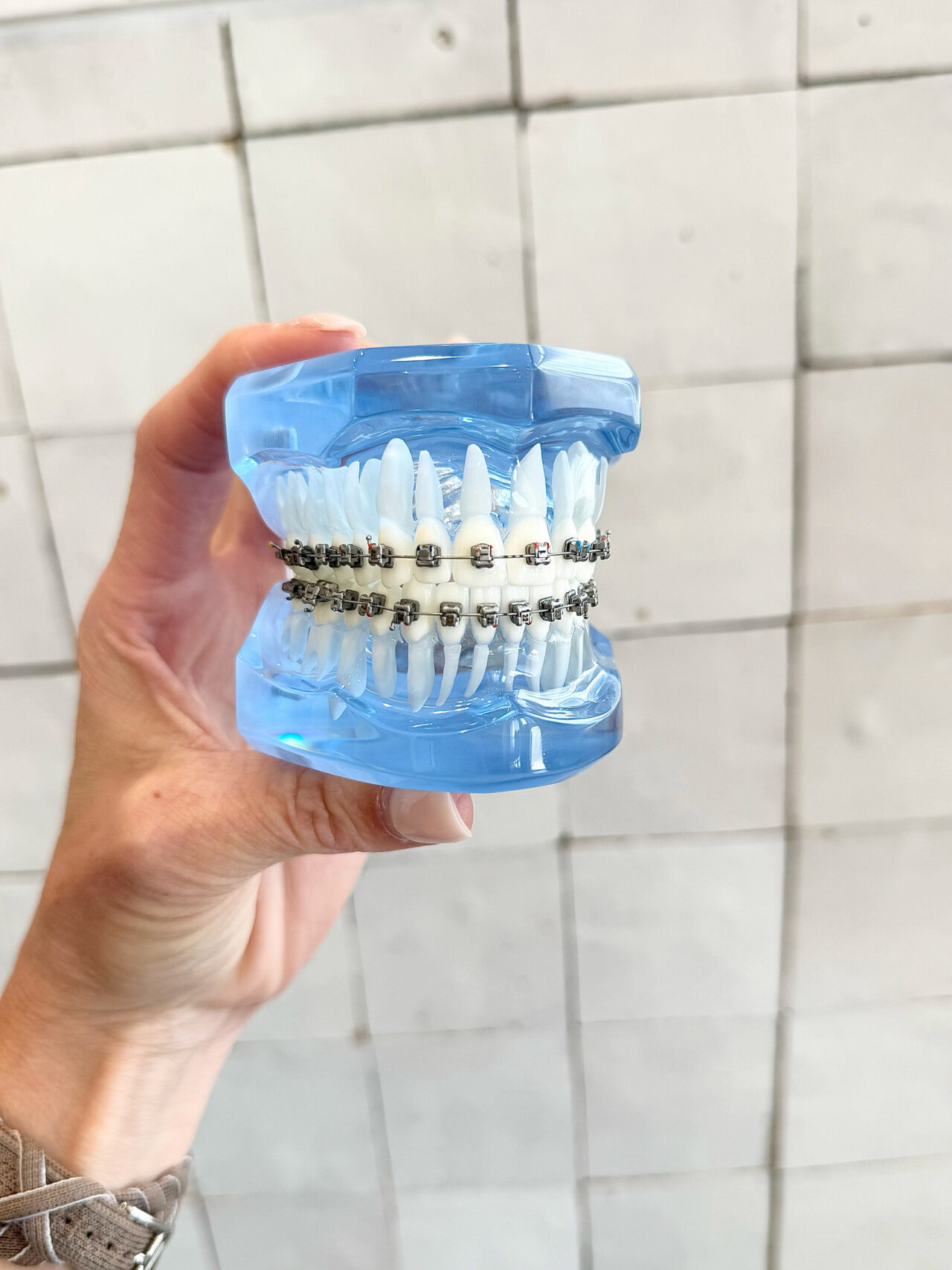
Dr. Vanderstelt is a board-certified orthodontist with an airway-focused boutique practice in Platt Park. 3D imaging is included at your consult, and flexible monthly payment plans are available.
Here is the part most people need to hear first: you do not have to figure this out alone. Once you sit down with the right person, the worrying part is over. That is the job. Let us take it from here.
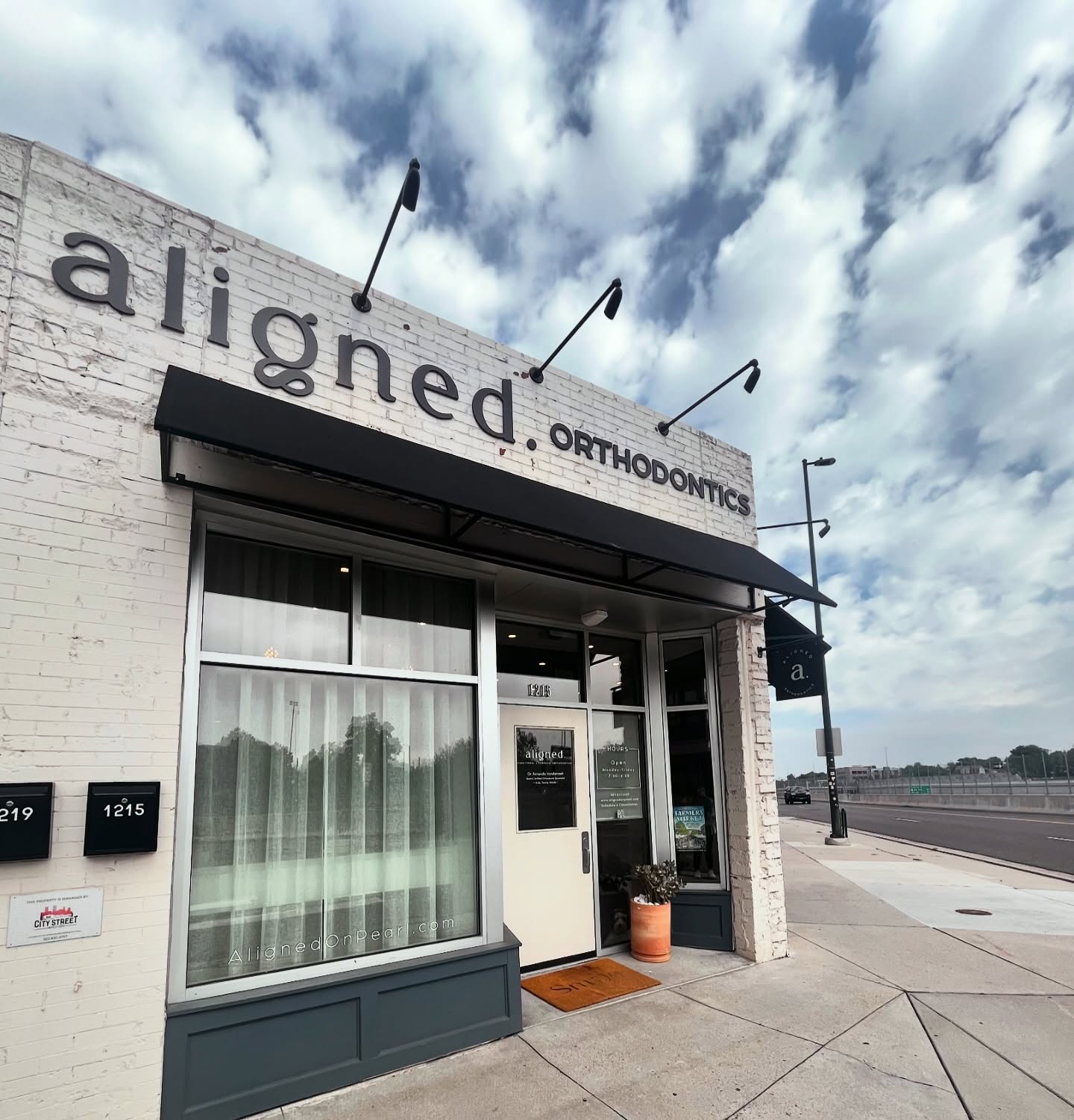
Aligned Orthodontics is at 1215 S Pearl St in Denver’s Platt Park neighborhood, a short walk from Wash Park and just off South Broadway. You can reach us at 303-521-3333.
We see patients from across the Denver metro, including Platt Park, Washington Park, Cherry Creek, University Park, Baker, Bonnie Brae, Cap Hill, the Highlands, Englewood, and Littleton. The office is easy to reach from I-25 and the block has parking. And yes, you will probably meet Benito, our office goldendoodle, on your way in.
How do I know if I need braces?
Most people who end up needing orthodontic treatment have one or more of these signs. If three or more sound like you, it is worth a consultation:
Is this you?
Tick the ones that sound familiar. If three or more do, a consultation makes sense.
You ticked 0 of 8
Tick the ones that sound like you to see if a consultation makes sense.
Book your consultationThat last cluster is the one most general dentists miss. Crowding and bite problems are often a downstream symptom of how the jaw and palate developed, and how you breathe plays a role in that. Dr. Vanderstelt evaluates both at your consultation, which is why patients across Denver come to Aligned for airway-focused orthodontics rather than just cosmetic alignment.
What braces cost in Denver
The cost of braces at Aligned Orthodontics in Denver typically ranges from $5,500 to $8,000. Traditional metal braces sit at the lower end, ceramic and custom digital braces run higher, and more complex cases that need extra appliances or longer treatment land toward the top of the range.
The three biggest factors are how much your teeth need to move, the type of braces you choose, and how long treatment takes.
Braces at Aligned Orthodontics
$5,500 – $8,000
Typical range. Your exact number depends on your case.
Metal braces
Starting around $5,500
Ceramic braces
Higher than metal
Custom digital braces
Higher than standard
Complex cases with extra appliances
Toward the top of the range
What is included
- Digital scans and 3D imaging
- All adjustment visits
- Your first set of retainers
- Airway and bite evaluation
No surprise charges later. We review your full estimate at your consultation.
You can see the full range of braces options at Aligned Orthodontics, including Damon self-ligating, custom digital, and lingual options, on the braces service page.
Your fee at Aligned covers everything from records and 3D imaging at your consultation through the first set of retainers after braces come off. No surprise charges later.
A few things drive your final number:
- Type of braces. Metal is the most budget-friendly. Ceramic costs more for the discreet look. Cases that need extra appliances cost more because there are more parts and more chair time.
- Case complexity. Mild crowding is a shorter, less expensive case than a significant bite correction or an airway-related issue. Your orthodontist can only give you a real number after seeing your teeth and your scans.
- Treatment length. Most braces cases run 12 to 36 months. Longer treatment means more adjustment visits, and that affects cost.
- Records and imaging. A good consultation includes digital scans and 3D imaging. At Aligned, that is part of your new patient workup, not an upcharge later.
We do not post a single flat price on this page on purpose, because anyone who quotes you an exact number before looking in your mouth is guessing. At your consultation, we review your full estimate in plain numbers, including the total fee, what your insurance covers, what your monthly payment would be, and what is and is not included. No surprise charges later.
Want to know your actual braces cost? Schedule a consultation at Aligned Orthodontics in Denver and we will review your treatment options, insurance benefits, and a monthly payment estimate before you start.
Board-certified orthodontist. 3D imaging included in every new patient workup. Flexible payment plans.
Are there hidden fees with braces?
This is one of the most common questions people ask after the initial price. With a reputable orthodontist, the quote you get at your consultation should be a flat fee that covers your active treatment, adjustment visits, and at least your first set of retainers. The places that surprise people are usually the practices that quote a low headline number, then add charges for things that should have been bundled.
Here is what to ask about before you sign anything:
- Are records, scans, and X-rays included in the consultation fee?
- Are all adjustment visits included, or is each visit billed separately?
- Are retainers included at the end of treatment, and how many sets?
- What is the policy if a bracket breaks?
- What happens if treatment runs longer than the original estimate?
At Aligned Orthodontics, your treatment fee is one number that covers everything from placement through the first set of retainers, so there is nothing waiting for you at the end.
How insurance, HSAs, and payment plans work for braces
Often, yes, insurance covers part of orthodontic treatment, though it varies a lot by plan. Many dental plans include an orthodontic benefit with a lifetime maximum, often somewhere between $1,000 and $3,000.
Some have age limits that only cover dependent children. Others treat braces and clear aligners the same, while a few exclude aligners. The only way to know your real number is to check your specific plan, which we are happy to help you do before you commit to anything.
If you have an HSA or FSA, that money usually applies too. The IRS treats orthodontic treatment as a qualified medical expense, so braces, retainers, and your appointments can typically be paid for with pre-tax dollars.
Because you are using pre-tax money, the effective savings can be meaningful depending on your tax bracket. FSA funds often follow a use-it-or-lose-it rule by year end, so timing your treatment start around your account can stretch your dollars further.
For anything insurance or pre-tax money does not cover, we offer flexible monthly payment plans so the cost spreads out across your treatment instead of landing all at once. Many patients combine all three: insurance reduces the total, an HSA or FSA handles a chunk, and a monthly plan covers the rest. For a deeper breakdown across all treatment types, see our orthodontic treatment cost guide.
How to get braces in Denver, step by step
The process is more straightforward than most people expect. Here is the path from your first call to the day your braces come off. (For a deeper walkthrough, see our guide to the step-by-step process of getting braces.)
Digital scans and 3D imaging so we can see how your bite and airway connect. You leave knowing your options, your timeline, and your estimate.
60 – 90 minWe map out the type of braces, how long treatment will take, and what to expect. Ask everything.
No needles. No drilling. We clean, bond the brackets, and run the wire. Most people describe it as pressure, not pain.
1 – 2 hrsQuick visits every four to eight weeks to adjust the wires and keep your teeth moving on schedule.
20 – 30 minPainless removal, a quick polish, and your first set of retainers to lock in the result.
30 – 60 minTrusted by patients across Denver. Same-day starts available for straightforward cases.
Can I start braces the same day as my consultation?
In many cases, yes. If your records are complete, your questions are answered, and your treatment plan is straightforward, we may be able to start braces the same day as your consultation. If your case needs additional review, especially with airway, jaw, or bite concerns, Dr. Vanderstelt will walk you through the next step before anything begins. Either way, you leave your first visit knowing exactly where you stand.
Do braces hurt? What the first week is really like
Placement itself is not painful. The soreness comes a few hours later, once your teeth start responding to the gentle pressure, and it follows a predictable pattern.
Most people feel the most soreness in the first 24 to 72 hours, then it fades over the rest of the first week. By week two, the brackets feel normal. Over-the-counter pain relievers, soft foods, and orthodontic wax handle almost all of it. After each adjustment you may feel mild tightness for a day or two, but it is never as intense as that first week, and it gets easier every time.
The patients who struggle most are the ones who were not told what to expect. Knowing that day one to three is the peak, and that it resolves on its own, takes most of the worry out of it. That is exactly the kind of thing we walk you through before you ever sit in the chair.
What you can and cannot eat with braces
The food rules are simpler than people think. For the first few days after placement and after each adjustment, stick to soft foods while your teeth are tender. After that, you can eat almost anything as long as you avoid the short list of foods that damage brackets.
Easy on day one: smoothies, yogurt, eggs, oatmeal, mashed potatoes, soup, pasta, soft fish, mac and cheese, ice cream.
Skip these the entire time you have braces: popcorn (the kernels are notorious for breaking brackets), nuts, hard candies, ice (do not chew it), caramels and taffy, gum, hard pretzels, and tough crusty bread.
Modify these: apples, carrots, corn on the cob, and bagels are fine if you slice or chop them into smaller pieces. You just cannot bite straight into them.
Most patients adapt their habits within the first month and stop thinking about it. The patients who run into trouble are usually the ones who forget and bite into something hard out of habit, which can pop a bracket and add an extra visit. It happens. Just call the office and we will get you in to fix it.
What happens after braces come off? The retainer phase
The day your braces come off is one of the best appointments in orthodontics. Removal is painless, just some pressure as each bracket pops off, followed by a quick polish. The whole appointment takes 30 to 60 minutes. You leave with straight teeth and your first set of retainers.
Retainers are non-negotiable. Teeth have memory and will try to drift back to their old positions, especially in the first year. The plan we use at Aligned is:
- First few months: full-time retainer wear, taken out only to eat and brush
- After that: transition to nighttime only
- Long-term: nighttime wear most nights, indefinitely
People who skip retainers are the ones who come back ten years later asking why their teeth have crowded again. The answer is almost always the retainer.
Your first set of retainers is included in your treatment fee at Aligned, and we walk you through wear schedules and care so you are not guessing.
Custom digital braces: what they are and why they matter
Most braces are off-the-shelf. The brackets come in a few standard shapes and the orthodontist bonds them to your teeth using their training and judgment to get the placement right. It works, and it has worked for decades.
Custom digital braces are different. We start with a 3D scan of your teeth, then design each bracket to fit the exact tooth it will sit on. The placement, the angle, and the prescription built into the bracket are all dialed in for your specific anatomy before anything touches your mouth.
What that means for you:
- More accurate tooth movement. Because each bracket is designed for the tooth it sits on, the forces moving your teeth are more precise.
- Often fewer adjustments. When the brackets are placed correctly the first time, there is less repositioning along the way.
- Potentially shorter treatment time. Many custom systems report faster results than standard braces for comparable cases.
- A better finish. Small details like rotations and tip are easier to get right when the system is built around your teeth from the start.
This is one of the newer technologies in orthodontics, and not every practice offers it. Aligned Orthodontics is bringing custom digital braces into the practice because the precision matches the way Dr. Vanderstelt plans cases: starting from a full 3D picture of your bite, your airway, and your jaw, and working backward to the right tools for your specific case.
If you are interested in custom digital braces, mention it at your consultation and we will walk you through whether they are a good fit for your case.
Braces vs. Invisalign: which is better in Denver?
This is the question most adults are sitting on before they call. Both work. The right answer depends on your case, not on which one sounds better at a dinner party.
Choosing your treatment
Standard braces, custom digital braces, or Invisalign?
Standard braces
Metal or ceramic
Strengths
- Handles complex cases reliably
- Most predictable tooth movement
- Lower price point
- Nothing to remember to wear
Trade-offs
- More visible
- Food rules apply
Custom digital braces
3D-designed per tooth
Strengths
- More accurate tooth movement
- Often fewer adjustments
- Potentially shorter treatment
- Better finish on small details
Trade-offs
- Higher cost than standard
- Same food rules as standard
Invisalign
Clear removable aligners
Strengths
- Nearly invisible
- Removable to eat and brush
- No bracket food rules
- Fewer in-office visits
Trade-offs
- Requires 20 – 22 hrs daily wear
- Less suited to complex cases
At your consultation we look at your specific case and tell you honestly which option will give you the best result. We offer both braces and Invisalign and clear aligners, so we are not steering you toward one because it is the only thing we do. If braces are clearly better for your bite, we will tell you. If clear aligners will get you there with the same result, we will tell you that too.
Am I too old to get braces?
No. About one in four orthodontic patients today is an adult, and braces work just as well on adult teeth. Adult bone is denser, so treatment can take a little longer, but the result is the same.
If you are weighing braces as an adult, our guide to adult braces in Denver covers your options, cost, how treatment fits a work week, and what Dr. Vanderstelt learned as an adult patient herself.
Why an airway-focused orthodontist makes a difference
Most Denver braces pages will tell you the same things about metal versus ceramic and how adjustments work. Here is what makes Aligned Orthodontics different.
Dr. Vanderstelt is a board-certified orthodontist who makes sure your airway is taken care of, not just your alignment. Crowded or crooked teeth are sometimes a sign of something deeper, like a narrow palate, mouth breathing, or how the jaw developed. Straightening teeth without looking at those root causes can leave the real issue in place. Her approach uses 3D imaging to evaluate how your bite and breathing connect, so your treatment supports your long-term health, not just your photos. You can see the full range of orthodontic treatments offered at Aligned on our treatments page.
This matters more in Denver than people realize. Altitude, dry air, and a long allergy season all put extra demand on how you breathe. Patients who have been mouth-breathing for years often do not realize how much it affects their sleep, energy, and recovery until it gets addressed.
Dr. Vanderstelt also brings something no competitor can copy. She is personally undergoing the same kind of adult treatment she recommends to her patients. She knows what the chair feels like from your side of it. That lived experience shows up in how she explains things, how she sets expectations, and how she takes care of people.
How to choose the right orthodontist in Denver
Picking the right orthodontist matters more than picking the lowest price. You are going to be in this office every four to eight weeks for one to three years. The relationship matters. Here is what we tell people to look for, even if they end up choosing somewhere else.
- Board certification. Look for board-certified orthodontists, not general dentists offering braces on the side. Orthodontics is a specialty that requires additional years of training.
- Modern imaging. Digital scans and 3D imaging like CBCT give the orthodontist a real picture of what is going on, not a guess based on a flat X-ray. If a practice is still using only traditional X-rays, that is a signal.
- Clear, written estimates. You should leave your consultation with a written treatment plan that includes the total fee, what is included, and what your monthly payment would be. If everything is verbal, that is a red flag.
- An orthodontist who looks at how everything connects. Crowding is often a symptom of something else. A good orthodontist asks about your breathing, your sleep, your TMJ, and your history, not just whether your front teeth are crooked.
- Someone who listens. You should feel heard at your first visit. If you feel rushed or talked down to, trust that feeling. There are other options.
For a closer look at these factors, use our guide to choosing the right orthodontist, including a quick quiz to help you prepare questions for your consultation.
Questions to ask a Denver orthodontist at your consultation
Bring this list with you, to any practice you visit:
- What type of braces do you recommend for my case, and why?
- How long will treatment take, and what is your honest estimate range?
- What does the total fee include? Records, adjustments, retainers, follow-ups?
- What happens if treatment runs longer than estimated?
- What is your policy on broken brackets or emergencies?
- Do you offer financing, and what are the terms?
- How often will I come in?
- Will I see you, or a different provider, at each visit?
- How do you handle bite, jaw, or airway concerns if those show up?
Any orthodontist worth their fee will answer all of these without hesitation.
Braces for adults, teens, and kids in Denver
Braces are not just for teenagers anymore. We treat patients from across the Denver metro:
- Adults in Platt Park, Wash Park, Cherry Creek, Cap Hill, Wash Park West, University Park, and Baker who put it off for years and are finally doing it for themselves, including many who want to address breathing and sleep at the same time. More on adult braces in Denver.
- Families in Platt Park, Wash Park, Bonnie Brae, and Observatory Park looking for early evaluation and treatment for their kids.
- Teens in the classic braces years, treated with a plan built for their specific bite.
- DU and CU Denver students, staff, and busy professionals who need a practice that respects their time and explains the plan clearly.
- Patients commuting from across the Denver metro, including the Highlands, RiNo, Sloan’s Lake, Englewood, Littleton, and the Tech Center, for orthodontic care that takes breathing and jaw development seriously, not just alignment.
Watch: why Dr. V opened Aligned
From her own airway struggles to treating yours
Dr. Vanderstelt grew up with the same airway issues she now treats every day. In this short reel, she shares what living with an undiagnosed airway problem looked like as a kid, why so few orthodontists were looking at breathing back then, and what changed.
She also walks through what is different now, including the diagnostic tools, the early intervention options for kids, and the adult treatments like MARPE that did not exist when she was growing up.
Dr. Amanda Vanderstelt, board-certified orthodontist
Frequently asked questions
How much do braces cost in Denver?
Braces at Aligned Orthodontics in Denver typically run from $5,500 to $8,000, depending on the type of braces and how complex your case is. Metal sits at the lower end, ceramic and custom digital braces are higher, and longer or more involved cases run toward the top of the range. Your fee covers records, all adjustment visits, and your first set of retainers, so there are no surprise charges later.
How long do braces take?
Most braces treatment takes 12 to 36 months, with the average around 18 to 24 months. Simple cases finish faster and complex bite corrections take longer. We give you a realistic timeline at your first visit so you know what to expect, and we are honest if your case is on the longer end.
Do braces hurt?
Getting braces put on does not hurt, and there are no needles or drilling. Mild soreness usually starts a few hours later and peaks in the first one to three days, then fades over the first week. Soft foods, over-the-counter pain relievers, and orthodontic wax handle most of the discomfort.
Does dental insurance cover braces?
Many dental plans cover part of orthodontic treatment, but coverage varies by plan and often has age limits or a lifetime maximum. We can help you check your specific benefits, and HSA or FSA funds usually apply to braces as well.
Can adults get braces?
Absolutely. About one in four orthodontic patients today is an adult, and treatment works just as well later in life. Many adults at Aligned Orthodontics also want to address breathing and jaw concerns at the same time as alignment, which is where Dr. Vanderstelt’s airway training comes in.
What is the difference between metal, ceramic, and custom digital braces?
Metal braces use stainless steel brackets and are the most budget-friendly and durable option. Ceramic braces work the same way but use tooth-colored brackets that blend in. Custom digital braces are designed and placed using a 3D scan of your specific teeth, so each bracket is shaped for the exact tooth it sits on. We walk you through all three at your consultation and help you choose based on your case and your priorities.
Are custom digital braces worth it?
For many patients, yes. Custom digital braces use a 3D scan of your teeth to design each bracket for the specific tooth it will sit on, which can mean more accurate tooth movement, fewer adjustments along the way, and often shorter treatment times. They cost more than standard braces, so the right answer depends on your case and what matters most to you. We help you weigh it at your consultation.
Is Invisalign better than braces?
Neither is better in every case. Braces tend to work better for complex bites, significant crowding, and airway or jaw concerns. Invisalign or clear aligners can work well for mild to moderate cases when you are disciplined about wearing them. We offer both and recommend the one that fits your case.
What foods can I not eat with braces?
Skip popcorn, nuts, hard candies, ice, caramels, gum, and hard or crusty bread the entire time you have braces. Foods like apples, carrots, and corn on the cob are fine if you cut them into smaller pieces instead of biting straight in. Soft foods are best for the first few days after placement and adjustments.
How often do I come in for adjustments?
Most patients come in every four to eight weeks so we can adjust the wires and keep treatment on track. These visits are short, usually 20 to 30 minutes.
How long do I have to wear retainers after braces?
You wear retainers full-time for the first few months after braces come off, then transition to nighttime only. Most orthodontists, including Aligned, recommend nighttime retainer wear indefinitely to keep teeth from shifting back. Your first set of retainers is included in your treatment fee.
What is the cheapest way to get braces in Denver?
Traditional metal braces are typically the most affordable option at any orthodontist. Beyond the type of braces, the biggest savings come from using your dental insurance benefit, pre-tax HSA or FSA dollars, and a monthly payment plan together. We help you stack all three at your consultation so the cost spreads out across your treatment instead of landing all at once.
From our patients
What people say on Google
Where is Aligned Orthodontics located?
You have already done the hard part
Deciding to look into braces is the step most people sit on for years. You are past it. From here, your only job is to come in, ask your questions, and let us build the plan. Dr. Vanderstelt and the Aligned team will handle the rest.
You found your person. You can relax now.