
Platt Park, Denver · Mouth breathing in kids
Mouth Breathing and Snoring in Kids: An Honest Look From a Denver Orthodontist
Reviewed by Amanda Vanderstelt, DMD, MSD, a board-certified orthodontist with airway-focused training
Plenty of Denver parents have watched the same scene play out for months. Your child drifts off and their mouth falls open and you hear your child mouth breathing. Some nights there’s a soft snore, most mornings there’s a damp spot on the pillow, and their lips stay chapped no matter the season. They get a solid nine hours and still drag through breakfast. At some point you started wondering whether this mouth breathing is actually normal, and somebody probably told you it’s just allergies.
If you’re in Platt Park, Wash Park, University Park, or anywhere across south Denver, allergies might be part of it. Our dry air and the Front Range pollen are hard on little noses. But a child who breathes through their mouth night after night for months is usually telling you something more than “pollen.” The reason an orthodontist pays attention is that the way a kid breathes during their growing years helps shape the jaw, the palate, and the bite, and it has a lot to say about how well they sleep and how they feel all day.
Dr. Vanderstelt is a board-certified orthodontist with airway-focused training who uses 3D CBCT imaging to evaluate the airway and jaw development. Airway consultations are complimentary for kids 13 and under at the boutique South Pearl Street practice in Platt Park, where an office goldendoodle named Benito handles greetings.
What you really want is to know which of a few things you’re dealing with: a habit, congestion, the way the jaw is developing, or some combination. That part is usually quick to sort out. And the window to do something easy about it is widest right now, while your child is still growing.

Is open-mouth sleeping actually a problem?
Sometimes yes, sometimes no. A stretch of open-mouthed nights during a cold or a heavy pollen week doesn’t mean much. What earns a second look is a pattern that hangs around long after the congestion is gone.
So here’s the simple test. A child who reliably sleeps with their mouth open, snores most nights, wakes up tired, or sits with their lips parted when they’re relaxed is usually doing more than picking up a habit. Steady mouth breathing in kids tends to come back to a few culprits: enlarged tonsils or adenoids, allergies that never fully settle, a narrow upper jaw that a palate expander can widen, where the tongue prefers to sit, or a little restriction in the airway overnight. A check around age 7 is usually enough to tell whether the cause is structural, allergy-driven, or behavioral, and whether doing something now would actually change the outcome.
This isn’t a box Dr. Vanderstelt only ticks when a parent brings it up. She looks at breathing and jaw development on every young patient, because airway is the lens she practices through, not an extra.
And here’s the reassuring part. Most parents who come in aren’t shopping for treatment. They want an answer. An airway consultation is really just a careful look that sorts your child’s mouth breathing into “passing habit,” “allergy thing,” or “structural, and worth handling while it’s still easy.” For kids 13 and under, that consultation is complimentary, so getting clarity costs you nothing.
What nose breathing does that mouth breathing can’t
We tend to treat the nose like a backup for the mouth. It’s the other way around. The nose warms, filters, and humidifies every breath before it reaches the lungs, and it does one more thing almost nobody mentions to parents: breathing through the nose keeps the tongue parked against the roof of the mouth.
For a kid who’s still growing, that resting tongue is doing quiet, important work. Held up against the palate, hour after hour, day and night, it acts like a built-in guide that encourages the upper jaw to widen enough for all the adult teeth on the way. Switch to mouth breathing and the tongue drops to the floor of the mouth, and that gentle outward pressure goes away. The change is slow and invisible, which is exactly why it’s easy to miss. Sleep suffers too, because a body working to pull air through a half-open mouth doesn’t rest as deeply, and that’s the part you actually see at the kitchen table the next morning.
The signs parents tend to notice first
Almost nobody catches this on a single night. It arrives so gradually that it just becomes “how my kid sleeps.” Here’s what we look for, sorted the way you’d actually bump into it at home.
Overnight, the tells are an open mouth during sleep, snoring even when it’s faint, a lot of tossing, drool on the pillow most mornings, and a kid who logs a full night and still wakes up flattened. Bedwetting later than you’d expect can sometimes ride along with this too.
In daylight, watch for chapped or perpetually dry lips, breath that brushing doesn’t touch, a nose that never quite clears, eating with the mouth open, and a kind of foggy focus that occasionally gets read as something else.
Then there’s what you can actually see in your child’s face. Lips that only meet with effort, a longer and narrower face than you’d expect, shadows under the eyes, teeth crowding in crooked, and a high, pinched roof of the mouth.
You don’t need all of these. If three or four ring true, that’s plenty of reason to have someone take a real look.
When does child mouth breathing need a closer look?
You don’t have to wait for it to feel like an emergency. It’s worth getting an evaluation if your child:
- sleeps with their mouth open most nights
- snores regularly
- wakes up tired after a full night
- rests with their lips parted
- drools on the pillow most mornings
- has crowded teeth or a high, narrow palate
- seems congested even between colds
Even if it turns out to be allergies or large adenoids, an orthodontic exam can tell you whether jaw growth and palate development are also in the mix. That’s the part that’s specifically our job, and it’s the part that gets harder to influence as the years go by.
Does this sound like your child?
You don’t have to wait for it to feel like an emergency. It’s worth getting an evaluation if your child:
You ticked 0 of 7
Tick the ones that sound like your child to see if a consultation makes sense.
Find Out What’s Going OnHow breathing can reshape a growing face
This is the piece most families never hear until a lot of the growing is already done. Long-running mouth breathing doesn’t just cost a child one rough night of sleep. It can steer how the face and jaw develop, and those are changes your child carries for life.
Come back to the tongue. Sitting on the floor of the mouth instead of the roof, it stops giving the upper jaw the outward nudge it’s built to get. Over a few years the palate tends to come in narrow and high, the lower jaw can swing down and back, and the whole face often grows longer and thinner than it otherwise would have. There’s a look clinicians recognize: a long face, lips slightly apart at rest, tired eyes, a smaller lower jaw, and crowding up front. It’s years of breathing the wrong way during the exact stretch when the bone is still soft enough to move.
That soft window is why timing carries so much weight. The seam running down the middle of the upper jaw stays guidable through most of childhood and begins to firm up in the early teen years. It’s the reason the American Association of Orthodontists puts the first orthodontic check at age 7, and the reason we’re glad to see kids younger when something is clearly off. If you want the fuller version of how jaw growth and the airway connect in kids, we lay it out there.
Before and after at Aligned
What guiding growth early can look like
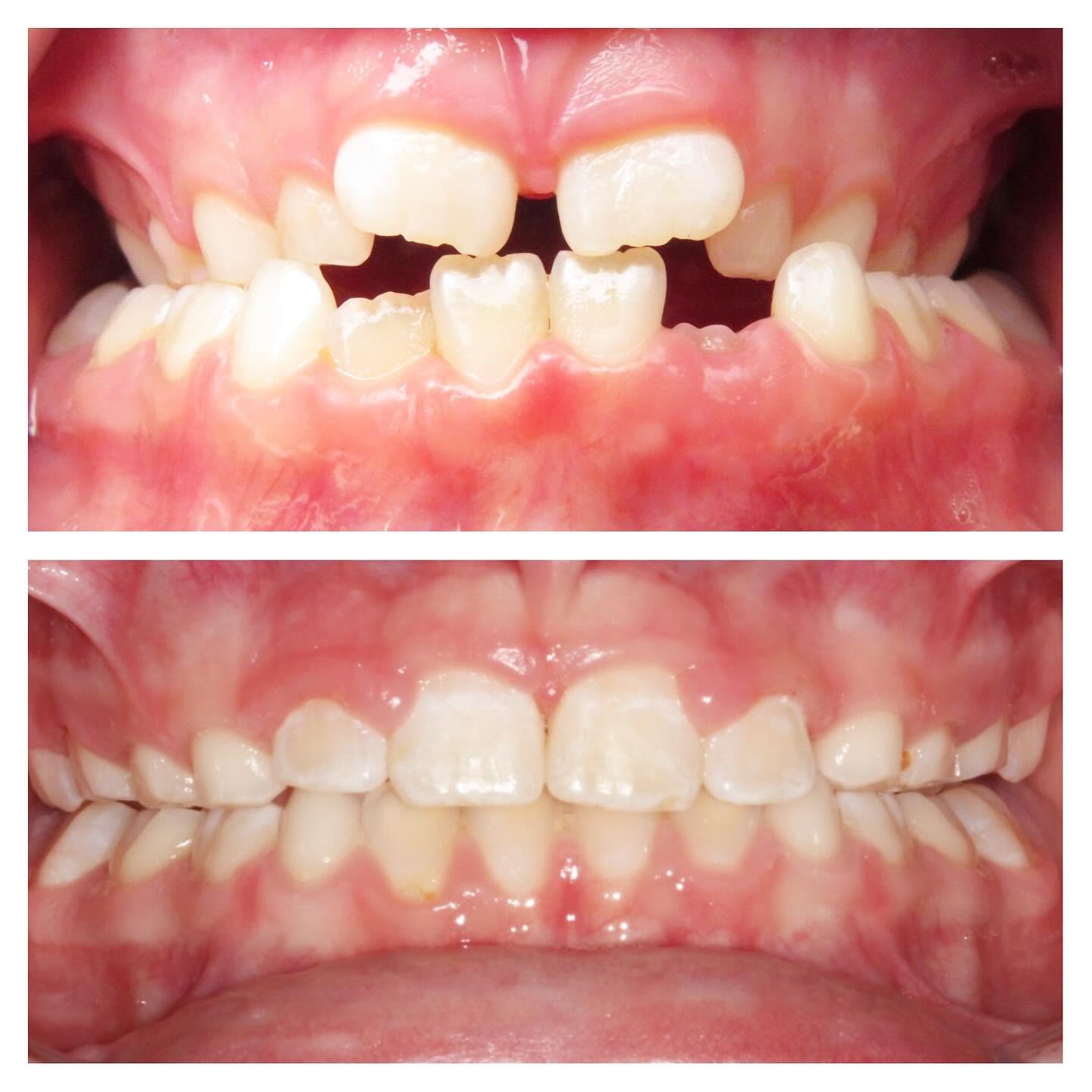
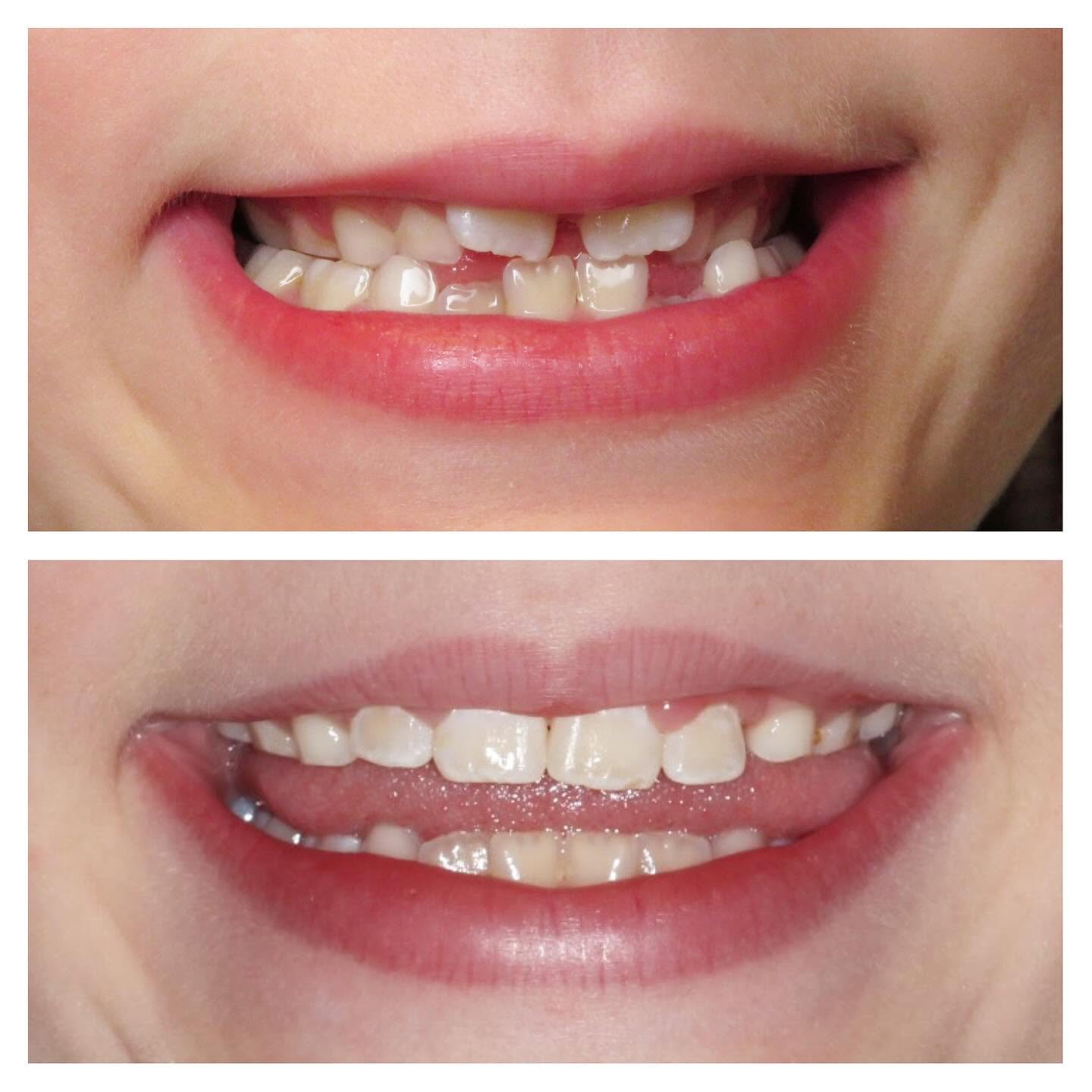
Actual patients of Dr. Vanderstelt at Aligned Orthodontics. Every child is different, and results depend on the case.
See if early treatment is right for your child ⊢Why so many Denver kids deal with this
Denver is rough on small noses. The air sits dry and low in humidity most of the year, which can leave nasal passages irritated and stuffy even when nothing’s truly wrong. Add the local pollen calendar on top, with tree pollen in spring, grasses through summer, and weeds in fall, and a lot of Front Range kids spend long stretches congested. Enough blocked nights in a row and the mouth becomes the path of least resistance, a pattern that can outlast whatever season kicked it off.
None of that makes the environment the whole story. Usually it isn’t. But it’s a good reason mouth breathing reads as “normal” to so many Denver families, because plenty of kids around here are stuffy enough that an open mouth at night just blends into the background. That’s the whole case for a real evaluation. It separates the dry-air-and-pollen part from anything structural in the jaw or palate, so you know which one you’re actually dealing with.
Snoring and mouth breathing often travel together
A lot of parents end up reading something like this because their kid snores with an open mouth every single night, and they’re trying to work out whether it’s allergies, big tonsils, or something about how the jaw is coming in. Reasonable question, and a good place to start sorting it.
It’s no accident that so many of the kids we evaluate for mouth breathing also snore. Snoring is what you hear when air can’t move cleanly and the soft tissues flutter. A few snory nights with a cold is nothing. Regular snoring alongside steady mouth breathing is a different conversation, since the two together are among the most common signs of what doctors call sleep-disordered breathing, where airflow gets partly pinched during sleep. That is not the same as sleep apnea, and we’re careful not to leap there. But when mouth breathing keeps company with snoring, restless nights, or daytime fatigue, your child’s airway has earned a closer look from someone who actually thinks about airway. There’s more in our piece on how orthodontic treatment can help children who snore or mouth breathe.
When both show up, we look harder at the usual suspects: large tonsils and adenoids, stubborn nasal congestion, a narrow upper jaw, and tongue posture. And we’ll say plainly what some practices won’t. We are not going to tell you braces cure sleep apnea, and you should be wary of anyone who does. What we can tell you is whether your child’s jaw structure is part of the picture, and we’ll send you to the right medical partner for the rest.
What usually causes it
Mouth breathing almost always begins because breathing through the nose got harder than it should be. These are the reasons we run into most.
Large tonsils or adenoids. The most common one by a good margin. That tissue can swell enough to choke off airflow at the back of the nose, and it gets worse once a child lies down and everything relaxes for sleep.
Allergies that won’t quit. Between spring tree pollen, summer grasses, and the weeds that arrive with a Colorado fall, plenty of local kids spend months with inflamed nasal passages, and the dry air piles on. After enough of that, mouth breathing becomes the default and tends to outlast the season that started it.
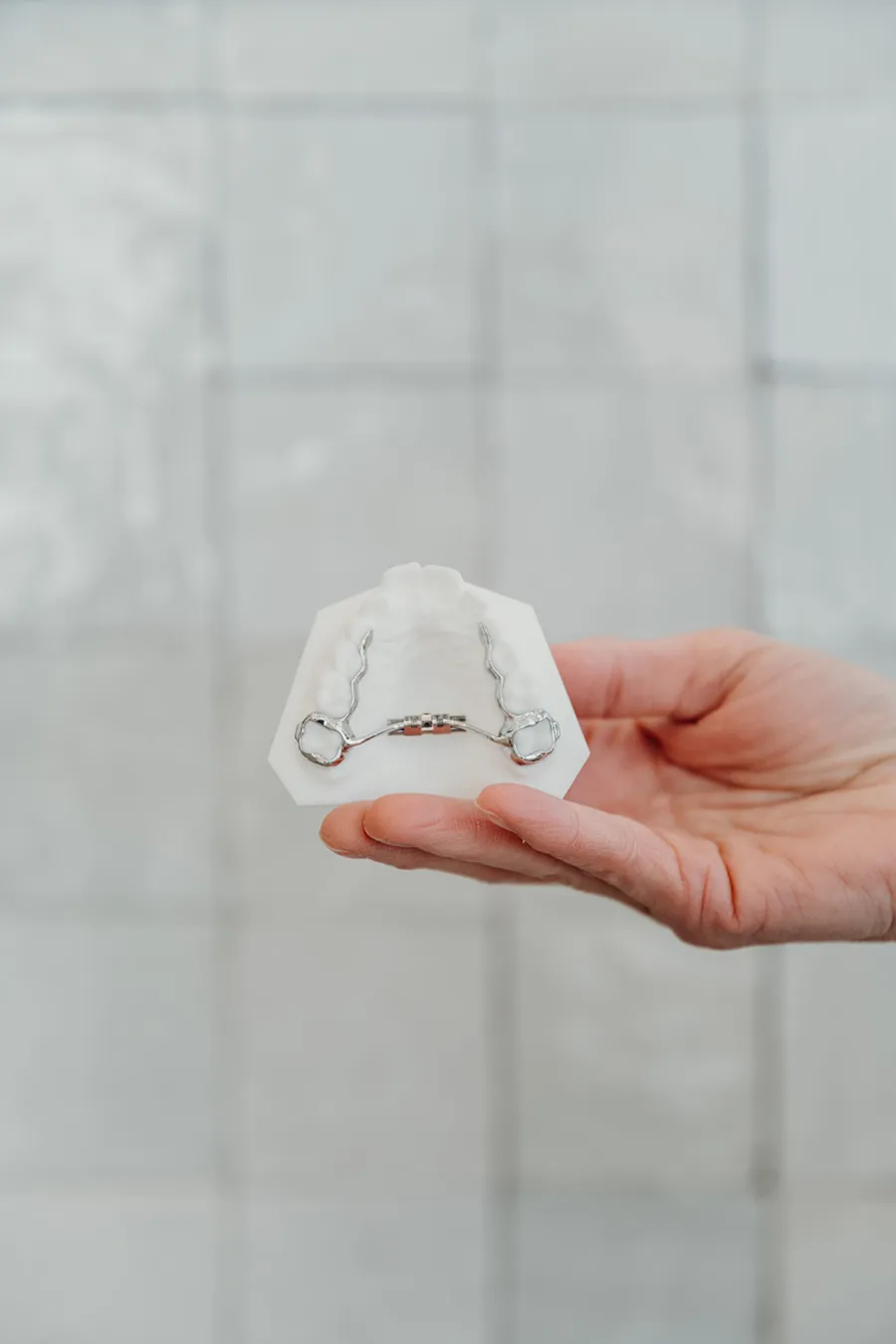
A narrow upper jaw. The roof of the mouth is also the floor of the nose, so a pinched upper jaw means less room for air right above it. Less space up top, less nasal airflow, more mouth breathing. When that’s the driver, a palate expander can widen the jaw and open the space above it during the years it’s still simple to do.
Tongue and lip habits. A low resting tongue, an open-mouth posture, or a lingering thumb habit can reshape the palate and change how the lips come together at rest. When that’s part of the story, retraining how the tongue and lips sit, often with myofunctional therapy, helps. We don’t do that in our office, but we’ll connect you with someone who does.
Something structural in the nose. A deviated septum or genuinely tight nasal passages make nose breathing physically harder. Those are an ENT’s call, not an orthodontist’s, but they often sit right next to the jaw and palate findings we evaluate.
The reason a real evaluation matters is that aiming at the wrong cause fixes nothing. We work alongside your child’s pediatrician, dentist, and an ENT when it’s warranted, so we’re chasing the actual root instead of the symptom that happens to be easiest to spot.
Watch from Dr. Vanderstelt
Has someone recommended a myobrace for your child?
A lot of parents are told an appliance will fix their child’s breathing. Dr. Vanderstelt explains why that recommendation is worth a second opinion from an airway-focused orthodontist who understands growth and development.
A real diagnosis means looking at the whole picture: the nasal passageway, the turbinates, the septum, the adenoids, the jaw structure, and the width of the upper jaw. If those were not evaluated, the root cause was not found.
Dr. Amanda Vanderstelt, Aligned Orthodontics, Denver
Where Dr. Vanderstelt lands on all this
If you’ve clicked through a few orthodontist sites already, you’ve seen the two extremes. One lists “breathing” once among the things orthodontics touches and moves right along. The other leans on fear and implies an appliance will fix everything from snoring to focus to bedwetting.
Dr. Vanderstelt does neither. The link between jaw structure and breathing is real, well supported, and central to how she treats. She’s a board-certified orthodontist who built her practice around the airway, and she understands expansion from both chairs, because she’s going through adult palate expansion herself. That’s a hard perspective to fake. But real doesn’t mean cure-all. The most useful thing she can hand you is a straight read on which of three things your child has: a habit that’ll fade, a structural issue worth treating while there’s still time, or something that belongs with your pediatrician or an ENT first. Some days the honest answer is “let’s look again in six months,” and she’d rather say that than start your kid on treatment they don’t need.
Want a straight answer about your child’s breathing?
A short airway consultation tells you whether this is a habit, an allergy thing, or something structural worth handling now. For kids 13 and under, it’s complimentary, and there’s no obligation to start treatment.
Book your child’s airway evaluationWhat orthodontics can do here, and what it can’t
Sometimes it’s the answer, sometimes it isn’t, and often it’s one part of a larger plan.
Orthodontics can help when mouth breathing ties back to a narrow upper jaw, crowded teeth, a low resting tongue, or jaw growth heading the wrong way. A palate expander, early Phase 1 treatment, or guiding how the jaw develops can widen the upper jaw, open the nasal floor above it, and give the tongue a real place to rest. Done at the right age, that can mean easier airflow, deeper sleep, and a face and bite that grow the way they were meant to. There’s more on airway-focused orthodontics and how Dr. V approaches it.
Orthodontics isn’t right for every child, though, and we won’t pretend it is. If large tonsils, adenoids, or stubborn allergies are running the show, your child needs a pediatrician or ENT alongside or ahead of any orthodontic work. When a low tongue posture or an oral habit is the issue, myofunctional therapy can move the needle, and we’re happy to refer. The only way to know which bucket your child is in is an actual look, and once you’ve had one the path usually gets clearer than parents expect.
What a first visit is actually like
It starts with listening. What you’ve noticed, how your kid sleeps, what’s been gnawing at you.
Then Dr. Vanderstelt examines your child herself: the width of the upper arch, the shape of the palate, where the tongue rests, whether the lips seal without effort, how the top and bottom jaws line up, and whether crowding or any airway concern is touching the bite. When it helps to see the upper airway clearly, our 3D CBCT imaging shows us what’s actually there rather than leaving us to guess, and our digital scanner means no tray full of goop.
You leave with a plan in plain language: what we found, the options, a timeline, and a clear breakdown of cost and payment, with nothing sprung on you later. Nobody’s asking you to decide anything that day. You can see more about what to expect at a first visit before you come in.
Why catching it early changes everything
When you act counts as much as what you do. Kids grow fast, and the easiest time to guide how the jaw and palate develop is while that growth is still underway. The same narrow upper jaw spotted at 6 or 7 might need a small, simple appliance for a few months. Found at 14, after the bone has set, the same problem can mean a longer road and sometimes surgical help to widen the jaw. One issue, two very different paths, with timing as the main thing separating them. That gap is exactly what an early orthodontic check is meant to save your family.
Why Denver families choose Aligned
Aligned is a boutique practice on South Pearl Street in Platt Park, and the small size is on purpose. It means Dr. Vanderstelt runs the exam herself, knows your kid’s name, and has time to actually explain what she’s seeing. Families come from Platt Park and Wash Park, from across south Denver, from University Park and the DU community, and a fair number drive out of their way because airway-focused care for kids isn’t easy to find.
She’s a board-certified orthodontist who built her whole approach around the airway, and she’s living the patient side of expansion right now, which changes how she talks families through it. Her full story is on the meet Dr. Vanderstelt page. Beyond that, families stay because the office is a pleasant place to walk into, because we’re straight about cost when plenty of practices won’t be, because we offer flexible payment plans, and because we’d rather tell you the truth about what your child does and doesn’t need than sell you an appliance. Benito the goldendoodle doesn’t hurt either.
Frequently asked questions
What is an airway orthodontist?
An airway-focused orthodontist looks at how breathing, sleep, and jaw growth fit together, then treats the root cause instead of only lining up teeth. Dr. Vanderstelt is a board-certified orthodontist with airway-focused training who sees adults and families across Denver, with an eye on long-term health rather than just a straight smile.
Will my child grow out of mouth breathing?
If the cause is short-lived, like a cold or a one-week pollen spike, sometimes. A steady pattern often doesn’t clear on its own, because mouth breathing can reinforce itself and nasal breathing may get harder the longer it runs. If you’ve been watching it for months or years, waiting it out usually isn’t the move.
Can mouth breathing really change my child’s face shape?
It can. Across the growth years, long-term mouth breathing can influence how the upper jaw, lower jaw, and facial muscles develop, sometimes nudging things toward a narrower palate, crowding, and a longer facial pattern. The sooner the breathing is corrected, the more of that growth can be pointed in a good direction.
Is snoring normal in kids?
Now and then with a cold, sure. Regular snoring is worth checking, especially when it comes with mouth breathing, restless sleep, or daytime tiredness. It’s one of the clearer hints that something may be narrowing the airway at night.
Could this just be allergies?
Sometimes, but not always. If your child keeps mouth breathing after the allergy symptoms ease, or does it year-round even on low-pollen days, there’s usually a structural piece in play too, like large adenoids or a narrow upper jaw. Both can be checked at the same visit.
Can enlarged adenoids cause mouth breathing?
Yes, and they’re one of the most common reasons. Adenoids sit at the back of the nose, and when they’re swollen they can block enough airflow that nose breathing becomes hard, especially lying down at night. That’s an ENT’s call, not ours, so if we suspect adenoids are the driver we’ll point you to the right doctor. We’ll still check whether jaw and palate development are part of it, since the two so often travel together.
Why does my child only breathe through their mouth while sleeping?
A few things stack up at night. Lying down lets congestion settle, the airway muscles relax, and any narrowing in the nose or jaw gets more obvious. So a kid can breathe fine through their nose all day and switch to their mouth the moment they fall asleep. It’s still worth a look, because that’s eight to ten hours a night without the benefits of nose breathing, during the years the face and jaw are forming.
Should I see an ENT or an orthodontist first?
Either works as a starting point. We routinely team up with pediatricians and ENT specialists around Denver. If we see signs pointing toward adenoids, allergies, or another medical cause, we’ll steer you to the right specialist. If your child’s doctor already flagged the breathing, we can pick up the jaw and airway side from there.
My pediatrician said it’s just allergies. Should I still come in?
If the allergies are well controlled and the mouth breathing stopped, no. If the allergies are being treated and your child is still mouth breathing, yes. Allergies are often part of this, but jaw width, tongue posture, and palate shape are a separate piece that doesn’t clear up when the pollen count drops.
What does a “narrow palate” actually mean?
It means the roof of your child’s mouth is more pinched than it should be for their age. It tends to show up with crowded teeth, a high arch, and mouth breathing, and it’s one of the more treatable things we see when it’s caught early. In a lot of cases a palate expander can widen the upper jaw before growth makes it harder.
Can a palate expander help mouth breathing?
It can, when a narrow upper jaw is part of why your child is mouth breathing. Since the roof of the mouth doubles as the floor of the nasal passages, gently widening the upper jaw can free up a bit more room for air to move through the nose. It’s not a fix for every cause, and it does nothing for enlarged adenoids or allergies. That’s the whole reason we evaluate first, so an expander only goes in when it’s the right tool.
Can mouth breathing cause crowded teeth?
It can contribute. When the tongue rests low instead of against the roof of the mouth, the upper jaw may not widen the way it should during growth. That can leave less room for the permanent teeth and make crowding more likely. Crowding has other causes too, which is why Dr. Vanderstelt looks at the whole picture rather than blaming any one thing.
Does the consultation cost anything?
For kids 13 and under, the airway consultation is complimentary. For ages 14 and up, there’s a consultation fee we confirm when you book. Either way, you don’t need a referral, and there’s no obligation to start treatment.
How much does treatment cost?
Early treatment for a young child is generally less than a full course of braces or aligners for a teen, and the number depends on the appliances and the timeline. We offer flexible payment plans, HSA and FSA dollars can be applied, and you’ll get a complete breakdown at your consultation, with no pressure to commit on the spot.
Will insurance cover this?
Coverage for airway and early treatment varies a lot from plan to plan, so we won’t promise something we can’t deliver. Our team will check your benefits and walk you through costs and payment options before you decide on anything.
What age should my child be evaluated?
The American Association of Orthodontists puts the first check at age 7. If you’re already seeing mouth breathing signs, you don’t have to wait. We’ll see kids younger when there’s a clear reason to.
Not sure yet? Start here.
If your child has been mouth breathing for months, every month it continues lets the growth pattern settle in a little more and makes it harder to change later. You don’t need a referral to come in, no referral is required to see an orthodontist, and for kids 13 and under the airway consultation is complimentary. A lot of parents book just to get a straight answer, and walk out knowing what, if anything, comes next, whether that’s treatment with us, a referral to a specialist, or a simple recheck down the road.
Not ready to book? Dr. Vanderstelt put together a free guide for parents called Breathe Well, Grow Well that covers what to watch for, why it matters, and what early orthodontics can and can’t do. Request a copy here.
From our patients
What Denver families say on Google
Book your child’s airway evaluation
Want to find out what’s behind your child’s mouth breathing? It takes a minute to book, and for kids 13 and under it’s complimentary.