
Reviewed by Dr. Amanda Vanderstelt, DMD, MSD, board-certified orthodontist. Last reviewed July 7, 2026.
If you’re looking into metal braces in Denver, you’ve probably noticed that most orthodontic marketing treats them like the old option. The thing you settle for. Here’s what that marketing leaves out: traditional metal braces are still the treatment orthodontists reach for when a case actually matters, because nothing else gives us the same control over how teeth and bites move.
At Aligned Orthodontics on South Pearl Street in Platt Park, Dr. Vanderstelt uses traditional braces for some of the most important cases in the practice, and this page explains when, why, and what they cost.
- Board-certified orthodontist
- 5-star Google rating
- Complimentary consultations
- Flexible payment plans
- 3D digital imaging
What are traditional metal braces?
Traditional metal braces are small stainless steel brackets bonded to the front of each tooth, connected by a thin archwire that applies steady, gentle pressure. Over months, that pressure guides teeth and bites into healthier positions. Metal braces treat the widest range of orthodontic problems of any appliance, from mild crowding to complex bite issues.
That’s the short version. The longer version is that the wire is doing most of the work. Modern archwires have shape memory, which means they keep applying a light, consistent force between visits instead of the heavy push-and-wait cycles braces used decades ago. If you’re curious about the biology underneath it, we wrote a full explanation of how braces actually move your teeth.
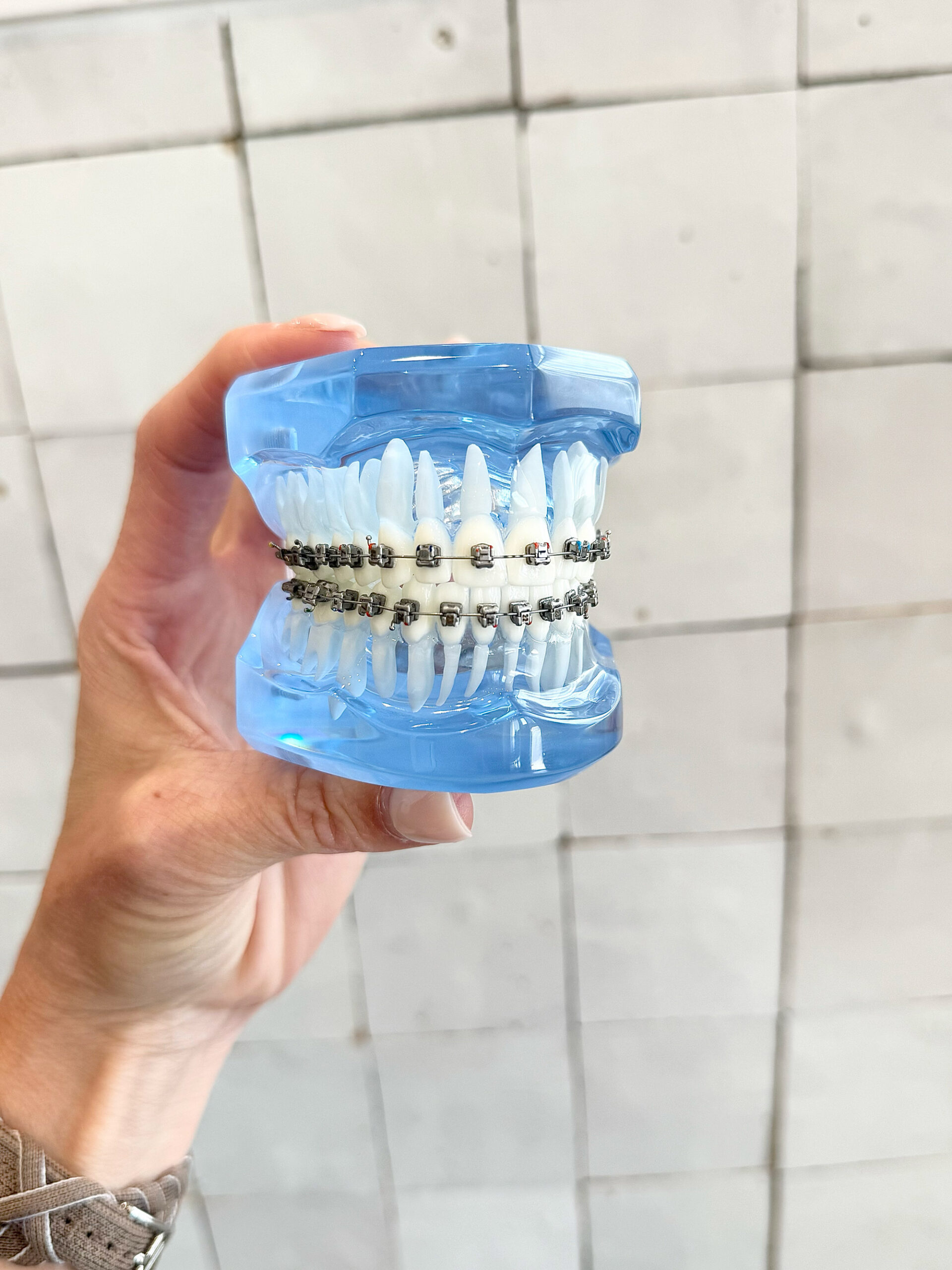
Today’s brackets: smaller, lower profile, and self-ligating
Why orthodontists still choose metal braces
Ask an orthodontist what they’d put on their own kid’s teeth for a complicated case and the answer is usually not a plastic tray. It’s traditional braces. A few reasons:
Control. Brackets and wires let Dr. Vanderstelt fine-tune the movement of individual teeth in three dimensions. Rotating a stubborn tooth, closing a large gap, or correcting how the upper and lower jaws meet are all movements where fixed braces outperform removable options.
Bite correction, not just straight teeth. Plenty of people finish aligner treatment with straighter front teeth and the same bite problem they started with. Traditional metal braces are built for the harder job: getting the bite to actually fit together. That matters for how you chew, how your teeth wear over time, and in some cases how your jaw sits at rest.
Nothing to lose, forget, or negotiate. Traditional braces work 24 hours a day whether or not anyone remembers to wear them. For teens especially, this is the honest advantage. There’s no aligner in a napkin at lunch, no tray sitting in a backpack for a week. Treatment moves forward on schedule.
Durability. Stainless steel brackets take a beating and keep working. They’re the sturdiest appliance we place, which is part of why treatment with metal braces tends to stay on track with fewer repair visits.
The honest downsides of metal braces
No treatment is all upside, and you deserve the full picture before you commit to one.
They’re visible. This is the obvious one. Modern brackets are small, but they’re not invisible, and for some adults that matters enough to choose ceramic or aligners instead. Fair enough.
Food rules apply. Hard, sticky, and chewy foods can break brackets, so popcorn, ice chewing, and caramel go on pause for the length of treatment.
Cleaning takes more effort. Brackets and wires give food more places to hide, so brushing and flossing get a little more involved. It’s a habit most patients build within a couple of weeks, but it’s real work.
Occasional soreness. Teeth are tender for a few days after braces go on and sometimes for a day or two after adjustments. It’s manageable and temporary, but it’s not nothing.
What you get in exchange is the appliance that handles the widest range of cases at the most accessible price point in orthodontics. For a lot of cases, especially bite corrections, that trade is easy to make.
These are not the braces your parents had
If your mental image of metal braces comes from a middle school yearbook photo in the nineties, update it. Today’s brackets are noticeably smaller and sit lower on the tooth. Wires are thinner and gentler. Bands around every tooth are gone. The whole system is lighter, more comfortable, and more precise than what previous generations wore.
At Aligned, we also plan traditional braces treatment digitally. Every patient gets a 3D digital scan instead of goopy impressions, and Dr. Vanderstelt uses CBCT imaging when the case calls for a full picture of the teeth, roots, and jaws. The braces may be traditional. The planning behind them is not.
See how far braces have come
Metal braces for kids and teens in Denver
Traditional metal braces are still the most common choice for kids and teens, and for good reason beyond durability. Growing patients often need the kind of bite correction that fixed braces handle best, and treatment doesn’t depend on a twelve-year-old’s discipline with a removable tray.
One heads-up if your kid has been promised colors by a friend at school: our brackets are self-ligating, which means they hold the wire on their own without the colored elastic ties older braces needed. So there are no colors to pick at each visit. Most kids get over it fast, somewhere between the Netflix in the chairs and meeting Benito.
If your child is younger and you’re wondering whether it’s too early to be thinking about any of this, it might not be. Some jaw growth and airway problems are easier to correct before the adult teeth are all in, which is what Phase 1 orthodontic treatment is for. Dr. Vanderstelt sees children for early evaluations well before braces would ever go on.
One question parents ask a lot: sports are fine with traditional braces. Your kid can keep playing soccer, basketball, hockey, whatever they love. The one non-negotiable is an orthodontic mouthguard for contact sports, which fits over the brackets and protects both the braces and the lips and cheeks around them. Regular boil-and-bite mouthguards molded tightly to braces can cause problems as teeth move, so ask us and we’ll point you to the right kind.
Adults get traditional braces too
Two questions come up constantly from adults, so let’s answer them directly.
Am I too old for braces? No. Teeth move at any age. Adult treatment sometimes takes a little longer because adult bone remodels more slowly, but the mechanics are the same and the results are just as stable.
Will people judge me at work? This worry is loud before treatment starts and then mostly evaporates. Most adults tell us the same thing a few weeks in: nobody cares nearly as much as they expected, and the people who do notice tend to say something like “good for you.” Adult orthodontics is common now. If visibility genuinely matters for your job or your comfort, that’s a real consideration and worth discussing, and it’s usually the point where we talk about clear ceramic braces or Invisalign instead. But don’t rule out metal before you’ve seen how small modern brackets are.
One more thing adults should hear: if you’re choosing between fixing your bite properly and a faster cosmetic fix for the front teeth, fix the bite. We regularly meet adults who did the shortcut version years ago and are now back to do the treatment they actually needed.
Metal braces vs ceramic braces vs Invisalign
Here’s the honest comparison, without a sales pitch for any of them.
Traditional metal braces are the strongest, most precise, and most economical option. They handle every case type. The tradeoff is that they’re visible, and you’ll follow some food rules during treatment.
Clear ceramic braces work the same way as metal with tooth-colored brackets. They’re a great fit for adults who want fixed-braces control with less visibility. The brackets are slightly larger and more brittle than steel, and they cost a bit more. Our full clear braces in Denver page covers them in detail, including the staining question everyone asks.
Invisalign is removable and nearly invisible, and it’s excellent for the right case. It depends entirely on wear time, and some tooth movements are simply harder to accomplish with aligners.
The right answer isn’t a matter of opinion. It’s a matter of diagnosis. Dr. Vanderstelt will tell you plainly at your consultation which options can fully treat your case and which would be a compromise, then the choice is yours.
Traditional metal braces
Handles every case- Case types
- All of them, including complex bite correction
- Visibility
- Visible, with small modern brackets
- Removable
- No, works around the clock
- Durability
- Strongest appliance we place
- Typical cost
- Lowest of the three
Clear ceramic braces
Lower profile- Case types
- Nearly all
- Visibility
- Low profile, tooth-colored brackets
- Removable
- No, works around the clock
- Durability
- Brackets are more brittle than steel
- Typical cost
- Slightly more than metal
Invisalign
Nearly invisible- Case types
- Mild to moderate cases work best
- Visibility
- Nearly invisible
- Removable
- Yes, needs 20+ hours of daily wear
- Durability
- Trays replaced on a set schedule
- Typical cost
- Varies by case
Who metal braces are for
Here’s the thing about metal braces that gets lost in all the marketing for newer options: they work for everyone. For decades they were the only tool orthodontists had, and they earned that run by treating every kind of case, from mild crowding to the most complex bite corrections. There is no case type where metal braces are off the table. That’s not something the alternatives can say.
So the real question isn’t whether metal braces are for you. It’s whether you’d prefer something else, and that comes down to two honest tradeoffs. If your case is mild and visibility genuinely matters for your work or your comfort, clear ceramic braces or Invisalign can often reach the same result with a lower profile. And if you’d rather not adjust your brushing routine around brackets, aligners come out for cleaning.
That’s the whole list. Everything else, metal handles. Dr. Vanderstelt will tell you at your consultation which options can fully treat your case, and if a lower-profile option would genuinely get you the same result, she’ll say so.
How much do metal braces cost in Denver?
Braces at Aligned Orthodontics typically run between $5,500 and $8,000 depending on the complexity of the case and how long treatment takes. Traditional metal braces sit at the economical end of that range, which is one of their quiet advantages: the most capable appliance is usually also the least expensive one.
That fee covers the full treatment, not just the hardware. Your adjustment visits, your digital scans, and the planning time behind your case are all part of it. We offer flexible payment plans that break the fee into manageable monthly amounts, and many dental insurance plans include an orthodontic benefit that can be applied. Coverage varies a lot from plan to plan, so bring your insurance information to your consultation and our team will walk you through exactly what your plan contributes. Consultations for new patients are complimentary.
Find out what your case would actually cost
No generic quote. Your complimentary consultation includes a 3D digital scan, an exam with Dr. Vanderstelt, and a real number for your specific case, with payment plans laid out clearly.
Book your free consultationWhat the first few weeks are like
The first week with braces is the adjustment period, in both senses. Teeth feel tender for a few days as they start to respond to the wire, with days two and three usually the peak before things ease off. Your cheeks and lips take a little while to get used to the brackets. Soft foods, orthodontic wax, and an over-the-counter pain reliever cover almost everyone through it. By the end of week one, most patients barely think about their braces.
After that, you’ll come in roughly every 6 to 8 weeks for adjustments. Some visits bring a day or two of mild soreness. Most don’t. If a bracket ever comes loose between visits, it’s not an emergency: cover anything poking with orthodontic wax, give us a call, and we’ll get you in to fix it. We wrote honestly about what orthodontic discomfort actually feels like if you want the full picture before you start, and our guide to caring for braces during treatment covers brushing, flossing, and keeping brackets intact. And when the braces come off, a retainer protects everything you just invested in, so plan on that being part of the finish line rather than an afterthought.
If you want the wider view of the whole process, from consultation to insurance paperwork to the day the braces come off, our complete guide to braces in Denver walks through every step.
Straight teeth are the start, not the goal
Here’s where Aligned differs from most places offering metal braces in Denver. Dr. Vanderstelt is a board-certified orthodontist with training in airway-focused care, which means before any brackets go on, she’s looking at more than crooked teeth. How the jaws developed. How much room the tongue has. Whether you or your child breathes through the nose or the mouth, especially at night.
Sometimes crowded teeth are just crowded teeth, and traditional braces are the whole answer. Sometimes crowding is a symptom of a jaw that didn’t develop enough room, and straightening teeth without addressing that means treating the result instead of the cause. Getting that diagnosis right at the beginning is the difference between a smile that looks good and a plan that actually resolves the underlying problem. You can read more about how we think about this on our airway orthodontics page, and if you like reading the science yourself, our airway orthodontics research library collects the studies behind it.
This matters for braces specifically because the same appliance can be part of very different plans. Metal braces might follow palate expansion in a growing child. They might stand alone for a teenager with a simple crowding case. They might be phase two of an adult plan that started with MARPE palate expansion, a treatment Dr. Vanderstelt has personally undergone. The brackets are traditional. The thinking behind where they fit is not.
Visiting us on South Pearl Street
Aligned Orthodontics is at 1215 S Pearl St in Denver’s Platt Park neighborhood, a few blocks from the South Pearl Street farmers market and an easy trip from Wash Park, University Park, and most of south Denver. The office doesn’t feel like a clinic. There’s a beverage bar, Netflix in the chairs, a comfort menu, and Benito, our office goldendoodle, who takes his greeting responsibilities seriously.
1215 S Pearl St, Denver, CO 80210
In Platt Park, on South Pearl Street near Wash Park
Get directions ⊢Families come to us for traditional braces from Cherry Creek, Englewood, Littleton, and across the Denver metro, and plenty of our braces patients are the siblings, parents, and neighbors of patients who finished treatment here. That tends to be how a small practice on Pearl Street ends up with a 4.9-star Google rating.
What Denver families say on Google
Frequently asked questions about metal braces
How long do metal braces take?
Most comprehensive treatment with traditional metal braces takes 18 to 24 months, though simple cases can finish in around a year and complex bite corrections can run longer. Dr. Vanderstelt gives you a specific estimate at your consultation based on your scan and exam, not a generic range.
Are metal braces faster than Invisalign?
For complex cases, often yes. Metal braces give the orthodontist direct control over difficult movements like rotations and bite correction, and they work around the clock without depending on wear time. For simple cases, treatment times are usually similar. The honest answer depends on your diagnosis, which is what the consultation is for.
Do metal braces hurt?
Getting braces put on doesn’t hurt. Your teeth will feel tender for three to five days afterward as they start to move, and mild soreness can return for a day or two after adjustments. Soft foods and an over-the-counter pain reliever handle it for almost everyone. Between visits, most patients forget their braces are there.
What can’t I eat with metal braces?
Skip anything hard, sticky, or chewy: ice, whole nuts, popcorn, caramel, gum, and biting directly into things like whole apples or corn on the cob. Burgers are fine, just take reasonable bites. Most everything else is fine too. Broken brackets are the main way treatment gets delayed, so the food rules are really about protecting your timeline.
Are metal braces cheaper than clear braces or Invisalign?
Usually, yes. Traditional metal braces are typically the most economical comprehensive treatment because the materials are durable and straightforward to work with. At Aligned Orthodontics, braces range from about $5,500 to $8,000 depending on case complexity, with metal at the lower end and payment plans available.
Will my teeth move years after braces?
They can, if you stop wearing your retainer. Teeth have a lifelong tendency to drift, which is completely normal and not a sign your treatment failed. A retainer worn as directed keeps your result exactly where treatment left it. This is why we treat the retainer phase as part of treatment, not an optional extra afterward.
Do braces make teeth 100% straight?
Braces can get teeth remarkably straight, but perfectly straight teeth were never really the goal. The goal is teeth that fit together correctly, function well, and stay healthy long term. A bite that works beats a photograph-perfect front six every time, and it’s the standard Dr. Vanderstelt plans every case around.
What age is best to get metal braces?
Most kids start braces between roughly 11 and 14, once enough adult teeth are in for full treatment. But the best age depends on the individual case, which is why we see children for early evaluations starting around age 6, and earlier if there are signs of jaw or breathing problems. Sometimes early treatment makes future braces shorter and simpler, and sometimes the right move is just to monitor growth. And there’s no upper limit; adults do well with braces at any age.
Find out if metal braces are right for you
A complimentary consultation with Dr. Vanderstelt includes a 3D digital scan, a clear treatment recommendation, and straight answers about cost and timing. No pressure, no upsell.
Book your free consultationBenito is usually around.