
Platt Park, Denver · Underbite treatment
Underbite Treatment in Denver: Start With the Jaw Everyone Overlooks
Most people who come to us asking about underbite treatment in Denver have already been given a story about their bite. Usually it goes like this: the lower jaw grew too much, and someday surgery will fix it. Dr. Vanderstelt hears that story at our South Pearl Street office all the time, from parents worried about a kindergartner’s profile and from adults who were told at 15 to wait and see.
Here’s what that story leaves out: in a large share of underbites, the lower jaw is not the problem at all.

Dr. Amanda Vanderstelt is a board-certified orthodontist who sees you at every visit, at one office on South Pearl Street in Platt Park. Standard orthodontic consultations are complimentary.
On this page
The 30 second version
- Many underbites come from an upper jaw that developed too little, not a lower jaw that grew too much.
- For kids, the window to guide jaw growth closes when growth ends, so early evaluation matters more here than almost anywhere in orthodontics.
- Many teens and adults can be treated without surgery, with braces or aligners, and MARPE in the right cases.
The jaw most people blame is usually the wrong one
An underbite, which orthodontists call a Class III malocclusion and some patients know as a reverse bite, is when the lower front teeth close in front of the upper front teeth instead of behind them. What you see in the mirror is a lower jaw that seems to lead. What Dr. Vanderstelt frequently finds in her imaging is different: an upper jaw that never developed far enough forward or wide enough.
The lower jaw looks prominent because the upper jaw is sitting behind where it should be.
This is not a technicality. It determines the entire treatment plan. An underbite caused by tooth position gets treated one way. An underbite caused by a small or retruded upper jaw gets treated another way, and pretending it’s just crooked teeth wastes your time and money. Some cases involve both.
Sorting out which one you’re dealing with is the whole point of the exam, and it’s why Dr. Vanderstelt looks at jaw structure and facial balance, not just where the teeth happen to sit.

Dr. Amanda Vanderstelt, DMD, MSD
Board-certified orthodontist
Dr. Vanderstelt treats underbites with training in airway-focused care, and she has gone through MARPE palate expansion herself as a patient. When she explains what treatment feels like, she is speaking from experience, not a brochure.
What an underbite does to your side profile
Search any underbite forum and you’ll find the same worry phrased a hundred ways: what is this doing to my face? Here’s the honest anatomy.
When the upper jaw sits too far back, the midface loses support, the area around the nose and under the eyes can look flat, and the chin appears to lead even when the lower jaw is completely normal. The prominent jaw in an underbite side profile is usually a midface that’s behind, not a jawline that’s ahead.
What treatment changes depends on which treatment you’re doing. Guiding a child’s upper jaw forward builds support into the midface while the face is still growing, which is why early treatment tends to balance the profile naturally.
Camouflage treatment with braces or aligners in teens and adults corrects how the teeth meet and can soften the look of the bite, but it changes the underlying skeletal profile less, and Dr. Vanderstelt will show you exactly what to expect from your case before you commit.
Jaw surgery produces the most visible profile and jawline change, which is part of why patients who genuinely need it usually end up glad they did it.
One more honest note: a slight underbite that isn’t causing wear, jaw strain, or breathing problems doesn’t automatically need fixing. Dr. Vanderstelt’s job is to tell you what’s structural, what’s cosmetic, and what she would do if it were her own bite.
Real aligned. patient
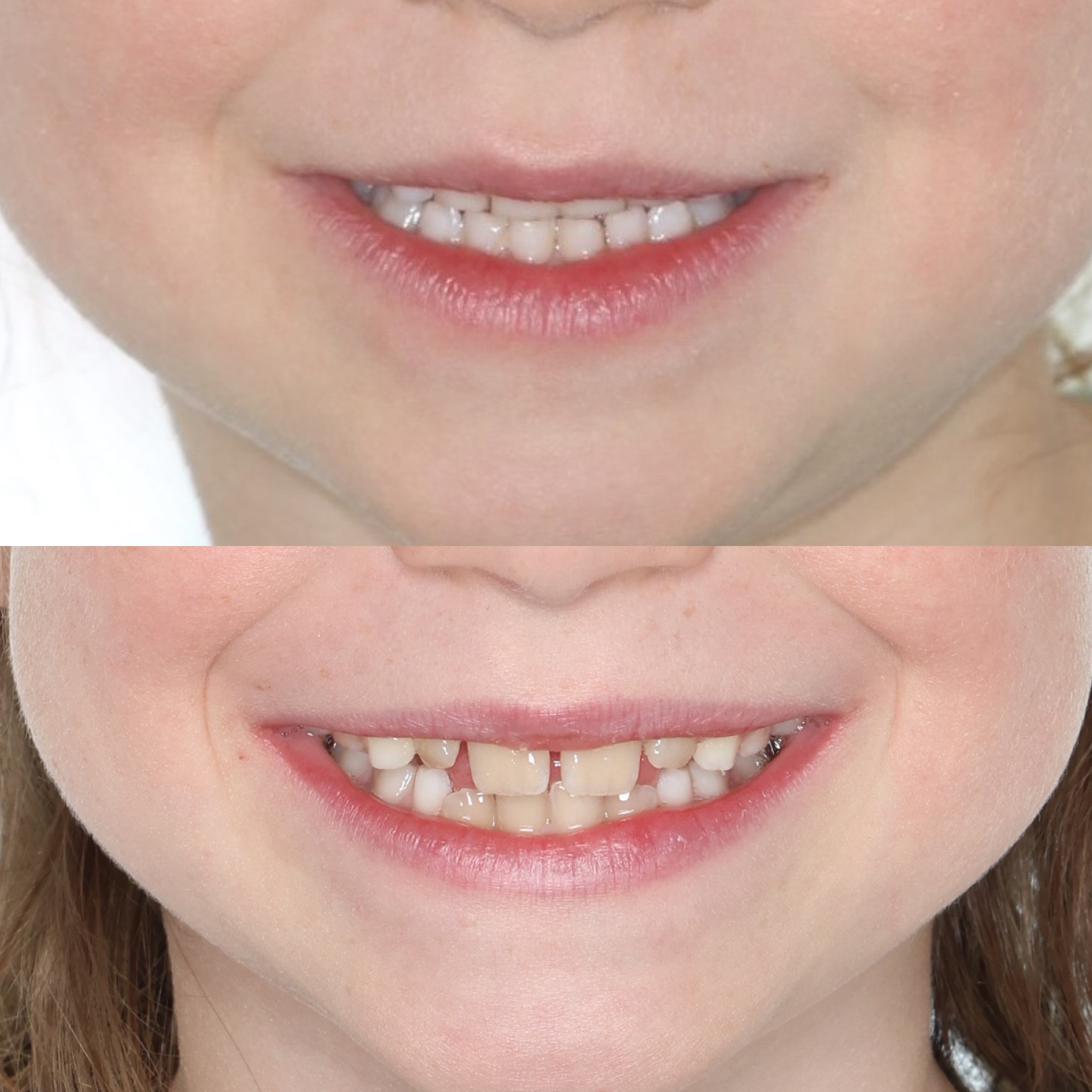
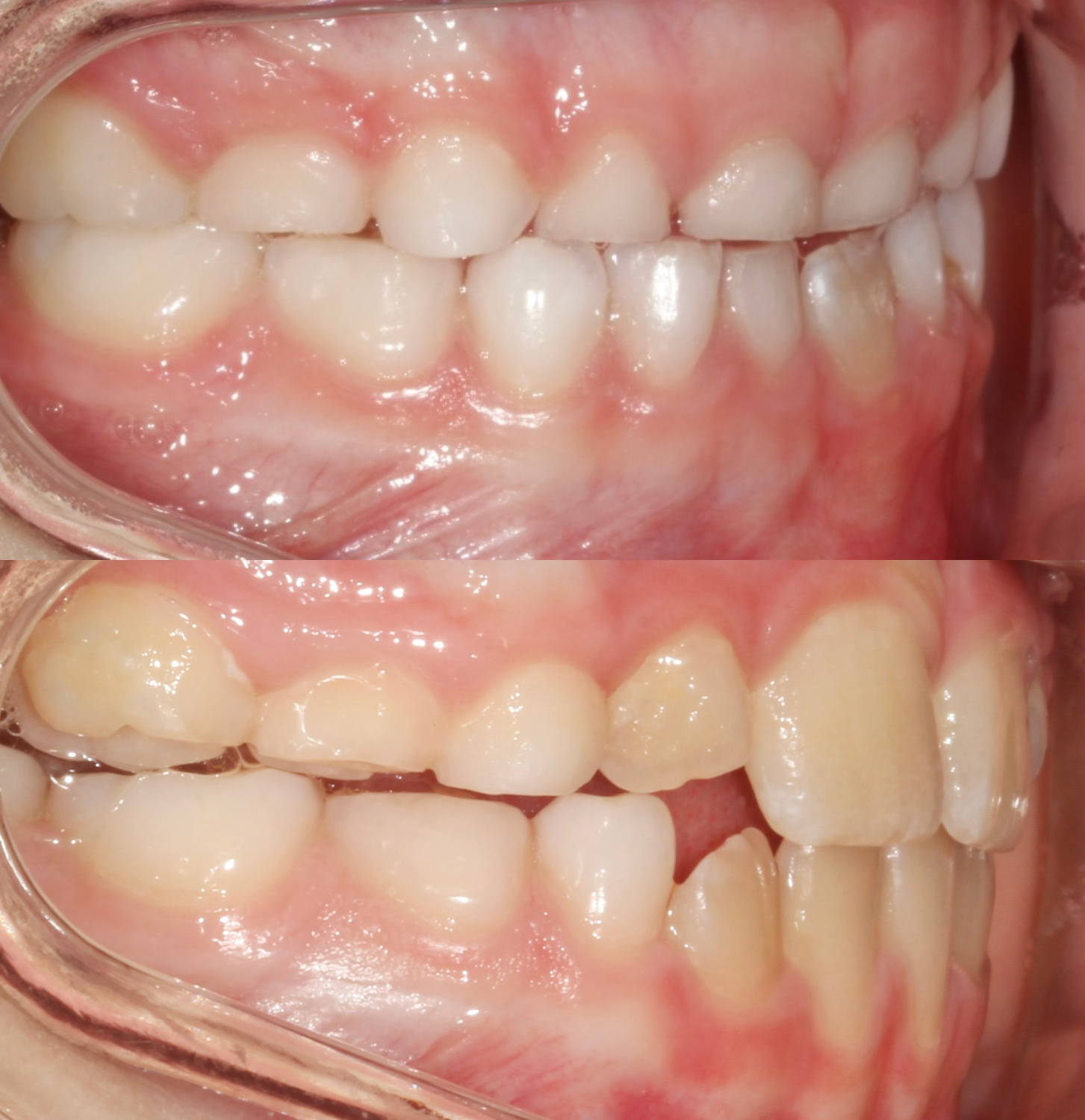
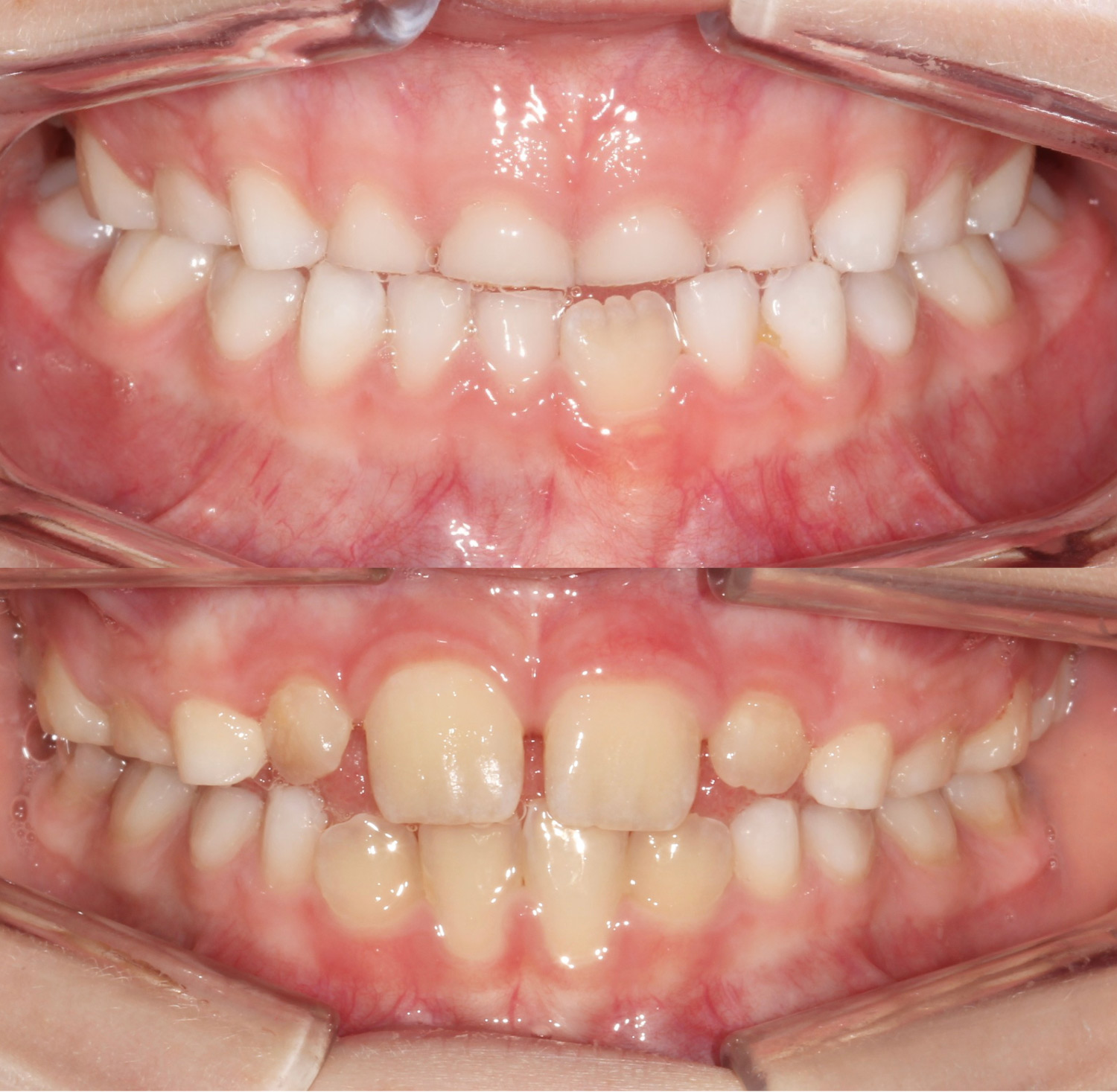
An underbite corrected without braces or surgery
 Before
After
Before
After
 Before
After
Before
After
 Before
After
Before
After
This patient’s Phase 1 treatment used an expander and facemask on the upper jaw only, no braces. The expander widened the upper jaw while the facemask guided it forward, correcting the Class III bite while the face was still growing. The spacing you see in the after photos is normal for this age as adult teeth come in. Many Phase 1 patients go on to have a shorter round of braces or aligners in their teens to fine-tune alignment once the adult teeth are in. Phase 1’s job was different: fixing the jaw imbalance while growth made that possible.
Actual patient of aligned. Orthodontics, shared with permission. Every case is different, and your child’s plan may look different too.
Why an underdeveloped upper jaw is never just about teeth
The upper jaw does double duty. It holds your upper teeth, and it forms the floor of your nose. When it’s narrow or positioned too far back, the nasal passages above it are smaller and the tongue has less room to rest where it belongs.
This is the connection Dr. Vanderstelt built her practice around. As a board-certified orthodontist with training in airway-focused care, she sees the same pattern over and over: the child with an underbite is often the same child who snores, breathes through their mouth, grinds their teeth at night, or wakes up tired. Those aren’t separate problems that happen to share a patient.
They frequently trace back to the same underdeveloped upper jaw. Parents researching mouth breathing in kids and parents researching underbites are often researching the same root cause without knowing it.
So when we treat an underbite by developing the upper jaw, we’re not only fixing how the teeth meet. In many cases we’re also creating room for the nose and the tongue. That’s the difference between straightening teeth and treating the reason they ended up where they are.
For kids, the timing is not negotiable
Dr. Vanderstelt is candid with parents about this one: an underbite is one of the few things in orthodontics where waiting has a real cost.
While a child is growing, the bones of the upper jaw haven’t fused. During that window, Dr. Vanderstelt can use growth guidance appliances, including palatal expanders, to encourage the upper jaw forward and wider, correcting the skeletal imbalance itself. The right appliance depends on your child’s specific anatomy, and she’ll walk you through exactly what she recommends and why at your consultation. This is classic Phase 1 treatment, and for underbites it does its best work between roughly ages 5 and 10.
After growth finishes, that option is off the table. And underbites do not correct themselves. The lower jaw grows later and longer than the upper jaw, with its biggest push during the teenage growth spurt. A child whose upper jaw is already behind at age 6 usually watches that gap widen through adolescence, not close.
The research bears this out: the Cochrane review of early Class III treatment found that treating young children improves jaw position and bite, and often reduces how much correction is needed later.
Dr. Vanderstelt will also tell you the honest caveat, because you deserve it: a small number of kids have a strong lower jaw growth pattern that continues through the teen years no matter what.
She monitors growth after early treatment for exactly that reason, and if surgery is still going to be part of your child’s future, she’ll say so directly instead of letting you find out at 17.
You may have heard the American Association of Orthodontists’ recommendation that every child see an orthodontist by age 7. For a visible underbite, don’t wait for that birthday. If your child’s lower teeth sit in front of their upper teeth, if they shift their jaw to chew, or if the underbite comes with snoring or mouth breathing, bring them in now.
An evaluation tells you where you stand. It doesn’t commit you to anything.
Quick check: is it time for an evaluation?
Tap any that sound like your child.
Even one of these is worth a look while your child’s jaw is still growing.
Underbite correction for teens and adults
Teens. If meaningful growth remains, Dr. Vanderstelt may still be able to influence jaw development. If the growth spurt has mostly passed, treatment shifts to braces or Invisalign to align the bite, along with a straightforward conversation about what tooth movement alone can and cannot do for a skeletal discrepancy. She makes that call with 3D imaging and a growth assessment, not a guess.
Adults. If you were told years ago that surgery was your only option, that advice may be out of date. Adults with mild to moderate underbites often have real nonsurgical options:
Braces or aligners can correct the bite by adjusting how the upper and lower teeth fit together, an approach called camouflage treatment. For many adults this resolves the chewing problems, the uneven wear, and the appearance concern, even when a small jaw discrepancy remains underneath.
When the underlying issue is a narrow upper jaw, MARPE, mini screw assisted palatal expansion, can widen an adult upper jaw without jaw surgery. Dr. Vanderstelt doesn’t just prescribe this treatment. She has gone through MARPE herself, as a patient, which means she can tell you what expansion actually feels like week by week instead of reading it off a brochure. Very few orthodontists anywhere can say that.
And when an adult underbite is severe and fully skeletal, orthodontics alone will not fix it, and Dr. Vanderstelt will not pretend otherwise. Those cases call for surgical orthodontics, where she coordinates your tooth alignment with a trusted Denver oral surgeon so the two plans work as one. If that’s your situation, you’ll hear it plainly at your first visit, along with exactly why.
Don’t just take our word for it. Here’s what one of our own underbite patients shared on Google:
“All the orthodontists I have been to in the past could not fix my underbite problem, here at aligned they took one look and knew exactly what to do with it! I am almost done with my invisalign and they are the best! Easy to work with and very nice! Would recommend them to anyone.”
Raoul W. · Google review
What an untreated underbite costs you over time
An underbite is a functional problem wearing a cosmetic disguise. Left alone, it tends to collect consequences:
Front teeth that can’t meet make biting into food awkward, so the back teeth take on work they weren’t built for. Teeth that strike in the wrong places grind each other down, and we see adults whose lower front teeth have worn visibly flat by their 40s. Sliding the jaw sideways or forward to chew, thousands of times a day for years, strains the jaw joints and muscles, which is how clicking, tension headaches, and jaw pain enter the picture.
Some kids end up in speech therapy for sounds that depend on front teeth meeting properly, working on a structural problem as if it were a habit. And when the underbite traces back to a small upper jaw, the breathing and sleep effects described above ride along with it.
Confidence belongs on this list too. Kids notice their profiles, and teenagers notice intensely. Wanting your child to feel at ease with their own face is not vanity. It’s parenting.
Which underbite path fits your situation?
Three quick questions. No email required, and nothing is saved.
Question 1 of 3
Whose bite are we talking about?
Question 2 of 3
How noticeable is the underbite?
Question 3 of 3
Any snoring, mouth breathing, or restless sleep?
Your likely path
What your consultation at aligned. looks like
Standard consultations at our South Pearl Street office are complimentary. Dr. Vanderstelt, a board-certified orthodontist, starts with a thorough exam and imaging, and takes a genuine look at the whole picture: how the upper and lower jaws relate, how the teeth contribute, and how your face is built. For underbites, that skeletal-versus-dental question drives everything, so she takes the time to answer it properly.
If the exam points toward a deeper breathing or sleep concern, she may recommend a dedicated airway consultation, which is a separate service. Those are complimentary for children 13 and under, and there’s a fee for patients 14 and up.
You’ll leave knowing what kind of underbite you’re dealing with, what she recommends, what she’d do in your position, and what it costs. We offer flexible payment plans, and plenty of Platt Park and Wash Park families take time to decide. Second opinions are welcome here too. If the plan you got somewhere else was right, she’ll tell you that.
Underbite treatment in Denver: your questions, answered
What actually causes an underbite?
Genetics drive most underbites, and the surprise is where the problem usually lives. Many underbites come from an upper jaw that developed too little, not a lower jaw that grew too much. Others are dental, meaning the jaws are fine but the teeth are tipped into a reverse bite. A 3D scan tells us which one yours is.
Can an underbite be fixed without jaw surgery?
Often, yes. Children evaluated while their jaws are still growing frequently avoid surgery entirely through growth guidance. Adults with mild to moderate underbites often do well with braces or aligners, and MARPE gives adults a nonsurgical way to widen an underdeveloped upper jaw. Severe skeletal cases still need surgical orthodontics, and Dr. Vanderstelt will tell you honestly which category you’re in.
At what age should my child be seen for an underbite?
The moment you notice it, even at age 4 or 5. The general guideline is a first orthodontic visit by age 7, but a visible underbite is a reason to come in sooner, because the treatments that guide jaw growth only work while the jaw is still growing.
Do underbites get worse on their own?
Yes, almost always. The lower jaw does most of its growing late, through the teenage years, so an upper jaw that’s already behind falls further behind over time. This is why we treat underbites as a now conversation rather than a someday conversation.
Can Invisalign fix an underbite?
For mild to moderate underbites caused by tooth position, aligners often can. For skeletal underbites, aligners alone cannot move jaw bones, though they may be one part of a plan that includes expansion or surgery. Dr. Vanderstelt will tell you at your consultation whether aligners can honestly get you there.
How much does underbite treatment cost in Denver?
It depends on whether treatment involves early appliances, braces or aligners, expansion, or surgical coordination. As a reference point, comprehensive treatment at our office typically runs about $5,500 to $8,000 for braces and $4,000 to $10,000 for Invisalign, and we offer flexible payment plans. You’ll get exact numbers for your case at your complimentary consultation.
Is my child’s underbite connected to their snoring?
It can be, and this is a question worth taking seriously. The upper jaw forms the floor of the nasal airway, so an upper jaw that didn’t develop fully forward often means less room to breathe through the nose. When an underbite and snoring or mouth breathing show up in the same child, Dr. Vanderstelt evaluates jaw development and breathing together rather than treating them as coincidence.
Will fixing my underbite change my face or side profile?
It can, and for many patients that’s welcome news. When treatment develops the upper jaw forward in a growing child, the midface gains support and the chin stops appearing to lead, so the profile becomes more balanced. Camouflage treatment with braces or aligners changes the bite more than the underlying profile, while jaw surgery produces the most dramatic facial change. Dr. Vanderstelt will show you what your specific treatment can and cannot do for your profile before you commit to anything.
How long does underbite correction take?
Early treatment for children usually runs 9 to 18 months, followed by monitoring while your child grows. Comprehensive treatment with braces or aligners typically takes 12 to 24 months depending on complexity, and cases involving expansion or surgery run longer. You’ll get a realistic timeline for your specific case, not a best-case sales number.
What Denver families say about us
Real reviews from real patients on Google.
Underbite care on South Pearl Street
aligned. Orthodontics treats underbites for kids, teens, and adults from our boutique office in Platt Park, a short walk from Wash Park and an easy drive from University Park, Cherry Creek, and neighborhoods across south Denver. One doctor, one location, and a practice built around treating the cause of a bite problem instead of just its symptoms.
aligned. Orthodontics
1215 S Pearl St, Denver, CO 80210
Platt Park, on South Pearl Street near Wash Park
An underbite never gets easier to treat by waiting, but it gets much easier to understand once someone looks at the whole face instead of just the teeth. Whether it’s your child’s bite or the one you’ve had since middle school, the first step is finding out what’s actually causing it.
Find out what’s actually causing your underbite
One complimentary consultation with Dr. Vanderstelt tells you whether it’s the teeth, the jaw, or both, and exactly what she’d do about it. No pressure, no countdown clock.
Reviewed by Dr. Amanda Vanderstelt, DMD, MSD, board-certified orthodontist, aligned. Orthodontics, Denver, CO.