
Platt Park, Denver · Braces for kids
Braces for Kids in Denver
If you are looking at braces for kids in Denver, you are probably trying to answer two questions at once. Does your child actually need orthodontic treatment yet, and can you trust the recommendation you are getting?
At aligned. Orthodontics on South Pearl Street in Platt Park, Dr. Amanda Vanderstelt, DMD, MSD, answers that the same way every time. Sometimes it is yes, start now. Sometimes it is not yet, come back in a year. Sometimes it is no, your child does not need treatment at all.

Dr. Vanderstelt, DMD, MSD, is a board-certified orthodontist at one location on South Pearl Street in Platt Park, rated 5.0 stars across more than 270 Google reviews. Consultations are complimentary, with no pressure.
You will leave knowing whether your child needs braces now, later, or not at all, and why.

Your child’s orthodontist
Dr. Amanda Vanderstelt
DMD, MSD, board-certified orthodontist
Dr. Vanderstelt is certified by the American Board of Orthodontics and has additional training in airway-focused care. For a child, that means she looks at how the jaw is growing and how your child breathes, not only at how straight the teeth are.
She diagnoses and treats every case at aligned. herself, at one location on South Pearl Street.
Meet Dr. VandersteltThe short answers, for parents in a hurry
- Most kids get braces between ages 11 and 13.
- The first orthodontic check-up should happen around age 7. That visit is about looking, not treating.
- Braces for kids usually stay on 18 to 24 months.
- Cost depends on how much has to change, how long treatment runs, and whether your child needs one phase of treatment or two. You get the full fee in writing at the consultation.
- You do not need a referral from your dentist to be seen.
- The consultation at aligned. is complimentary, and you leave with an actual recommendation.
When kids actually need braces, and when they do not
Most kids who end up in braces have one of a handful of things going on. Crowding, gaps, an overbite, an underbite, a crossbite, or permanent teeth that are not coming in where they should.
Some of those are worth addressing the moment they show up. Most are not urgent.
Crooked front teeth in an eight year old usually are not a reason to start treatment. A crossbite in that same eight year old often is, because of how it can affect the way the jaw develops.
Dr. Vanderstelt will tell you which category your child falls into. If the answer is wait, she will say wait, and she will tell you exactly what she is watching for between now and the next visit.
Here is a fuller look at the orthodontic problems we see most often in children and how each one is handled.
Three questions
Now, later, or not yet?
Not a diagnosis. Just a sense of where your child probably stands before you come in.
How old is your child?
What have you noticed?
Has an orthodontist seen your child before?
Your best first step
Start with a complimentary consultation
Dr. Vanderstelt will look at your child’s teeth, bite, and jaw growth and tell you whether treatment makes sense now, later, or not at all.
General information, not a diagnosis. Only an exam can tell you what your child needs.
How to tell whether you are being sold something
Parents ask us this more than any other question, usually after a consultation somewhere else left them uneasy. It is a fair question and there is a simple test.
Ask what happens if you wait. A problem that genuinely cannot wait has a specific reason, and any orthodontist should be able to name it in plain language. A crossbite is wearing the enamel on one side. A permanent tooth is erupting into the path of another one. The palate has to be widened before the growth plate finishes.
If the reason comes back vague, or if it is mostly about appearance, you have time to think.
Get a second opinion. We say that to families in our own chair. An office that is confident in the recommendation has no reason to discourage you from checking it, and if another orthodontist reaches the same conclusion, you will start treatment with a lot less doubt.
If you are comparing recommendations, our guide to choosing an orthodontist for your family can help you compare offices and decide what to ask at a second consultation.
What we will not do is put your child in an appliance so that something is happening. Waiting and watching is a real treatment plan, and for a lot of seven and eight year olds it is the right one.
Before you agree to anything
Three questions to ask any orthodontist
- What happens if we wait?A real reason to start now can be named in one plain sentence.
- What exactly are you watching for, and when do we look again?Waiting should come with a plan, not a shrug.
- Is this one phase or two, and what does each one cost?Early treatment and full braces are two fees. You should hear both numbers up front.
We are glad to answer all three at your consultation, and we will not mind if you ask another office too.
What age do kids get braces?
Most kids get braces between ages 11 and 13, once the last baby teeth have come out and the permanent teeth are in. A smaller group needs earlier treatment, usually between 7 and 9, to guide jaw growth rather than to straighten teeth.
The right age depends on your child's development, not their birthday. Two ten year olds can be two years apart in dental age.
The American Association of Orthodontists recommends a first orthodontic check-up by age 7. That recommendation is about looking, not treating. At seven, a mix of baby and adult teeth makes certain problems visible while they are still easy to change, and most of those kids are told to come back in a year with nothing done.
If your child is on the younger end and something does need attention now, that is a different conversation than braces. See phase one orthodontics in Denver, or the breakdown of how phase one and phase two treatment differ.
Signs your child may need braces
Some of these you will notice at the dinner table. Some of them you will only notice if you know to look.
- Crowded, overlapping, or visibly crooked permanent teeth
- Upper front teeth that sit well forward of the lower teeth, or lower teeth that sit in front of the uppers
- Upper and lower teeth that do not meet on one side when your child bites down
- Baby teeth lost noticeably earlier or later than their classmates
- A jaw that shifts to one side, or clicks, when your child closes
- Trouble biting into food, or chewing mostly on one side
- Repeatedly biting the inside of the cheek
- Thumb sucking past about age five, or a tongue that pushes forward when swallowing
Also tell us if your child regularly mouth breathes, snores, grinds their teeth at night, sleeps restlessly, or wakes up tired with dark circles under their eyes. Those are not automatically a reason for braces. They are a reason to look closely at how the jaw is growing, which is the part Dr. Vanderstelt can actually tell you about.
If that sounds like your child, start with mouth breathing in children or how orthodontic treatment can help kids who snore or mouth breathe. For a persistent habit, we also offer thumb sucking treatment in Denver.
What we look at that most offices do not
Straight teeth are the easy part. The harder question is why the teeth ran out of room to begin with.
Usually it comes back to the upper jaw. The roof of the mouth is also the floor of the nose, so when the upper jaw comes in narrow, there is less room for air to move through.
Breathing through the nose keeps the tongue resting against the roof of the mouth, where it works like a built-in guide that encourages the upper jaw to widen as your child grows. When a child breathes through their mouth instead, the tongue drops down and away and the jaw stops getting that nudge. Over a few years the palate tends to come in high and narrow, with less room for the adult teeth on the way.
That is why crowding and mouth breathing so often turn up in the same kid. The American Association of Orthodontists lists mouth breathing among the warning signs worth having an orthodontist look at.
Braces move teeth. Changing the width of the upper jaw is a different job, with a different appliance, and it depends on growth that happens earlier than most parents expect.
We are not going to tell you braces fix your child's sleep, and you should be careful with anyone who does. Tonsils, adenoids, and allergies can all be part of the picture, and when they are, Dr. Vanderstelt will say so and coordinate with your pediatrician, an ENT, or a sleep specialist. What she can tell you is how your child's jaw is developing, how much room that leaves, and whether there is a window here worth using.
If it looks relevant, she will walk you through what a dedicated airway evaluation involves before you commit to anything. It is a separate appointment with its own fee, and it is not something we add on without telling you.
For the mechanics of widening a narrow upper jaw while a child is still growing, see how jaw expanders work.
Kids we have treated at aligned.
Four growing kids, four different problems, each one treated while there was still growth to work with.
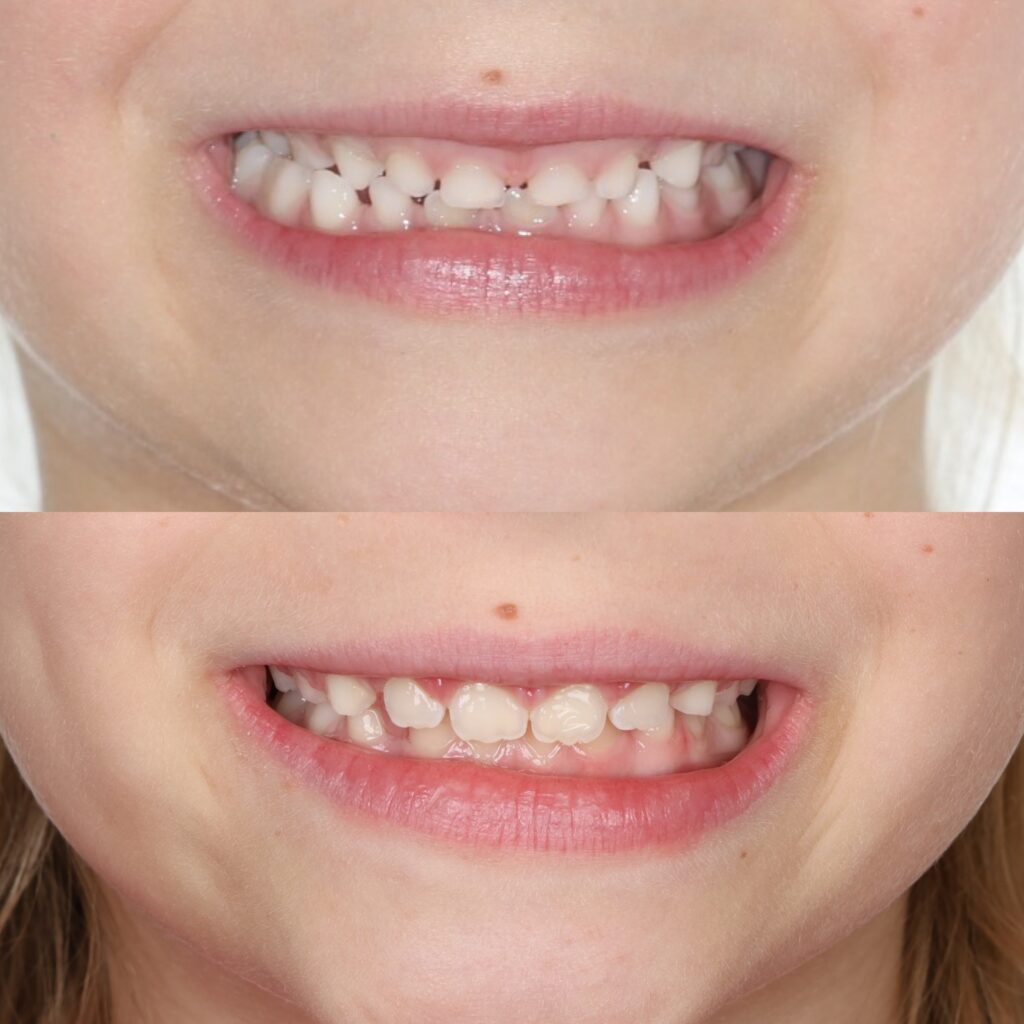
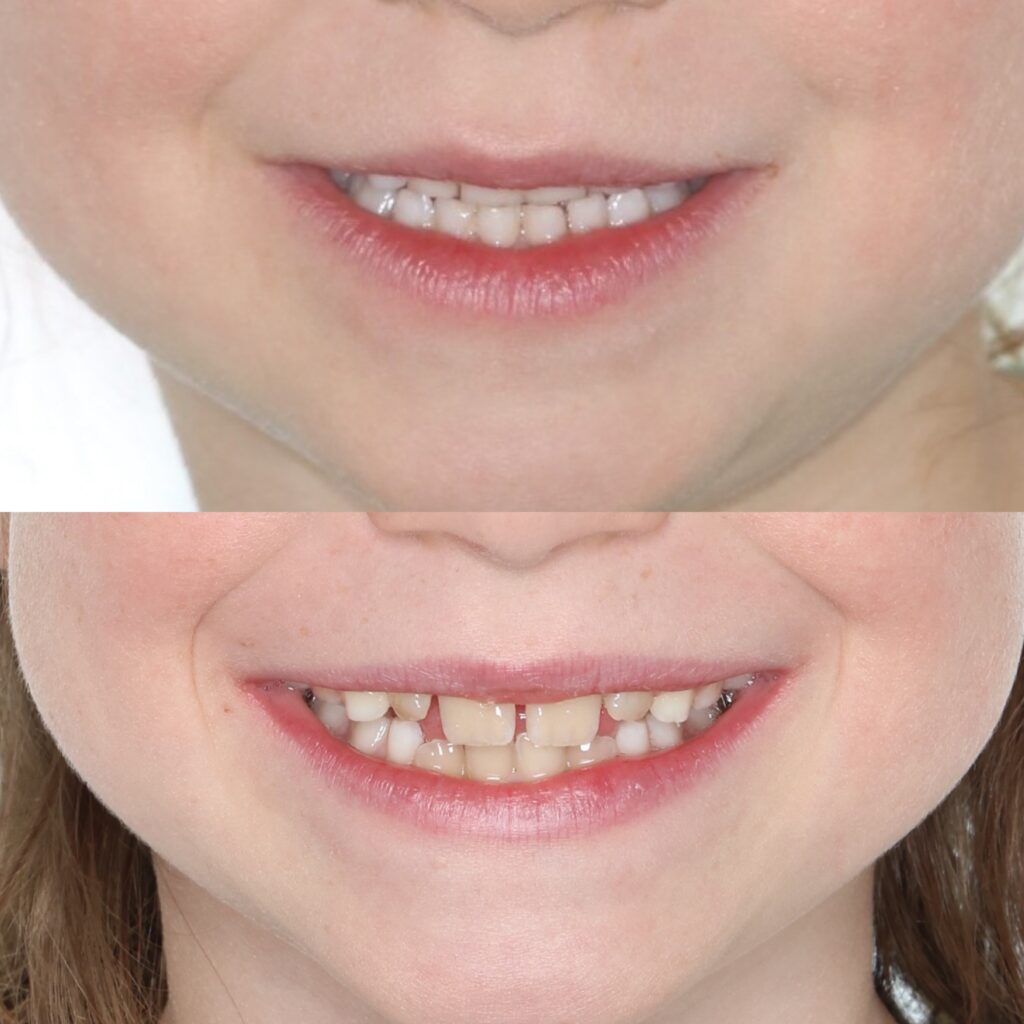
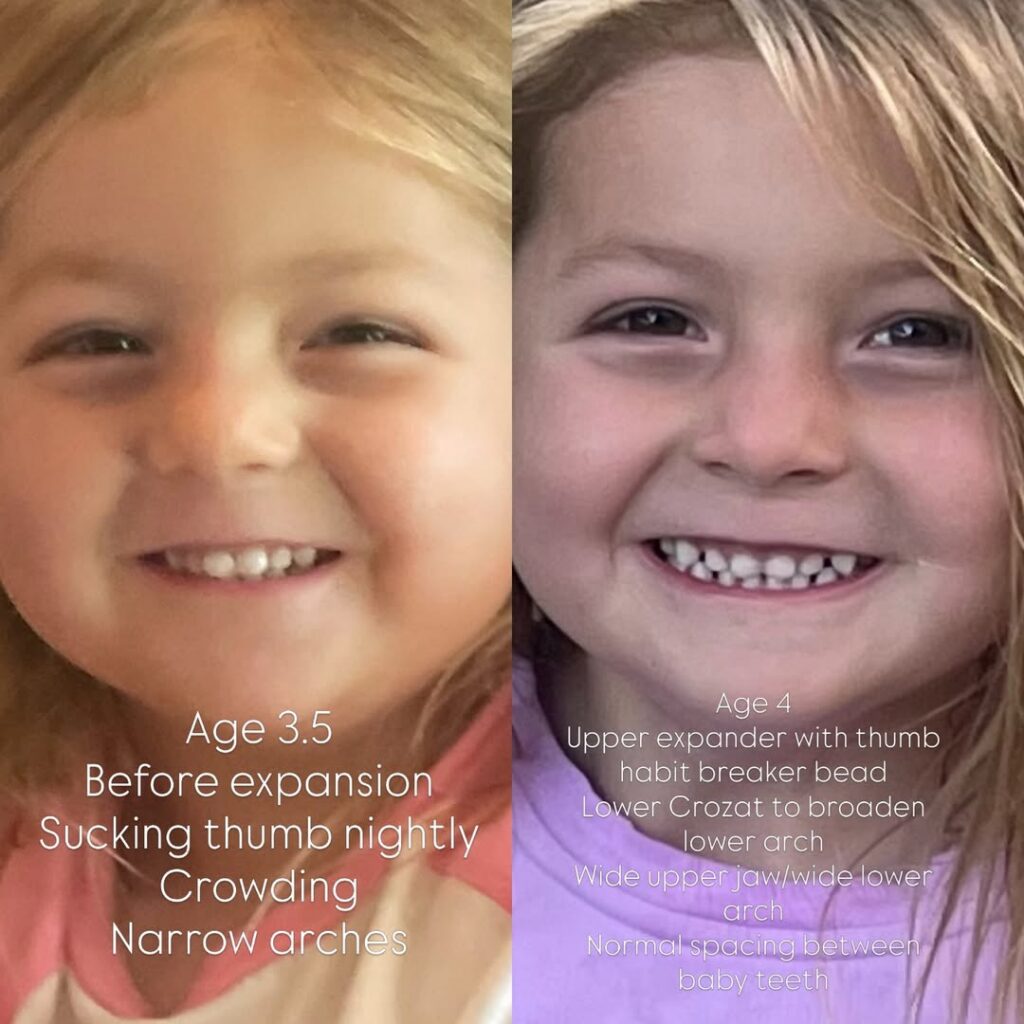
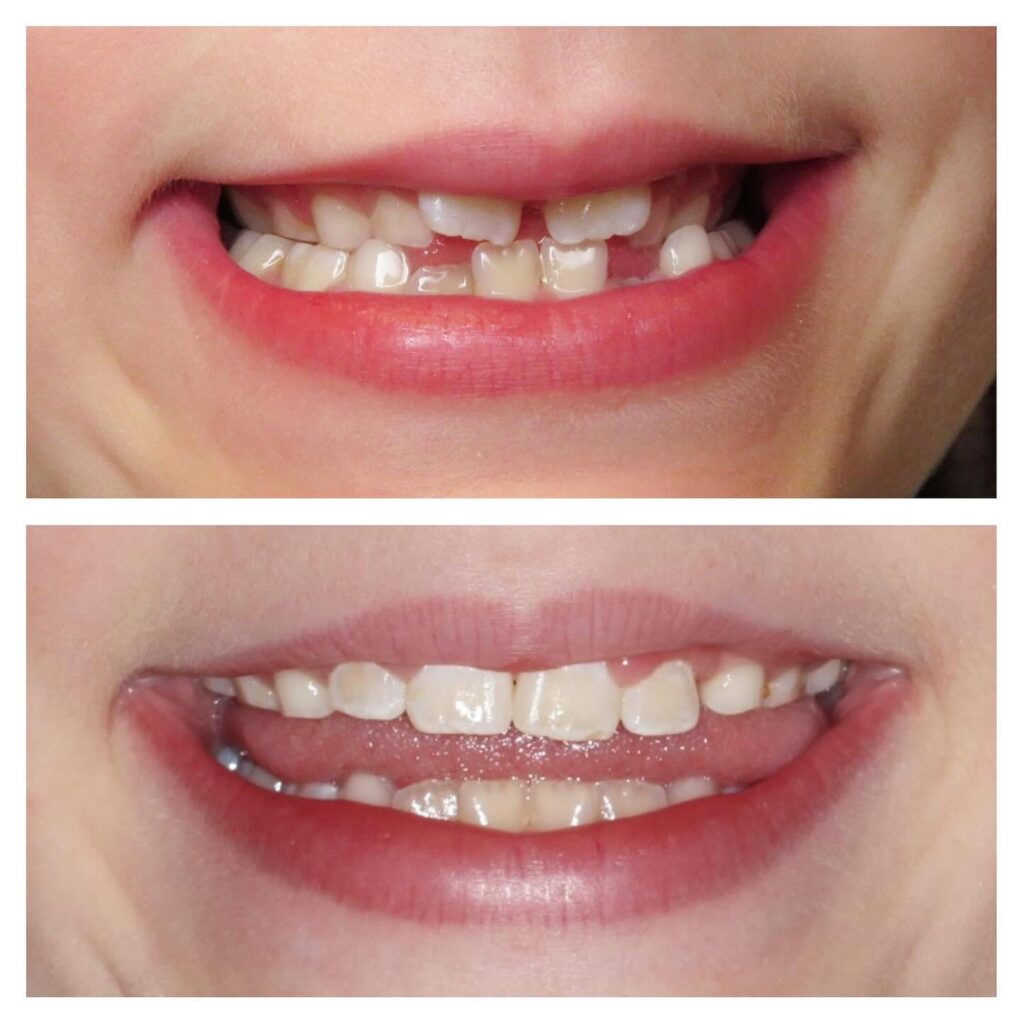
Individual results vary. Every child’s plan depends on their growth, their bite, and how they breathe.
Should my child see a pediatric dentist or an orthodontist?
Your child needs both, for different things. A pediatric dentist handles cleanings, cavities, and general oral health. An orthodontist is a dental specialist who completed two to three additional years of training after dental school, focused entirely on tooth movement, bite correction, and jaw growth.
Plenty of Denver practices offer both under one roof, and that can be convenient. It is worth knowing which provider is actually planning your child's treatment, and how much of their week is spent doing orthodontics.
Dr. Vanderstelt is a board-certified orthodontist. Orthodontics is the only thing she does, and she is the one who plans and adjusts your child's case at every visit.
You do not need a dentist's referral to be seen here. If you have a concern, you can book directly. More on whether you need a referral for an orthodontist and on the difference between a dentist and an orthodontist.
Braces vs. clear aligners for kids
Both can work for children and teens. The right choice depends on the orthodontic problem being corrected and on how reliably your child will wear something removable.
Braces or clear aligners for your child
Both can work. The better pick depends on the bite and on the kid.
| Consider | Braces | Clear aligners |
|---|---|---|
| Who it suits | Kids who will forget, lose things, or fight a routine | Kids who are organized and self motivated |
| Daily effort | Nothing to remember, they are already on | 20 to 22 hours a day, in and out for every meal |
| Complex bites | Handles the widest range of movements | Works well for many cases, less predictable for some |
| Food | A short list of things to avoid | No restrictions, trays come out to eat |
| Sports | Fine with a mouthguard | Trays out, mouthguard in |
| Losing them | Not possible | The main reason aligner cases run long |
If your child is old enough to have an opinion, bring them to the consultation and let them ask. A teenager who chose their treatment wears it. More detail on clear aligners vs. braces, and on clear aligners for children and teens at aligned.
What braces are actually like for a kid
The first week is the hardest part, and it is mostly soreness rather than pain. Teeth feel tender when biting for three or four days, then settle. Soft food and an over the counter pain reliever cover it.
We use Damon self-ligating braces, which hold the wire with a small sliding door built into the bracket rather than elastic ties. For a kid that means fewer small parts to break loose and less around each bracket to trap food.
Appointments typically run every eight to ten weeks and take about twenty minutes, though Dr. Vanderstelt sets the interval for your child's case. Most families schedule around school rather than pulling kids out mid day.
Sports are fine with a mouthguard. Instruments are fine after a short adjustment. The food list is short and mostly predictable, and we send it home with you on day one. There is a fuller version in foods to avoid with braces.
Brushing is the thing that actually matters. Kids who keep up with it finish on time with healthy enamel, and kids who do not can end up with white marks around where the brackets were. We show your child exactly how, and we check at every visit. Here is our guide to caring for braces during treatment.
How long do kids wear braces?
Most kids wear braces 18 to 24 months. Simple crowding can finish closer to 12 months, and cases involving jaw growth or impacted teeth can run past two years.
Two things move that number more than anything else. How much has to change, and whether your child shows up and wears what they are asked to wear. Broken brackets and skipped elastics are two common reasons treatment runs longer than planned.
After the braces come off, retainers hold everything in place while the bone settles. That part is not optional, and it is where a lot of teenage results get lost. More on retainers after braces.
How much do braces cost for kids in Denver?
Three things decide what braces cost for a child. How much has to change, how long treatment runs, and whether your child needs one phase of treatment or two. A twelve month case to close some spacing and a twenty six month case involving jaw growth are not the same project, and a range pulled off the internet will not tell you which one you are looking at.
You get your child's actual fee at the consultation, in writing, before you decide anything.
That last one catches parents off guard more than anything else. If a child starts with early treatment at eight and then needs full braces at twelve, those are two courses of treatment with two fees, not one fee split in half. Any office recommending early treatment should tell you that up front. We do.
On insurance, plans treat orthodontics differently from regular dental work, often as a lifetime benefit amount per child rather than a percentage of each bill. Plans vary widely, and some carry age limits or waiting periods. Bring your card and we will verify it for you.
HSA and FSA dollars can be used for orthodontic treatment, which is worth knowing before open enrollment if braces are on the horizon. If you have more than one child heading this direction, tell us. We would rather plan the sequence with you than have you find out two years from now.
At your consultation we give you the complete treatment fee, your estimated insurance benefit, the payment options available, and the monthly number, before you decide whether to begin. No surprises later.
What you get at the consultation
In writing
The full fee
Every phase your child needs, not just the first one.
Insurance
Verified for you
Bring your card and we check the orthodontic benefit before you decide.
Paying for it
Monthly plans
HSA and FSA dollars can go toward treatment too.
More than one child
Planned together
Tell us early and we will map out the sequence with you.
Kids’ cases vary too much for a number pulled off the internet to mean anything. You get your child’s actual fee at the complimentary consultation.
What happens at your child's first orthodontic visit
The consultation is complimentary, and it takes about an hour.
We start with photos and a digital scan, no impression trays. Dr. Vanderstelt examines your child's teeth, bite, and jaw growth, and asks about sleeping, breathing, and any habits you have noticed.
Then she sits down with you and tells you what she found. If treatment makes sense, she explains what she would do, how long it would take, and what it costs. If it does not make sense yet, she tells you that instead and sets a time to look again.
You will leave with a clear answer, a written fee if treatment is recommended, and no pressure to decide that day.
Your child is in the room for all of it. We explain things to them directly, because kids who understand what is happening are the ones who cooperate with it. More on what to expect at an orthodontic consultation.
Photos and a digital scan
No impression trays and no putty, just a quick digital scan and a few photos.
Dr. Vanderstelt examines your child
Teeth, bite, and jaw growth, plus the questions about sleep, breathing, and habits that most offices skip.
A straight answer
Start now, wait and watch, or no treatment needed, with the reason in plain language.
The fee in writing
If treatment makes sense, you get the complete fee, your estimated insurance benefit, and the monthly number. Nobody asks you to decide that day.
Braces for kids in Platt Park and across Denver
Our office sits at 1215 S Pearl St, Denver, CO 80210, on the walkable stretch of South Pearl Street in Platt Park, a few blocks from Washington Park.
That puts us within an easy drive for families in Wash Park, University Park, Englewood, Cherry Creek, Park Hill, and Littleton, and parents come from further out across the Denver metro for the airway side of what we do. You can see every neighborhood we serve on our areas we serve page.
It is a small practice on purpose. For families looking for a children's orthodontist in Denver, that means you see Dr. Vanderstelt at your appointments rather than a rotating set of assistants, and she knows your child's case without opening the chart.
Braces for kids on South Pearl Street
aligned. Orthodontics
1215 S Pearl St, Denver, CO 80210
Platt Park, just south of Wash Park. A short walk from the Louisiana and Pearl light rail station.
Common questions about braces for kids
What is the best age for a child to get braces?
For most kids, braces go on between ages 11 and 13, once the permanent teeth are in and enough jaw growth remains to work with. Some children need earlier treatment around ages 7 to 9 for growth related problems, and some do not start until later. Development matters more than age.
Is age seven too early for braces?
Age seven is the right time for an evaluation, not usually for braces. The American Association of Orthodontists recommends a first check-up by seven because some problems, especially crossbites and jaw growth issues, are easier to address while a child is growing. Most seven year olds we see leave with nothing more than a follow up date.
Can kids get braces while they still have baby teeth?
Yes, though it is uncommon and it looks different from full braces. Early treatment with baby teeth still present is usually about guiding growth or making room, often with an expander or a partial set of brackets, followed by a rest period before any full treatment.
How do I know if my child really needs braces, or is just being sold them?
Ask what happens if you wait. A problem that is genuinely time sensitive has a specific reason it cannot wait, and your orthodontist should be able to explain it in plain language. If the explanation stays vague, or it is mostly about appearance, you have time to think and to get a second opinion. We will tell you outright when waiting is the better call.
Will my child need two rounds of braces?
Most kids need only one. Two phase treatment is for children with growth related problems that are better corrected early, such as a crossbite or a severely narrow upper jaw, and it means an early phase around ages 7 to 9 followed by full braces in the early teens. Two phases means two courses of treatment and two fees, so ask for both numbers before you agree to the first one.
Will my child need teeth pulled for braces?
Sometimes, though far less often than it used to be. Extractions are considered when there is not enough room in the jaw for all the permanent teeth, and expansion or other approaches cannot create it. Dr. Vanderstelt will explain why a tooth is being recommended for removal and what the alternatives are before anything is scheduled.
How long will my child wear braces?
Most kids finish in 18 to 24 months. Straightforward crowding can be done closer to a year, and cases involving jaw growth or impacted teeth can run longer.
Do braces hurt kids?
Not really, though they are sore. Teeth feel tender for three or four days after braces go on and for a day after most adjustments. Soft food and an over the counter pain reliever handle it, and kids typically stop noticing the braces within a couple of weeks.
Are clear aligners a good option for kids?
For the right kid, yes. Aligners only work when they are worn 20 to 22 hours a day, so they suit organized, self motivated children. The orthodontic problem matters too, since some movements are more predictable with braces. We will give you an honest read on which one fits after we have met your child.
Does insurance cover braces for kids?
Many plans include an orthodontic benefit for children, often as a lifetime amount per child rather than a percentage. Coverage varies widely, and some plans have age limits or waiting periods. Bring your insurance card to the consultation and we will verify what your plan actually pays before you commit.
Do I need a referral from my dentist?
No. You can book an orthodontic consultation directly. Many dentists do refer, and we are glad to coordinate with yours, but a referral is not required to be seen at aligned. Orthodontics.
What if my child snores or breathes through their mouth?
Mention it at the consultation. Snoring, daytime mouth breathing, restless sleep, and night grinding can point to a narrow upper jaw and a crowded airway, and they can also come from tonsils, adenoids, or allergies. Dr. Vanderstelt evaluates the structural side, meaning how the jaw is developing and how much room it leaves, and she coordinates with your pediatrician or an ENT when something outside orthodontics is driving it. If it looks relevant, she will explain what a dedicated airway evaluation would involve.
What if my teenager does not want braces?
Bring them anyway and let them do the talking. Most of the resistance we see is about not knowing what it will be like, and a lot of it goes away once a teenager hears the timeline, sees the options, and gets to weigh in on which one. A kid who feels like a participant wears their elastics.
Ready when you are
Bring your child in and get a straight answer. If they need braces, we will tell you what that looks like, what it costs, and how long it will take. If they do not, we will tell you that too, and we will tell you when to come back.
aligned. Orthodontics, Denver
Now, later, or not at all
Whether you have a seven year old due for a first check or a twelve year old with crowding you can see from across the room, the first step is the same. The consultation is complimentary, and you will leave knowing what your child needs and when.
Prefer to talk it through first? Call 303-521-3333.