Platt Park, Denver · Overbite treatment
Overbite Treatment in Denver, Without the Guesswork
If you are looking into overbite treatment in Denver, you have probably already spent time in front of a mirror with your phone camera flipped around, trying to decide whether what you are seeing is normal. Here is the short version: almost everyone has some overbite.
The question is not whether you have one. The question is how much, why it is there, and whether it is doing anything to your teeth, your jaw joints, or your breathing. At aligned. Orthodontics on South Pearl Street in Platt Park, Dr. Amanda Vanderstelt answers those three questions before she recommends anything.

Dr. Amanda Vanderstelt is a board-certified orthodontist who sees you at every visit, at one office on South Pearl Street in Platt Park. Standard orthodontic consultations are complimentary.
You are not behind. You are not too old. And you are very likely a more straightforward case than you think.

Who is reading your case
Amanda Vanderstelt, DMD, MSD
Board-certified orthodontist
Dr. Vanderstelt diagnoses and treats every case at aligned. Orthodontics herself. Not a rotating associate, and not a different provider each visit.
- Board certified through the American Board of Orthodontics, which is voluntary and requires defending finished cases before a panel of peers
- Trained in airway-focused care, so bite and breathing get evaluated as one picture
- One doctor, one location, on South Pearl Street in Platt Park
First, what you have may not be what you think it is
The short answer: An overbite is vertical. It is how far your upper front teeth cover your lower front teeth when you bite down. An overjet is horizontal. It is how far your upper front teeth sit in front of your lower ones. Most people who say they have an overbite and mean their front teeth stick out are actually describing an overjet.
That mix-up is the most common one we see, and it matters more than most people realize, because the two problems move in different directions and get corrected different ways.
Overbite is vertical
An overbite is how far your upper front teeth cover your lower front teeth when you bite down. It is measured up and down. Everyone has some. When the upper teeth cover the lower teeth too far, orthodontists call it a deep bite, or a deep overbite.
If your lower front teeth disappear behind your uppers when you close, or if they are hitting the roof of your mouth or the gum tissue behind your upper teeth, that is a deep bite. The opposite, where the front teeth do not overlap at all, is an open bite.
Overjet is horizontal
An overjet is how far your upper front teeth sit in front of your lower front teeth. It is measured front to back.
When people say “I have an overbite” and mean “my top teeth stick out,” they almost always mean overjet. This is the one people notice in photos and in their side profile. It is also what most people are describing when they use the phrase buck teeth.
You can have one, the other, or both
Plenty of people have a deep bite with a perfectly normal overjet. Plenty have protruding upper teeth with almost no vertical overlap at all. And some have both, which usually points to something happening at the jaw level rather than just the tooth level.
This is why a real diagnosis matters. Two people can walk in describing the exact same complaint and leave with completely different treatment plans, because the underlying problem is not the same.
30 second self-check
Which one do you actually have?
Most people who say they have an overbite are describing an overjet. Three questions will tell you which direction your bite is leaning.
Bite down normally. How much of your lower front teeth can you still see?
Now look at your side profile. How far do your upper front teeth sit in front of your lower ones?
Any of these sound familiar? Lower teeth hitting the roof of your mouth, chipping or flattening on your front teeth, jaw aching in the morning, snoring or restless sleep.
What this points to
You also flagged something worth looking at directly. Wear, tissue contact, and disrupted sleep are the signals that move a bite from cosmetic to worth treating, and they are the ones that do not improve on their own.
This is a starting point for a conversation, not a diagnosis. Only records and an exam can tell you what is actually going on.
How much overbite is normal
Orthodontists generally consider it normal for the upper front teeth to overlap the lower front teeth by roughly one to three millimeters when you bite down, which works out to about the top ten to thirty percent of the lower teeth being covered. Overjet is usually considered normal in a similar range, around one to three millimeters of horizontal distance.
Once the upper teeth are covering more than about half of the lower teeth, we start calling it a deep bite. Once the horizontal gap is meaningfully larger than a few millimeters, we start calling it an increased overjet.
Those numbers are useful for context, but please do not try to measure yourself with a ruler and then decide what you need. Millimeters are hard to judge in your own mouth, and the number by itself does not tell you anything about the cause. A four millimeter overjet from tooth position and a four millimeter overjet from a small lower jaw are the same measurement and two entirely different treatment plans.
What is worth paying attention to at home is not the number. It is whether anything is changing or bothering you.
Is an overbite actually a problem, or just cosmetic
For a lot of people, honestly, it is cosmetic. A mild overbite or a slight overjet that is stable, comfortable, and not wearing anything down is not an emergency, and we will tell you that.
There are situations where it is doing real damage, and those are the ones worth catching. Signs a bite is working against you:
- Your lower front teeth are wearing flat, chipping, or getting shorter over time
- Your lower teeth are hitting the gum tissue or the roof of your mouth behind your upper front teeth
- You are seeing gum recession on the inside of your upper front teeth or the outside of your lowers
- Your jaw muscles ache, especially in the morning, or you have wondered whether orthodontics can address jaw alignment issues
- You cannot bite cleanly into a sandwich or an apple with your front teeth
- You are clenching or grinding, or your dentist has told you that you are
- Your upper front teeth stick out far enough that they are vulnerable in a fall or a collision
Any of those are worth a conversation. Wear on adult teeth does not reverse on its own, and the earlier we intervene the less restorative dentistry you tend to need later. If you are not sure whether what you have counts, it may help to read through other common bite problems and how they are corrected.
Worth a closer look?
Is your bite actually doing damage?
A bite that looks unusual and a bite that is causing problems are two different things. Check anything that applies to you.
Nothing checked yet. If none of these apply, that is genuinely good news and there may be nothing here that needs fixing.
The part most overbite pages leave out
A significant number of overbites and overjets are not really a tooth problem. They are a jaw position problem. The upper teeth are not too far forward. The lower jaw is sitting too far back.
That distinction matters beyond the smile, because the tongue is attached to the lower jaw. When the lower jaw sits back, the tongue sits back with it, and the space at the back of the throat gets smaller. A recessed lower jaw is a recognized risk factor for sleep-disordered breathing, which is why an increased overjet, a small chin, crowded lower teeth, and a history of snoring or restless sleep so often show up in the same person.
Dr. Vanderstelt is a board-certified orthodontist with training in airway-focused care, which means she looks at bite and breathing as one picture rather than two unrelated topics. You can read more about how airway-focused orthodontic care works. If your records suggest the airway is worth a closer look, she will say so and explain what a dedicated airway evaluation involves. If they do not, she will tell you that too.
To be clear, an overbite is not a diagnosis of sleep apnea, and nobody should tell you it is. It is one finding among several. But it is a finding that a lot of practices never mention, and if it applies to you, you deserve to know.
How an overbite gets corrected in adults
Almost every bite correction comes down to some combination of three things: moving teeth, changing how the upper and lower arches relate to each other, and in a small number of cases, repositioning a jaw.
Clear aligners
Clear aligners and Invisalign handle a lot of overbite and overjet cases very well, particularly mild to moderate ones. They are good at intruding front teeth to open a deep bite and at retracting upper front teeth when there is room to work with. Most adults who come in worried they will need braces end up with aligners.
Where aligners get harder is significant skeletal discrepancy, cases needing large amounts of tooth movement front to back, and patients who will not wear them the full twenty-two hours a day. That last one is not a technology limitation. It is the single biggest predictor of whether aligner treatment finishes on time.
Braces
Braces remain the most precise tool for complex bites, and what braces treatment involves is not what you may remember. We use Damon self-ligating brackets, which hold the wire with a small sliding door instead of an elastic tie. Lighter forces, fewer adjustment visits, and no rubber bands stretched across the front of every tooth.
For deep bites and larger overjets, braces give us more control over the vertical dimension and more reliable results when the correction is substantial.
Elastics and small anchors
Both braces and aligners are often paired with elastics you wear between the upper and lower arches, which is how we shift the front to back relationship. In cases that need more anchorage, we can place temporary anchorage devices, which are very small titanium anchors that give us a fixed point to push or pull against. They sound more intense than they are, and they have made a lot of cases correctable without surgery that used to require it.
Growth guidance, for kids
In a growing child, we have an option we simply do not have in adults: we can influence how the jaws grow rather than only moving teeth within them. That is covered further down.
Your options
Three ways an overbite gets corrected
Clear aligners
Best for
Mild to moderate deep bites and overjets where the problem is mostly tooth position
How it works
Custom trays intrude front teeth to open a deep bite, or retract upper teeth to reduce overjet
Typical length
Often twelve to eighteen months
The catch
Requires twenty-two hours of wear a day. Compliance, not the technology, is what decides whether it finishes on time
How common
Most adults who arrive expecting braces end up here
Damon braces
Best for
Deep bites, larger overjets, and any case needing precise control of the vertical dimension
How it works
Self-ligating brackets hold the wire with a sliding door instead of an elastic tie, often paired with elastics or small anchors
Typical length
Often eighteen to twenty-four months
The catch
They are visible. Lighter forces and fewer adjustment visits than the braces you remember
How common
The most versatile option, and the one complex bites usually land on
Surgical component
Best for
Cases where the size difference between the jaws is too large for tooth movement to correct on its own
How it works
Orthodontics before and after, with the jaw repositioning performed by an oral and maxillofacial surgeon
Typical length
Around two years, including the orthodontics on either side
The catch
It is real surgery with real recovery, and it produces results nothing else can in the cases that need it
How common
A genuine minority. Most adults asking about overbite treatment do not need it
Timelines above are typical ranges, not promises. Dr. Vanderstelt gives you an estimate specific to your case once she has seen your records, and she will tell you if she thinks you fall outside these ranges.
What corrected bites actually look like
Reading about millimeters is one thing. Seeing it is another.
This is a real patient treated at aligned. Orthodontics. Look at the lower front teeth in the before photos, not just the smile. That vertical overlap is usually the thing people never noticed until someone pointed it out, and it is often the thing that changes most.
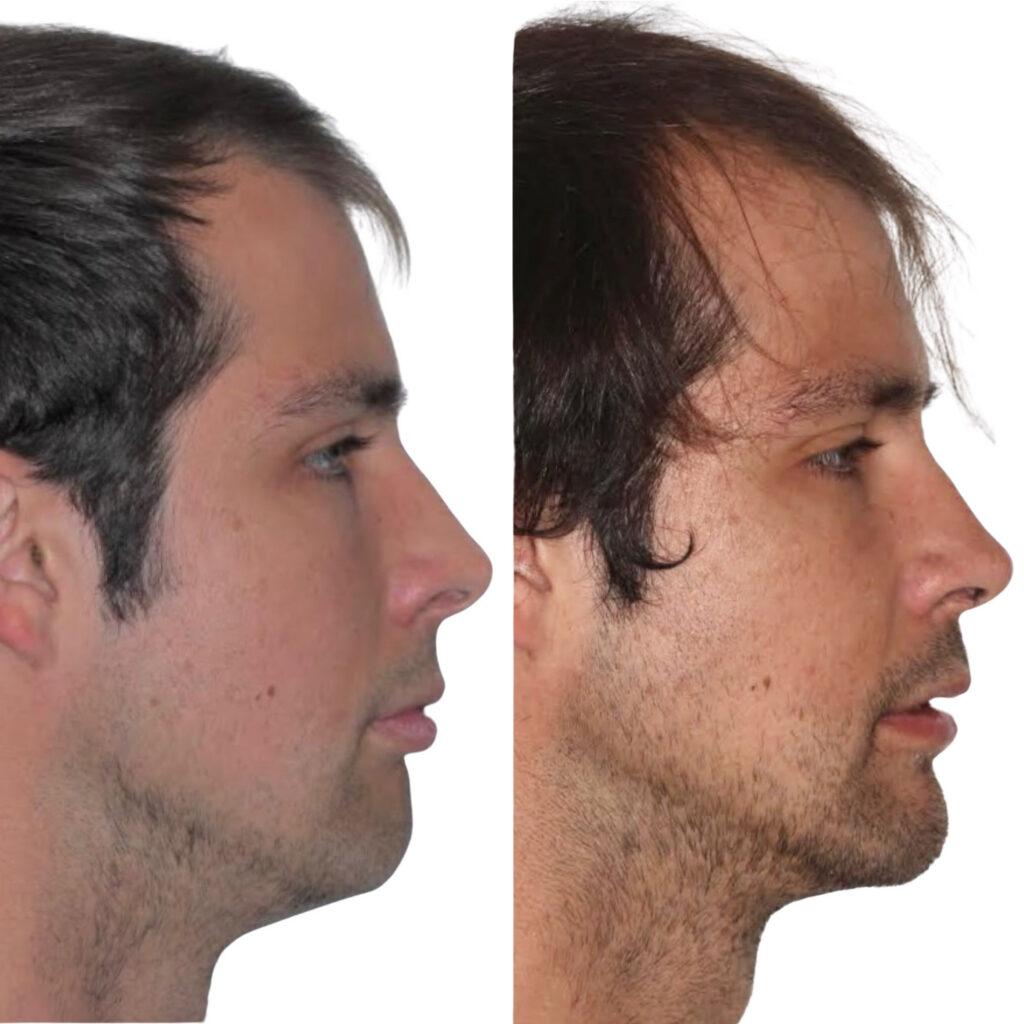
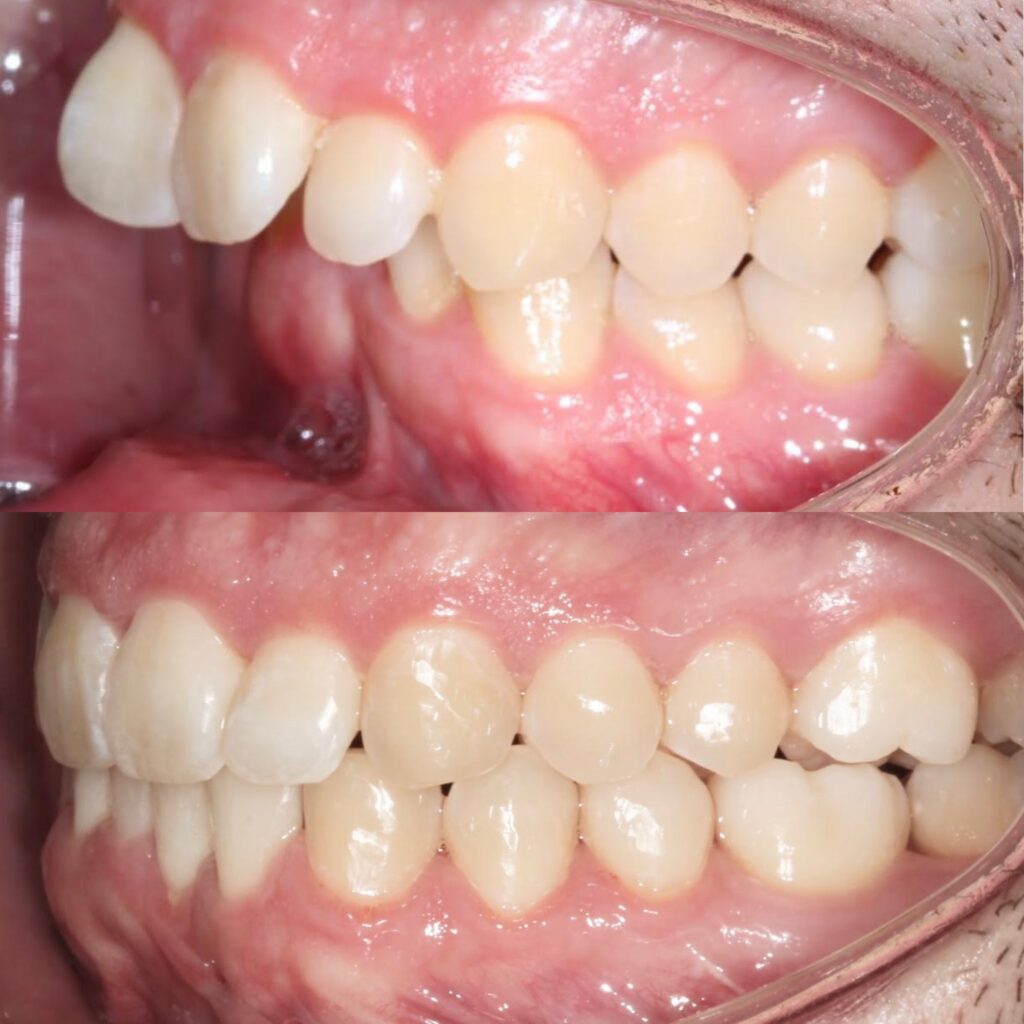
A Class II overbite with a large overjet, corrected with orthodontics and jaw surgery. This one needed surgery. Most overbites don’t.
Will I need jaw surgery
This is the fear that brings most people to this page, so here is the direct answer. The large majority of adults asking about overbite treatment do not need jaw surgery.
Surgery becomes a real conversation when the discrepancy between the upper and lower jaws is large enough that moving teeth alone would either fail to correct the bite or would correct it by tipping teeth into positions that are not stable or healthy long term. That is a genuine subset of patients, and for them surgery produces results that nothing else can. But it is a subset, not the default. Where breathing is the primary concern rather than the bite, jaw surgery for sleep apnea is a related but separate conversation.
If you have been told you need surgery and it did not sit right with you, come get a second opinion. If you have been told you absolutely do not need surgery and you are still not chewing properly, come get a second opinion on that too. We give plenty of both.
One clarification, because it confuses people: Dr. Vanderstelt is the orthodontist. She handles diagnosis, candidacy, and the orthodontic treatment before and after surgery. If a case genuinely calls for a surgical component, that portion is performed by an oral and maxillofacial surgeon, and she coordinates the plan with them from the beginning.
What bite correction does and does not do to your profile
A lot of people looking at overbite treatment are not really looking at their teeth. They are looking at their side profile, their chin, and their jawline, and wondering whether fixing the bite will change any of it.
Sometimes yes, sometimes very little, and the honest answer depends entirely on where the problem lives.
When upper front teeth are flared out and get retracted, the upper lip usually follows, and the change to the profile can be noticeable. When a deep bite is opened and the vertical dimension improves, the lower third of the face can look better proportioned. Those are real changes and they are also modest ones, measured in millimeters.
What orthodontic treatment alone does not do is move your chin forward. If your concern is a recessed chin or a jawline you have never liked, tooth movement will improve your bite without addressing the underlying jaw position. In a growing child, we can influence that. In an adult, meaningful skeletal change requires surgery.
We have written more about how orthodontic treatment affects facial aesthetics and profile if you want the longer version. We would rather tell you what to expect at the consultation than have you finish treatment with a corrected bite and a disappointment nobody warned you about. Dr. Vanderstelt will show you what your specific case can and cannot change before you start.
If you had braces as a kid and your teeth moved back
This is one of the most common reasons adults sit down with us, and a lot of people arrive apologetic about it.
You do not need to be. Teeth drift throughout life. It happens to people who wore their retainers and it happens faster to people who did not. Deep bites in particular have a tendency to return, because the same muscle patterns and bite forces that created the problem the first time are usually still there.
A relapsed case is often simpler and shorter than the original treatment, because much of the correction is still holding. Frequently it is an aligner case measured in months rather than years.
Two things worth knowing. First, if a bite relapsed once, retention is not optional the second time, and we will be direct with you about why retention matters after braces. Second, if the original treatment corrected the teeth without addressing why the bite was off in the first place, that is worth looking at now rather than repeating the cycle a third time.
Can you fix an overbite naturally, without braces
You will find a lot of content online claiming that tongue posture exercises, chewing devices, or jaw stretching can correct an overbite in an adult. We are going to be straight with you: they cannot.
Adult facial bones are fused. Tongue posture does not move them. Teeth move through bone when a sustained, controlled, biologically appropriate force is applied over time, and there is no way to generate that force with your tongue. What these approaches can do is waste months of your time and, in a few cases we have seen, cause damage through unregulated force on teeth and jaw joints.
There is a real, evidence-supported role for myofunctional therapy, which retrains tongue posture, swallowing patterns, and lip seal. It is a genuine and valuable tool. It is a supporting player alongside orthodontic treatment, not a replacement for it, and anyone selling it as a standalone cure for an adult skeletal problem is not being honest with you.
In children, whose bones are still growing, tongue and breathing habits genuinely do influence development. That is a large part of why early evaluation matters.
Overbite in kids, and why timing matters
If you are here as a parent, the timing question is the important one.
The American Association of Orthodontists recommends a first orthodontic evaluation around age seven. That is not because most seven year olds need braces. Most do not. It is because that is the age when enough permanent teeth have come in to see how the bite is developing, and it is early enough that we still have growth to work with. That window is what early orthodontic treatment in Denver is built around.
A growing child gives us a window that closes. We can encourage the lower jaw forward, create width in the upper arch using an expander, and guide the permanent teeth into better positions before the problem becomes structural. In an adult, that same problem may require extractions, anchors, or surgery to correct. Same condition, very different treatment, entirely because of when it was caught.
Protruding upper front teeth in a child are worth an early look for a second reason: they are considerably more likely to be injured in a fall or a sports collision.
Thumb sucking and prolonged pacifier use are common contributors to an increased overjet in kids, and habits that persist past the age when permanent teeth arrive are worth addressing. We also look at whether a child is breathing through their mouth, snoring, or sleeping restlessly, because those patterns influence how the face and jaws develop.
An early evaluation frequently ends with us saying “nothing to do yet, come back in a year.” That is a good outcome, and it is a free appointment.
What overbite treatment costs in Denver
We would rather give you real ranges than make you call to find out.
At aligned. Orthodontics, braces typically run from $5,500 to $8,000, and Invisalign typically runs from $4,000 to $10,000. Where a case falls in those ranges depends on complexity, treatment length, and whether additional appliances are part of the plan. We break the aligner side down further in our guide to what Invisalign costs in Denver.
Two honest notes on cost. First, a shorter, simpler case costs less, which is one of several reasons not to wait if something is actively wearing down. Second, orthodontic insurance benefits are usually a fixed lifetime amount rather than a percentage, so the benefit is often similar regardless of which treatment you choose. We will verify your specific coverage and lay out payment plan options at your consultation, before you commit to anything.
No call required
What this actually costs
We would rather give you real ranges than make you phone in to find out.
Braces
$5,500 to $8,000
Damon self-ligating brackets, start to finish
Invisalign
$4,000 to $10,000
Clear aligners, start to finish
Where a case lands depends on complexity, treatment length, and whether additional appliances are part of the plan. A shorter, simpler case costs less, which is one reason not to wait if something is actively wearing down.
Orthodontic insurance benefits are usually a fixed lifetime amount rather than a percentage, so your benefit is often similar whichever treatment you choose. We verify your specific coverage and lay out payment plans at your consultation, before you commit to anything.
No surprises
What your first visit actually looks like
It is a real appointment, not a sales meeting. Here is the whole thing.
1
Exam and records
A 3D digital scan and low-radiation imaging. No putty, no guessing at what your bite is doing.
2
You see your own bite
Dr. Vanderstelt walks you through the scan on screen and points out what is going on before she says a word about treatment.
3
She tells you what she thinks
Including when the answer is that you do not need treatment right now, which happens more often than people expect.
4
You go home and think
Options, timeline, cost, and insurance in writing. You are not asked to decide anything that day.
Standard consultations are complimentary. If your records suggest breathing is part of the picture, a dedicated airway evaluation is a separate, longer appointment with its own workup. It is complimentary for children thirteen and under, with a fee for ages fourteen and up, and we tell you the cost before you book it.
Why you can stop second-guessing this
You are researching an orthodontist because you want to be confident you picked the right one. Here is what we would want to know if we were in your position.
One doctor, one location. Dr. Vanderstelt sees you at every visit. Not a rotating associate, not a different provider at a different office each month. She diagnoses your case, she treats it, and she is the one who adjusts course if it needs adjusting.
Board certified. Board certification through the American Board of Orthodontics is voluntary. It requires submitting finished cases to a panel of peers for review and defending the results. Most orthodontists do not pursue it.
Diagnosis before recommendation. We take full records and look at them before we tell you anything. No treatment plan gets quoted off a glance in the chair.
She will tell you no. If your bite is stable and nothing is at risk, the recommendation is to leave it alone and keep an eye on it. A practice that recommends treatment to everyone who walks in is not diagnosing.
Second opinions are welcome. A meaningful share of our consultations are people who were quoted something elsewhere and wanted another read. Bring your records or bring nothing. Either is fine.
Damon self-ligating brackets and Invisalign, chosen by case. We are not a one-appliance practice steering everyone toward whatever we happen to prefer.
Bite and breathing evaluated together. Not as an upsell, and not as a diagnosis we hand out to everyone. As a question that gets asked and honestly answered.
Also, there is a goldendoodle named Benito. He works here. He is very good at his job, which is mostly being available to anyone who is nervous.
And you do not have to take our word for any of the above.
From our patients
You do not have to take our word for it
Everything above is us describing ourselves. This is everyone else describing us.
Overbite treatment questions we hear most
What is the difference between an overbite and an overjet?
An overbite is vertical: how far your upper front teeth cover your lower front teeth when you bite down. An overjet is horizontal: how far your upper front teeth sit in front of your lower ones. Most people who say “overbite” and mean protruding front teeth are actually describing an overjet.
How much of an overbite is normal?
Orthodontists generally consider one to three millimeters of vertical overlap normal, which is roughly the top ten to thirty percent of the lower front teeth being covered. Beyond about fifty percent coverage, it is usually classified as a deep bite. The measurement alone does not determine whether treatment is needed.
Can Invisalign fix an overbite?
Yes, for many mild to moderate cases. Clear aligners are effective at opening deep bites and reducing overjet when the discrepancy is primarily at the tooth level. Larger skeletal discrepancies may need braces, elastics, temporary anchorage devices, or in some cases a surgical component. A records appointment tells you which category you are in.
Do braces fix an overbite?
Yes. Braces give the most precise control over bite correction, especially for deep bites and larger overjets. We use Damon self-ligating brackets, which apply lighter forces and typically need fewer adjustment appointments than conventional braces.
Will I need jaw surgery to correct my overbite?
Most adults do not. Surgery is considered when the size difference between the upper and lower jaws is large enough that moving teeth alone would not produce a stable, healthy result. Temporary anchorage devices have made many cases correctable without surgery that previously required it.
How long does overbite treatment take?
Most cases run twelve to twenty-four months, depending on severity, the appliance used, and how consistently aligners or elastics are worn. Mild corrections can finish faster. Dr. Vanderstelt gives you an estimated timeline at your consultation, once she has seen your records.
Can an overbite cause sleep apnea?
An overbite does not cause sleep apnea by itself, but a lower jaw positioned too far back is a recognized risk factor for sleep-disordered breathing, because it reduces space at the back of the throat. If your bite pattern and symptoms point that direction, it is worth evaluating properly rather than assuming either way.
Will fixing my overbite change my face or profile?
It can, modestly. Retracting flared upper front teeth often changes the upper lip position, and opening a deep bite can improve the proportions of the lower face. Orthodontic treatment alone does not move the chin or jaw forward in an adult. Dr. Vanderstelt will show you what your specific case can change before you start.
My teeth shifted back after braces as a kid. Can that be fixed again?
Yes, and it is usually faster the second time because much of the original correction is still holding. Many relapsed cases are aligner treatment measured in months. Deep bites are especially prone to returning, so retention after the second round is not optional.
Is it too late to fix my overbite as an adult?
No. Teeth move at any age as long as the gums and bone are healthy. Adult treatment can take somewhat longer and relies more on tooth movement than growth guidance, but adults make up a large share of the bite correction we do.
Come see us
On South Pearl Street in Platt Park
1215 S Pearl St, Denver, CO 80210
Just south of Washington Park, on the historic South Pearl shopping strip
- By carStreet parking on South Pearl and the surrounding residential blocks. We are a few blocks north of where the Sunday farmers market sets up, so weekday parking on our block is straightforward.
- By light railThe Louisiana and Pearl station is a short walk up the street.
One appointment, one straight answer
Find out what you actually have
Bring your questions, your old records, or a second opinion you are not sure about. You will leave knowing exactly what your bite is doing and what it would take to change it.
Book your complimentary consultation- Consultation is free
- Second opinions welcome
- No decision required that day
aligned. Orthodontics, 1215 S Pearl St, Denver, CO 80210, in Platt Park