Reviewed by Amanda Vanderstelt, DMD, MSD, board-certified orthodontist.
An open bite means your back teeth close but your front teeth don’t. Most people notice it when they can’t bite through a sandwich and end up tearing food off with their side teeth instead.
If you are looking into open bite treatment in Denver, you have probably also read that open bites are hard to fix and tend to come back. Some of that is true. When an open bite returns, the reason often traces back to whatever held it open in the first place: where the tongue rests, how you breathe, a habit, or the way the jaws grew.
At aligned. Orthodontics on South Pearl Street in Platt Park, Dr. Amanda Vanderstelt finds that cause before she recommends anything. Then she closes the bite and builds a plan to keep it closed.
Open bite treatment in Denver: the short answer
An open bite can usually be corrected with clear aligners, braces with elastics, or small orthodontic anchors. A severe jaw-level open bite may need jaw surgery, but that is a minority of cases.
The right approach depends on what is keeping your bite open: tooth position, jaw growth, tongue posture, breathing, a habit, or a mix of those. At aligned. Orthodontics, Dr. Vanderstelt uses a 3D scan and imaging to sort that out before she recommends treatment.
Braces here typically run $5,500 to $8,000 and Invisalign $4,000 to $10,000. The consultation is complimentary, and you leave with a plan and a price in writing.

Reviewed by
Dr. Amanda Vanderstelt
DMD, MSD, board-certified orthodontist
Dr. Vanderstelt is certified by the American Board of Orthodontics and has additional training in airway-focused care. With an open bite, that means the tongue, the breathing, and the jaw joints get looked at along with the teeth.
She diagnoses and treats every case at aligned. herself, at one location on South Pearl Street.
Meet Dr. VandersteltWhat an open bite is
Close your back teeth together and look in a mirror. In a typical bite, the upper front teeth overlap the lower front teeth by a couple of millimeters.
With an open bite, your front teeth don’t meet. There is a gap between them instead. Sometimes it is a sliver. Sometimes it is wide enough to rest your tongue in, and many people with an open bite do exactly that without realizing it.
Anterior open bite
The front teeth do not touch when the back teeth are together. This is the most common type and what most people mean when they say open bite.
Posterior open bite
The front teeth touch, but some back teeth on one or both sides do not. It is less common, and the causes are different: a tongue that rests between the side teeth, or back teeth that stopped coming in the rest of the way. It needs a careful diagnosis before anyone treats it.
Dental or skeletal open bite
Orthodontists sort open bites into two broad groups, dental and skeletal. In plain language, tooth-level and jaw-level.
A dental open bite lives in the teeth. Often a thumb, a pacifier, or the tongue sat between the front teeth while they were coming in and kept them from finishing.
A skeletal open bite lives in the bones. The face grew longer than usual from top to bottom, the lower jaw rotated down and back, and the back teeth ended up doing all the meeting.
Plenty of people have some of both. Which one you have decides your treatment.
Signs you might have an open bite
- Your front teeth do not touch when your back teeth are together
- You cannot bite through a sandwich, a slice of pizza, lettuce, or noodles with your front teeth
- You have a slight lisp on s, z, or th sounds
- Your tongue pushes forward between your teeth when you swallow
- Your lips sit apart at rest, or you have to strain to close them
- You breathe through your mouth, snore, or wake up tired
- Your back teeth are wearing down, or your jaw muscles feel tired
- A bite that used to close has started to open
That last one deserves its own line. If your bite has been opening up as an adult, tell us. A bite that changes after growth is finished can point to changes in the jaw joints, and that gets looked at before anything else.
Three questions
Where should you start?
Not a diagnosis. Just the most useful first step for your situation.
Who is this for?
Which of these sounds most like it?
What bothers you most about it?
Your best first step
Start with a complimentary consultation
A 3D scan shows whether your open bite is dental, skeletal, or both, and what is holding it open. That decides everything else.
General information, not a diagnosis. Nothing you pick here is stored or sent anywhere.
Is an open bite worth fixing?
Sometimes it is not, and Dr. Vanderstelt will tell you that. A small open bite that is stable, lets you eat normally, and is not wearing anything down may be fine to leave alone and watch.
It is worth fixing when it is costing you something. Most of that shows up at the table. You order around foods you cannot bite into, or skip the sandwich at a lunch meeting because you know how it goes.
Some of it shows up in photos. People with an open bite often learn to smile with their lips closed, or cover their mouth when they laugh.
Some of it builds slowly. When the front teeth never touch, the back teeth take the whole chewing load, and over years that can mean wear, chips, and tired jaw muscles.
In adults, an open bite does not close on its own. In young kids, a mild open bite from a thumb or pacifier often improves once the habit stops. One that is still there as the adult teeth come in usually needs help.
What causes an open bite
Front teeth keep coming in until they meet something. Usually that is the opposing teeth. If what they meet is a thumb, a pacifier, or a tongue resting between them, they stop there and a gap is left behind.
Thumb sucking and pacifiers
A sucking habit that continues once the permanent front teeth start coming in can hold those teeth apart. Our page on thumb sucking treatment covers the small habit appliance Dr. Vanderstelt made for her own daughter, and why it works without punishment or nightly battles.
A low, forward tongue
Some people rest their tongue low in the mouth and push it forward between the teeth every time they swallow. Researchers still debate whether that pattern causes an open bite or develops to fill a gap that was already there. Either way, it has to be part of the plan, or it can work against the result.
Mouth breathing
When you breathe through your mouth, your tongue drops to the floor of the mouth and your lower jaw hangs slightly open. In growing kids, mouth breathing, a low resting tongue, a narrow palate, and a longer face are often seen together, and years of that posture can let the lower jaw swing down and back while the front teeth stay apart.
Enlarged tonsils or adenoids, allergies that never fully settle, and a narrow upper jaw are common reasons a child breathes through the mouth. Our page on mouth breathing and snoring in kids walks through what to watch for.
How your face grows
Some faces simply grow more vertically than others, and that runs in families. A growth pattern is not a habit you can stop, which is why skeletal open bites usually need more than aligners.
How Dr. Vanderstelt figures out what is holding your bite open
This is the step that shapes both your treatment plan and the plan for keeping the result.
Many offices look at the gap. Dr. Vanderstelt looks for the reason there is a gap.
- A 3D digital scan and imaging show whether your open bite is dental, skeletal, or both
- She checks the width of your palate, where your tongue rests, and how you swallow
- She checks whether your lips close without effort and whether you breathe through your nose
- She checks your jaw joints, especially if your bite has changed as an adult
Dr. Vanderstelt is a board-certified orthodontist with training in airway-focused orthodontics, so bite and breathing get evaluated as one picture.
If breathing is part of your open bite, she coordinates with the right people: an ENT for tonsils and adenoids, your doctor for allergies, or a myofunctional therapist to retrain where the tongue rests. We do not do myofunctional therapy in our office, but we will connect you with someone who does.
An open bite is not a sleep apnea diagnosis. Only a sleep study can diagnose that. What Dr. Vanderstelt can tell you is whether jaw structure and tongue space are part of your picture.
A standard consultation is complimentary. If breathing looks like part of the story, an airway evaluation is a separate, longer appointment. It is complimentary for children thirteen and under, with a fee for ages fourteen and up, and we tell you the cost before you book it.
How we treat open bites in Denver
Every plan has two jobs: close the bite, and deal with what held it open.
Open bite treatment for children
A growing child gives us options we do not have in adults, because the bone is still responding to how it is guided.
- Stopping the habit, often with a small habit appliance
- Widening a narrow upper jaw with an expander, which also gives the tongue room to rest where it belongs
- Getting breathing looked at by a pediatrician or ENT when tonsils, adenoids, or allergies are involved
- Myofunctional therapy to retrain tongue posture and swallowing
The research on kids points one direction: orthodontic treatment and tongue retraining together tend to work better than either one alone. This is a big part of what phase one orthodontics is for.
Plenty of young kids with a small open bite just need the habit to stop and a check-in six months later. If that is your child, Dr. Vanderstelt will say so.
Open bite treatment for teens and adults
Clear aligners. Invisalign and clear aligners handle many mild to moderate dental open bites. A 2025 review of the adult research found aligners closed front open bites by close to three millimeters on average, mostly by bringing the front teeth down to meet. They need to be worn about twenty-two hours a day, and that wear time decides whether treatment finishes on schedule.
Braces with elastics. Braces give more control over how teeth move up and down. We use Damon self-ligating brackets, often paired with small elastics that help bring the front teeth together.
Small anchors to lift the back teeth. Many adult open bites exist because the back teeth came in too tall and prop the jaw open. Tiny titanium anchors, called temporary anchorage devices, let us press those back teeth up into the bone.
When the back of the bite comes down, the lower jaw rotates closed and the front teeth meet. Research reviews describe this as a less invasive alternative to surgery for many adults.
Palate expansion for adults. If your upper jaw is narrow, MARPE can widen it without surgery. That gives the tongue a place to rest other than between your teeth.
Jaw surgery, for a minority. When a skeletal open bite is large, moving teeth alone either will not close it or will close it in a way that will not hold. For those cases, surgery that repositions the jaws produces results nothing else can.
Dr. Vanderstelt does the orthodontics before and after, and an oral and maxillofacial surgeon performs the surgery. She coordinates the plan with them from the first visit.
Four ways an open bite gets closed
Most cases use the first three. Surgery is for a minority.
| Approach | Best for | How it closes the bite |
|---|---|---|
| Clear aligners | Mild to moderate dental open bites | Brings the front teeth down to meet, with some control of the back teeth |
| Damon braces with elastics | Moderate open bites, or bites needing precise up and down control | Moves front teeth together, with elastics helping close the gap |
| Braces or aligners plus small anchors | Adults whose back teeth prop the bite open | Presses back teeth up so the lower jaw rotates closed |
| Jaw surgery with orthodontics | Large skeletal open bites | Repositions the jaws, with orthodontics before and after |
Which one fits depends on your scan and imaging, not on how the gap looks in a mirror.
Most open bite cases take between twelve months and two years, depending on severity, the approach, and how consistently aligners or elastics are worn. Surgical cases take longer because of the orthodontics on either side. You get a timeline for your own case once Dr. Vanderstelt has seen your records.
Open bites closed at our South Pearl office
Two cases, two very different routes. Before is on top, after is below.
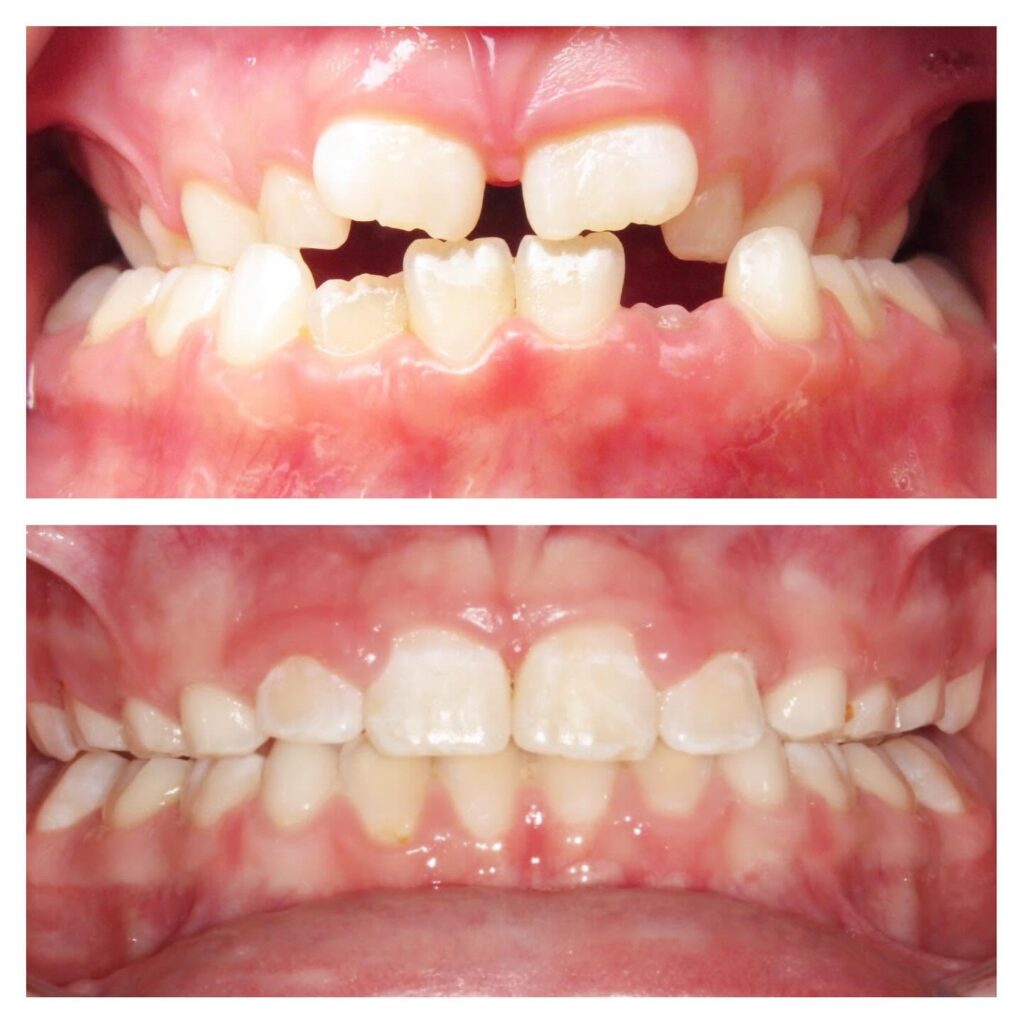
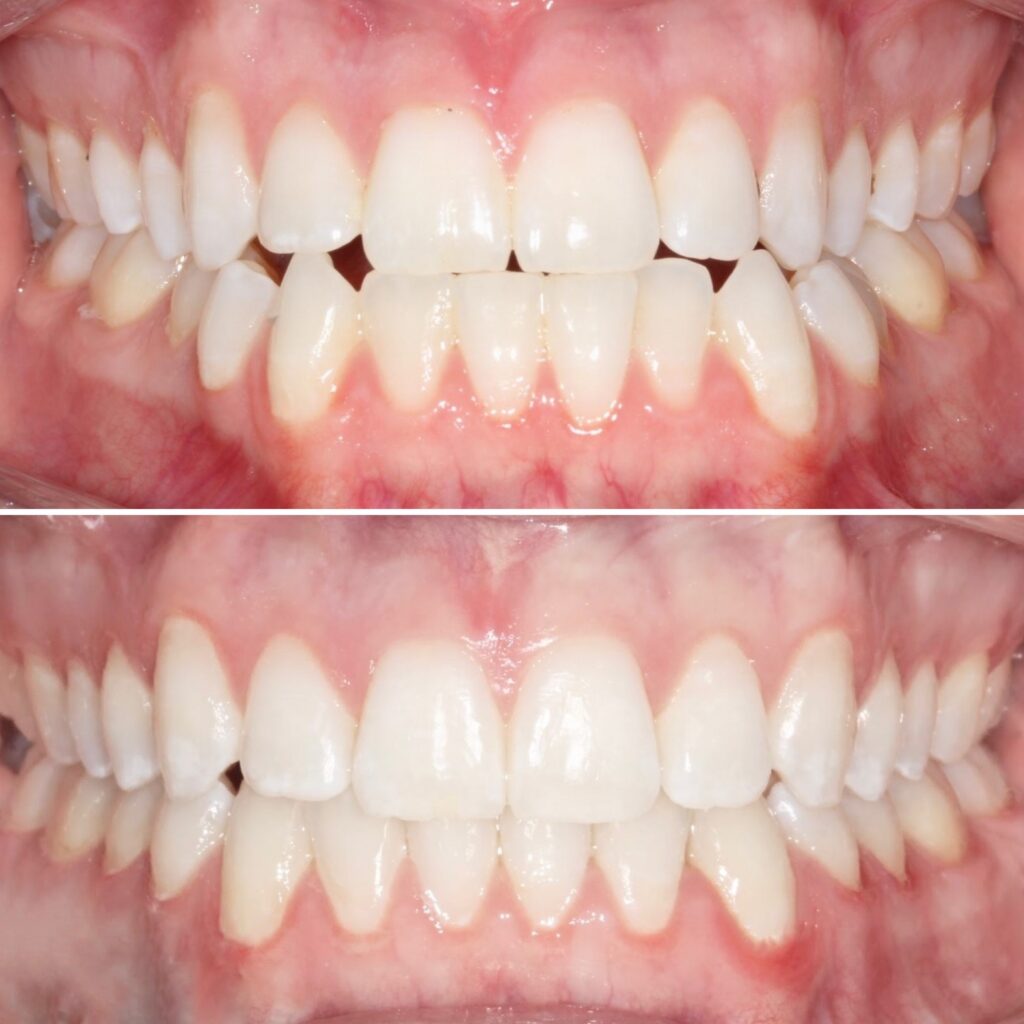
Individual results vary. Treatment time and outcome depend on the case.
Keeping an open bite closed
Open bites have a reputation for coming back, so here is what the research shows.
A meta-analysis of treated open bites found that in the studies it pooled, more than three out of four were still closed at least a year after treatment, with surgery and without. That is encouraging. It also means some reopen.
What improves your odds:
- Treating the cause along with the teeth. If a tongue habit, mouth breathing, or a narrow jaw held the bite open, it needs a plan too.
- Wearing retainers exactly as directed. For open bites, that often means a retainer bonded behind the front teeth plus a removable one at night.
- Coming back for follow-up visits, so small changes get caught while they are still small.
If you had braces as a kid and your open bite came back, the second round starts with figuring out what reopened it, so the plan covers that along with the teeth. We will also be direct with you about why retainers matter after braces.
Can you fix an open bite without braces?
You will find videos online promising that tongue exercises, jaw posture tricks, or chewing devices will close an adult open bite. On their own, they generally cannot move an adult’s teeth or jaws enough to correct an established open bite.
Myofunctional therapy is different. It is a real tool that retrains how your tongue rests and how you swallow, and it has a place in treatment and in keeping a result stable. The research does not support it as a stand-alone fix for an adult open bite.
Some people close a small gap with bonding or crowns on the front teeth. That is a decision to make with your dentist, and it can look good. It does not change why the bite opened.
Will fixing an open bite change your face?
Sometimes, modestly. The change people notice most is often their lips. When the front teeth meet, the lips can close at rest without straining, and the lower face looks more relaxed.
When back teeth are pressed up with anchors and the lower jaw rotates closed, the lower face can get slightly shorter and the chin can sit a little more forward. Surgical cases change more. Orthodontics alone will not reshape a jaw in an adult.
We have written more about how orthodontic treatment affects your face and profile. Dr. Vanderstelt will show you what your specific case can and cannot change before you start.
Open bite, overbite, crossbite, or underbite?
These get mixed up constantly, and many people have more than one.
- Open bite: some teeth do not meet when the rest of the bite is closed.
- Overbite: the upper front teeth cover too much of the lower front teeth. A deep bite is the opposite of an open bite. Read more on overbite treatment.
- Crossbite: some upper teeth sit inside the lower teeth instead of outside them. Crossbites and open bites often travel together with a narrow upper jaw. See crossbite treatment.
- Underbite: the lower front teeth sit in front of the upper front teeth. See underbite treatment.
- Crowding: teeth overlap or twist because there is not enough room. See crooked teeth treatment.
You do not need to know which one you have before you come in. Figuring that out is what the first visit is for.
What open bite treatment costs in Denver
We would rather give you real ranges than make you call to find out.
No call required
Braces
$5,500 to $8,000
Damon self-ligating brackets, start to finish
Invisalign
$4,000 to $10,000
Clear aligners, start to finish
Anchors or expansion can move a case within these ranges. Jaw surgery is billed separately by the surgeon. Payment plans available, and we verify your insurance before you commit.
At aligned. Orthodontics, braces typically run from $5,500 to $8,000, and Invisalign typically runs from $4,000 to $10,000. Where your case lands depends on how complex it is, how long it takes, and whether anchors or expansion are part of the plan. If your case includes jaw surgery, the surgeon’s fees are separate from the orthodontic fee.
Orthodontic insurance benefits are usually a fixed lifetime amount rather than a percentage, so your benefit is often similar whichever treatment you choose. We verify your coverage and lay out payment plan options at your consultation, before you commit to anything.
What your consultation looks like
It is a real appointment, not a sales meeting.
A 3D digital scan and imaging
No putty, and no guessing at whether your open bite is dental or skeletal.
You see your own bite
Dr. Vanderstelt shows you your bite on screen and points out what is holding it open.
She tells you what she thinks
Including when the answer is to watch it rather than treat it.
You go home with it in writing
Options, a timeline, the cost, and your insurance picture. You are not asked to decide anything that day.
Questions to ask any orthodontist about your open bite
Wherever you go in Denver for open bite treatment, these are the questions worth asking. Here is how we answer them.
Is the person diagnosing me an orthodontist?
Plenty of general and pediatric dental offices offer braces and aligners. At aligned., your case is diagnosed and treated by Dr. Vanderstelt, a board-certified orthodontist, at every visit.
Board certification through the American Board of Orthodontics is voluntary and requires defending finished cases before a panel of peers. You can read more about her training and background.
Is my open bite dental, skeletal, or both, and can you show me?
You should see it on your own scan and imaging before anyone quotes you a treatment.
What caused it, and what is the plan for that?
Ask whether anything beyond the teeth is involved: a habit, tongue posture, breathing, how the jaws grew, or the jaw joints. For an open bite, one or more of those is often part of the answer.
What is the retention plan?
For open bites, retention should be part of the treatment plan from day one, not a conversation at the end.
What happens if I wait?
Sometimes waiting is the right call. You deserve to hear that when it is true. If you were told you need surgery and it did not sit right, or you were told you do not and you still cannot bite into a sandwich, come get a second opinion.
Also, there is a goldendoodle named Benito. He works here, mostly by being available to anyone who is nervous.
Finding us on South Pearl Street
aligned. Orthodontics is at 1215 S Pearl St, Denver, CO 80210, in Platt Park on the South Pearl Street strip just south of Washington Park. The Louisiana and Pearl light rail station is a short walk up the street, and there is street parking on South Pearl and the surrounding blocks.
We see patients from Platt Park, Washington Park, Bonnie Brae, University Park, Cherry Creek, Virginia Village, and around DU, plus families who drive in from Englewood, Littleton, and Greenwood Village.
Open bite treatment on South Pearl Street
aligned. Orthodontics
1215 S Pearl St, Denver, CO 80210
Platt Park, just south of Wash Park. A short walk from the Louisiana and Pearl light rail station.
Open bite questions we hear most
What is an open bite?
An open bite is when some upper and lower teeth do not touch while the rest of the bite is closed. Most often the front teeth don’t meet, which is called an anterior open bite. When back teeth on one or both sides do not meet, it is called a posterior open bite.
What causes an open bite?
Common causes are thumb sucking or pacifier use while the adult front teeth come in, a tongue that rests low and pushes forward between the teeth, mouth breathing, and a face that grows more vertically. In adults, a bite that starts opening after growth is finished can point to jaw joint changes and should be checked first.
Can orthodontics fix an open bite without surgery?
Yes, in most cases. Clear aligners, braces with elastics, and small anchors that press the back teeth up can close many open bites, including many in adults. Surgery is reserved for large skeletal open bites where moving teeth alone would not produce a stable result.
Can Invisalign fix an open bite?
For many mild to moderate open bites, yes. Research on adults shows aligners close front open bites mainly by bringing the front teeth down to meet. Larger or skeletal open bites may need braces, anchors, or a surgical component. Your records show which group you are in.
Is an open bite worth fixing?
It depends on what it is costing you. If it keeps you from biting into food, affects your speech, wears down your back teeth, or is changing over time, it is worth having an orthodontist look at whether treatment would help. A small, stable open bite that causes no problems may be fine to watch.
Can an open bite cause a lisp?
It can. When the front teeth do not meet, the tongue often pushes into the gap on s, z, and th sounds. Speech often improves once the bite is closed, though some people also benefit from working with a speech therapist.
Will my child’s open bite close on its own?
Sometimes. A mild open bite from a thumb or pacifier in a young child often improves once the habit stops. An open bite that is still there as the adult front teeth come in, or one tied to mouth breathing or tongue posture, is worth an orthodontic evaluation.
How long will I need braces for an open bite?
Most cases take between twelve months and two years, depending on severity, the approach, and how consistently aligners or elastics are worn. Surgical cases take longer because of the orthodontics before and after. Dr. Vanderstelt gives you a timeline once she has seen your records.
What is the success rate of open bite treatment?
A meta-analysis of treated open bites found more than three out of four were still closed at least a year after treatment, both with and without surgery. Addressing tongue posture, breathing, or habits, and wearing retainers as directed, improves your odds of keeping the result.
How much does open bite treatment cost in Denver?
At aligned. Orthodontics, braces typically run from $5,500 to $8,000 and Invisalign from $4,000 to $10,000. Where your case lands depends on complexity, length, and whether anchors or expansion are part of the plan. Surgical fees are separate. Consultations are complimentary.
Why don’t my back teeth touch?
That is a posterior open bite. It can come from a tongue that rests between the side teeth or from back teeth that did not finish coming in. The causes are different from a front open bite, so it needs an exam and imaging before anyone recommends treatment.
Is an open bite related to mouth breathing?
Often. Mouth breathing drops the tongue to the floor of the mouth and holds the lower jaw open, and in growing kids it is commonly seen alongside open bites and longer faces. An open bite is not a sleep apnea diagnosis, but it is a reason to look at breathing along with the bite.
Does fixing an open bite change your face?
It can, modestly. Many people find their lips close more easily at rest. When back teeth are pressed up and the lower jaw rotates closed, the lower face can look slightly shorter. Orthodontics alone does not reshape an adult jaw. Surgery changes more.
aligned. Orthodontics, Denver
Find out what is holding your bite open
Whether you have been tearing food with your side teeth for years or you just noticed your child’s front teeth don’t meet, the first step is the same. The consultation is complimentary, and you will leave knowing whether your open bite is dental, skeletal, or both.
Prefer to talk it through first? Call 303-521-3333.
Sources and research
Greenlee GM, Huang GJ, Chen SS, et al. Stability of treatment for anterior open-bite malocclusion: a meta-analysis. American Journal of Orthodontics and Dentofacial Orthopedics, 2011.
Correa E, Michelogiannakis D, Barmak AB, et al. Efficacy of clear aligner therapy for the treatment of anterior open bite in adults: a systematic review and meta-analysis. Orthodontics and Craniofacial Research, 2025.
Burgos-Lancero P, Ibor-Miguel M, Marqués-Martínez L, et al. Correction of anterior open bite using temporary anchorage devices: a systematic review and meta-analysis. Journal of Clinical Medicine, 2025.
Cenzato N, Iannotti L, Maspero C. Open bite and atypical swallowing: orthodontic treatment, speech therapy or both? A literature review. European Journal of Paediatric Dentistry, 2021.
Alam MK, Alayyash A. Management strategies for open bite relapse: a systematic review and meta-analysis. Cureus, 2024.
Kandasamy S. Mouth breathing and orthodontic intervention: does the evidence support keeping our mouths shut? American Journal of Orthodontics and Dentofacial Orthopedics, 2025.