Platt Park, Denver · Crossbite treatment
Crossbite Treatment in Denver
Written and clinically reviewed by Amanda Vanderstelt, DMD, MSD, board-certified orthodontist at aligned. Orthodontics in Denver’s Platt Park neighborhood. Last reviewed August 2026.
Close your teeth together slowly and pay attention to the last moment before they meet.
If your lower jaw slides sideways to get there, that slide is worth paying attention to. It usually means one or more teeth are contacting early, and your jaw is shifting to find a position where everything can meet. Orthodontists call that a functional shift.
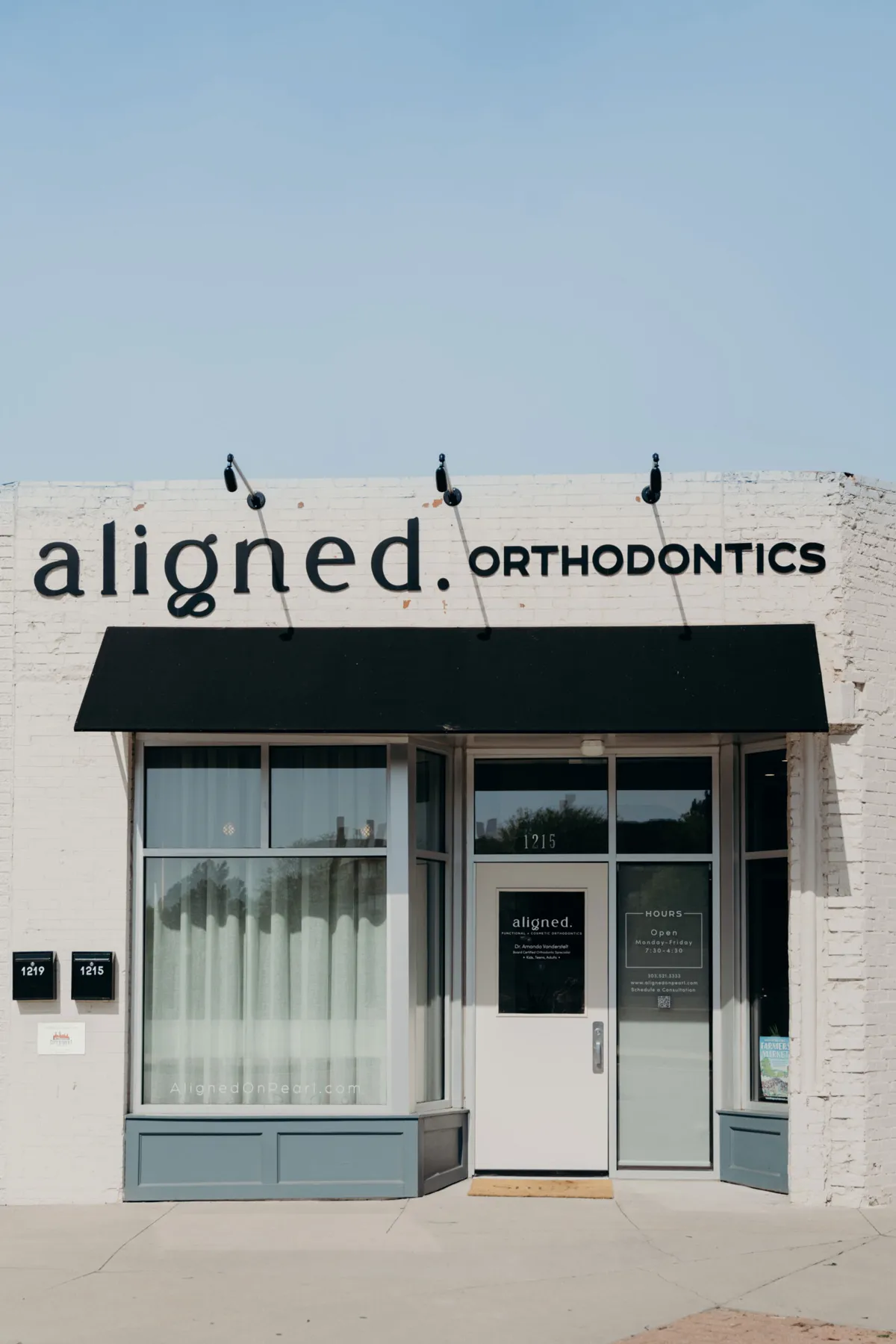
Dr. Vanderstelt, DMD, MSD, is a board-certified orthodontist at one location on South Pearl Street in Platt Park, rated 5.0 stars across more than 270 Google reviews. Consultations are complimentary, with no pressure.
Not every crossbite has one. Some involve tooth position or jaw width with no visible slide at all, which is why two bites that look similar in the mirror can need very different treatment.
But when a shift is present, where your jaw has to go to close matters as much as where the teeth sit, and that’s the part most pages leave out.

Reviewed by
Dr. Amanda Vanderstelt
DMD, MSD, board-certified orthodontist
Dr. Vanderstelt is certified by the American Board of Orthodontics and has additional training in airway-focused care, which is why a narrow upper jaw gets read as a structural finding here and not just a crooked-teeth problem.
She has also been through adult palate expansion herself. When she tells you what week two feels like, that is not something she read.
Meet Dr. VandersteltThe short answer: A crossbite is when the normal relationship between upper and lower teeth is reversed somewhere in the mouth, so lower teeth sit outside or directly on top of the uppers instead of inside them. It can affect the front teeth, the back teeth, one side, or both. Most crossbites, and posterior crossbites with a jaw shift in particular, are unlikely to correct on their own. In growing children, a palate expander guides the upper jaw and corrects most of them straightforwardly.
In adults, treatment depends on whether the cause is the position of the teeth or the width of the jaw, and mini-screw assisted expansion has given some adults a non-surgical option they wouldn’t have had before.
At our South Pearl Street office, Dr. Vanderstelt sees children with narrow upper jaws, teens finishing bite correction, and adults who were told years ago that surgery was their only option.
The ten-second check you can do right now
Sit up straight. Close slowly. Notice whether your jaw slides.
Then look in a mirror with your teeth together. In a normal bite, the upper teeth sit slightly outside the lower ones all the way around, like a lid on a box. If any lower teeth sit outside or directly on top of the uppers instead, that’s a crossbite.
Neither check is a diagnosis. Both tell you whether an evaluation is worth an hour of your time.
Which of these sound familiar?
Tick anything you have noticed. Nothing is stored or sent anywhere.
0
Tick anything above that applies and this will update.
Book a complimentary consultationThis is a conversation starter, not a diagnosis. Only an exam with records can tell you what kind of crossbite you have.
What is a crossbite?
The American Association of Orthodontists describes a crossbite as a reversal of the normal relationship between opposing teeth. It can involve one tooth or a whole group, and there are two main kinds that behave very differently.
Anterior crossbite affects the front teeth. One or more lower front teeth sit ahead of the uppers when you close. People often mistake this for an underbite.
Posterior crossbite affects the molars and premolars. The lower back teeth sit outside the uppers, which usually means the upper jaw is narrower than it should be. This is the type most connected to breathing, and the type we see most often in kids.
A crossbite can also be unilateral, on one side only, or bilateral, on both. Unilateral is more common, and it’s the one most likely to make your jaw shift sideways, because your bite is hunting for a comfortable landing spot and only one side is in the way.
Crossbite, overbite, or underbite?
These get mixed up constantly, and the confusion matters because it changes what treatment looks like.
Crossbite, overbite, or underbite?
These get mixed up constantly, and the difference changes what treatment looks like.
Crossbite
Overbite
Underbite
An anterior crossbite can look like a small underbite, but it’s usually more localized and often more straightforward to correct. More on the vertical version on our overbite treatment page. If the front teeth don’t meet at all, that’s an open bite, which is treated differently.
If you’re not sure which one you have, that’s normal. Bringing the question to a consultation beats trying to diagnose it from photos online.
Why does a crossbite make your jaw shift?
A sideways jaw shift, called a functional shift, happens when one or more teeth contact before the rest and the jaw moves off center to reach a position where everything meets. Unilateral crossbites are a common cause. Not every crossbite produces one, and the presence or absence of a shift is often what determines how urgent treatment is.
Here’s the part most articles skip.
When a crossbite makes your jaw slide sideways every time you close, you aren’t just chewing with crooked teeth. You’re chewing with uneven contacts and an asymmetric pattern, and with a handful of teeth absorbing a load meant to be shared by all of them.
Over years, that can show up as localized wear, or as gum recession on the side taking the pressure. Some patients with crossbites also report jaw soreness, clicking, or headaches. Those symptoms have several possible causes, though, and correcting a bite is not a guaranteed treatment for a jaw joint disorder. If joint symptoms are part of your picture, they deserve to be evaluated on their own terms, and our page on orthodontics and jaw pain goes further.
Where a functional shift is present, the teeth are the part you can see and the shift is the part doing the work. Correcting it properly means addressing the path your jaw takes to close, not just lining the teeth up so they photograph well.
Does a crossbite change your face shape?
This is one of the most common things patients ask us, and it deserves a straight answer.
Yes, a crossbite can affect how your face looks. But the reason why is more encouraging than most people expect.
There are two different things that can produce that appearance, and they are not the same problem.
In some patients, what you’re seeing is the jaw resting in a shifted position. Your chin looks off center because your jaw is parked off center. In others, an actual difference in how the two sides of the jaw grew is contributing.
That distinction is the whole ballgame. When a functional shift is corrected and the jaw closes where it belongs, some patients notice their chin and lower face look more centered. A skeletal growth difference is a different conversation and a different plan.
Photographs, bite records, scans, and imaging are what separate the two.
You can’t tell which one you have by looking. We can tell with records, and we’ll tell you honestly which one you’re dealing with before you commit to anything.
You cannot tell which kind you have by looking
Whether a crossbite is dental or skeletal, and whether your jaw is shifting, are the two things that decide the whole plan. Both take records to answer. That visit is complimentary, and you will leave knowing which one you are dealing with.
Book a complimentary consultationWhat happens if a crossbite is not treated?
Crossbites rarely sort themselves out. Baby teeth fall out and adult teeth come in, but an underlying width problem or the interference causing a shift generally stays put.
In children, an untreated crossbite means the jaw keeps developing around the shift. The longer that goes on, the more the growth itself starts to follow the compensation. This is the main reason orthodontists push early evaluation for crossbites specifically, more than for most other bite problems.
In adults, the growth question is settled but the wear question isn’t. Uneven bite contacts can contribute to localized wear over time, though cracks and fractures usually have more than one cause behind them.
None of this is meant to alarm you. Plenty of people live with a mild crossbite for decades without much trouble. The point is knowing which category you’re in, because the answer changes what waiting costs you.
Is a crossbite connected to breathing?
A posterior crossbite usually means the upper jaw is too narrow.
The floor of your nose is the roof of your mouth. Same bone. Because of that anatomy, a narrow upper jaw is worth noting alongside symptoms like chronic mouth breathing, snoring, or restless sleep, and it’s a reason orthodontists may ask about breathing during an evaluation.
This is where Dr. Vanderstelt’s background changes the conversation. She reads a narrow upper jaw as a structural finding, not just an orthodontic one, and she asks the breathing questions rather than skipping them.
But a crossbite does not diagnose an airway disorder, and expansion is not a stand-alone treatment for sleep apnea. We won’t tell you it is. What we will do is look at breathing as part of the picture instead of ignoring it, and refer you to a physician if that’s what your situation calls for. More on our approach to airway-focused orthodontics.
If breathing and sleep are part of why you’re here, ask about a dedicated airway evaluation. That’s a separate, more in-depth appointment with its own imaging and analysis. It’s complimentary for children 13 and under, and there’s a fee for ages 14 and up.
How is a crossbite corrected?
Crossbite treatment depends on three things: where the crossbite sits, whether the cause is the position of the teeth or the width of the jaw, and how much growth is left. In children, expansion. In teens, expansion combined with braces or aligners. In adults, braces or aligners for dental crossbites and mini-screw assisted expansion for skeletal ones, with surgery reserved for significant discrepancies.
At aligned. Orthodontics, what Dr. Vanderstelt recommends comes out of records rather than a photo, because there’s no single crossbite.
In children
Growing children have the widest range of options, by a wide margin.
A posterior crossbite in a growing child usually calls for a palate expander. The upper jaw is still in two halves joined by a seam down the middle, so widening it means guiding growth rather than moving bone that has already fused. A Cochrane review of trials in children and adolescents found expansion appliances effective for correcting posterior crossbite. Many kids adjust quickly, though the first few days usually involve some pressure, extra saliva, and temporary changes to speech.
An anterior crossbite in a child can sometimes be corrected with a simple appliance or a short course of limited braces, especially when a single tooth is the culprit.
This is core Phase 1 treatment, and crossbite is one of the few situations where we genuinely recommend not waiting. The AAO recommends a first orthodontic check-up no later than age seven, and crossbite is a good example of why.
If your child also snores or breathes through their mouth, mention it at the visit. Here’s more on mouth breathing in children.
How treatment changes with age
The palate is the reason. It stays workable in children and becomes more interlocked over time.
Children
Roughly 7 to 11
Teens
Roughly 12 to 17
Adults
18 and up
In teens
Teens sit in a useful window. There’s often still enough growth to work with, and treatment usually pairs expansion with braces or clear aligners to finish the bite properly.
We use Damon self-ligating brackets when fixed braces are the right fit for the plan. Appointment frequency and total treatment time depend on the case. Clear braces are available for teens who’d rather they not show.
In adults
The seam down the middle of the palate becomes progressively more interlocked as you mature, and how much so varies quite a bit from person to person. That’s why widening an adult upper jaw takes a different approach. Adults with significant skeletal narrowing were traditionally considered for surgically assisted expansion.
Mini-screw assisted palatal expansion changed that for some patients. It anchors the expander directly into bone rather than pushing against the teeth, which can achieve genuine skeletal widening without an operating room. Whether it’s an option for you depends on your anatomy, your age, and the condition of your gums and bone, which is what records are for. At aligned. Orthodontics, Dr. Vanderstelt almost always expands slowly, over a longer period, because slower expansion tends to be more comfortable and more predictable.
Dr. Vanderstelt has gone through adult palate expansion herself. When she tells you what week two feels like, that isn’t something she read. Details on our adult palate expansion page.
For adult crossbites that are dental rather than skeletal, meaning the teeth are tipped but the jaws are fine, braces or aligners alone often handle it.
Two minutes
What kind of crossbite are you looking at?
Who is this for?
Where does the bite look wrong?
Does the jaw slide sideways to close?
Is snoring, mouth breathing, or poor sleep part of the picture?
What this usually points to
Book a complimentary consultationThis is general information, not a diagnosis. What you actually have is determined from records, not from answers to four questions.
Can Invisalign or clear aligners fix a crossbite?
Clear aligners can correct dental crossbites, where teeth are tipped but the underlying jaw width is adequate. They cannot widen an adult palate, so a crossbite caused by a skeletal width difference needs expansion first or a different approach. Which type you have is determined from clinical records, not from photographs.
That’s the short version. Here’s the longer one.
Clear aligners work well for dental crossbites, where individual teeth are tipped into the wrong position but the underlying jaw width is adequate. They tip and rotate teeth into a correct relationship effectively.
Aligners cannot widen a fused adult palate. If your crossbite comes from a skeletal width difference, aligners on their own move the teeth without addressing why they ended up there, which can mean limited correction or a less stable result. In those cases we may pair expansion with aligners, or recommend braces instead.
Which category you’re in should be determined from clinical records rather than photographs. We’ll show you the imaging and explain what we see. Compare the two on our clear aligners versus braces page, and see current pricing on our Invisalign cost in Denver page.
Does a crossbite require surgery?
For most people, no. Surgery is generally considered for adults with significant skeletal discrepancies, and mini-screw assisted expansion has given some adults a non-surgical option for width problems that would previously have been referred for surgically assisted expansion.
Surgery enters the conversation for adults with significant skeletal discrepancies, or when the jaws are far enough out of position that moving teeth alone can’t produce a stable, functional bite. That’s a minority of crossbite cases.
Mini-screw assisted expansion has reduced how often surgery is the answer for adult width problems specifically. Some adults who would have been directed toward surgical expansion have a non-surgical path today. More on that on our adult palate expansion page.
If your case genuinely does call for a surgical approach, we’ll tell you plainly, explain why, and walk you through what it involves. We aren’t going to talk you into a surgery you don’t need, and we aren’t going to talk you out of one that would give you the better result.
Sometimes the answer is that you’re fine
Not every crossbite needs treatment right now.
If yours is mild, your jaw doesn’t shift when you close, your teeth aren’t wearing unevenly, and you have no joint symptoms, monitoring is a legitimate plan. We’ll document where you are today so there’s something to compare against, and we’ll tell you what specific changes would mean it’s time to act.
You won’t leave here with a treatment plan you didn’t need. If watching is the right call, that’s what we’ll say.
A crossbite result from our South Pearl office
Treated in two stages: the upper jaw was widened with a palate expander first, then clear aligners finished the bite.
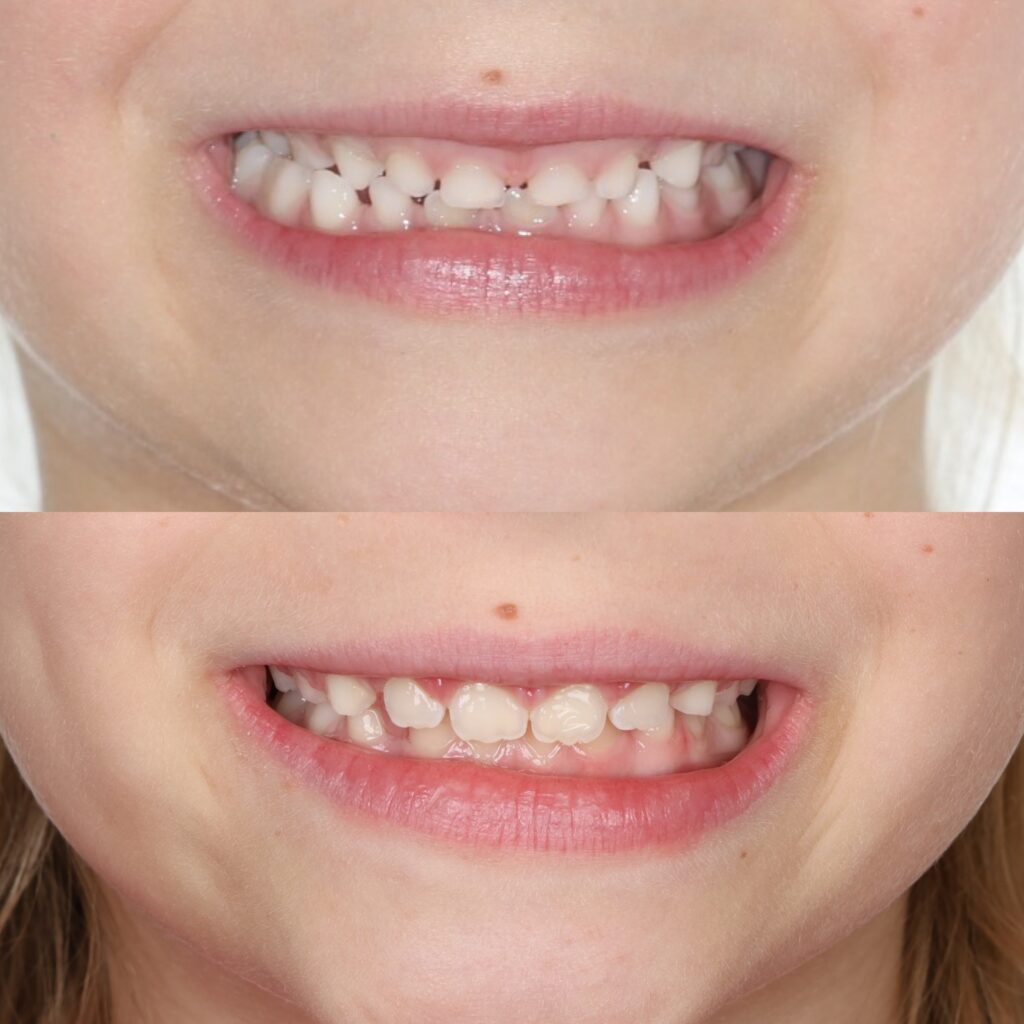
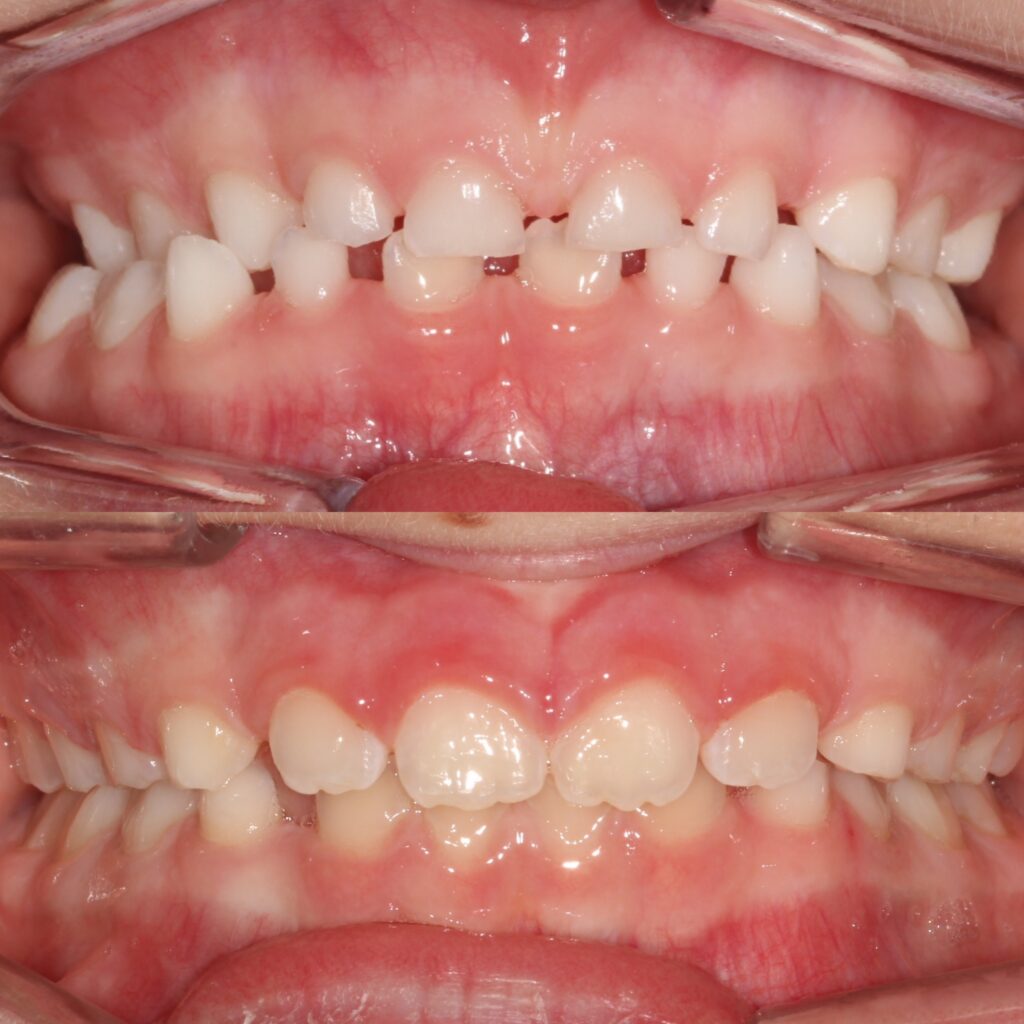
Individual results vary. Treatment time and outcome depend on the case.
What working with us looks like
Three steps, and you can stop after the first one if you want to.
Come in and get real answers
Complimentary consultation with a full set of records, including digital scans and imaging. Dr. Vanderstelt walks you through what she sees on the screen with you: which kind of crossbite it is, whether the jaw is shifting, and whether it is dental or skeletal.
See your options, with the trade-offs
What is possible, what each path involves, roughly how long, and what it costs. If more than one approach is reasonable you hear about all of them, honest downsides included. Then you decide. No pressure and no same-day-only pricing.
We do the work
One location, and you see Dr. Vanderstelt at your appointments rather than rotating through whoever is available. Benito, the office goldendoodle, will be around. He has talked more than one nervous patient through a first visit.
What crossbite treatment costs in Denver
Cost is the reason a lot of people put this off, and vagueness about it is the reason they put it off longer. So here are the actual numbers at aligned. Orthodontics in Denver, as of August 2026, for comprehensive treatment:
Braces: $5,500 to $8,000, with metal at the lower end of that range and clear ceramic toward the upper end, since ceramic brackets cost more.
Invisalign and clear aligners: $4,000 to $10,000. More on that on our Invisalign cost in Denver page.
Where you land inside those ranges comes down to how much movement your case needs and how long treatment runs.
What we won’t do is quote your crossbite over the phone. Not because we’re being cagey, but because crossbites genuinely are all different. A single tipped tooth in a nine-year-old and an adult needing skeletal expansion are not the same job, and pretending a phone call can tell them apart does you no favors. A child’s limited treatment, an expander on its own, or expansion paired with full treatment are all quoted individually once we’ve seen records.
You get your complete breakdown at your complimentary consultation, before you commit to anything. We offer flexible payment plans, and we check your insurance benefits so the number you hear is the real one.
What changes after
People expect the cosmetic difference. It’s the functional one that surprises them.
You close your teeth and they just land. No hunting for the bite, no sideways slide, no favoring one side when you chew something tough. Meals stop being a thing you navigate.
Your teeth stop absorbing forces they weren’t designed for, which is the point of doing this properly rather than cosmetically.
After expansion, patients whose crossbite came with a narrow upper jaw often see a broader smile that shows teeth instead of dark corners. Some report changes in nasal breathing, though that varies and isn’t something we promise.
And for the people who came in worried their face looked uneven: when a functional shift is corrected and the jaw closes where it belongs, some patients notice their chin and lower face look more centered. Not a different face. Your face, without the workaround.
★★★★★
She came in to correct her bite and stop further recession. She finished with a wider smile and, in her words, the ability to chew without hearing clicking or popping.
Google review, aligned. Orthodontics
One patient came to us wanting her bite corrected and to stop further gum recession. She finished treatment with a wider smile and, in her words, the ability to chew without hearing clicking or popping in her jaw joint. The bite correction was what she came for. The joint was the part she didn’t expect.
That’s worth doing properly. It’s worth doing once.
Frequently Asked Questions
What is a crossbite?
A crossbite is when the normal relationship between upper and lower teeth is reversed somewhere in the mouth, so lower teeth sit outside or directly on top of upper teeth instead of inside them. It can affect the front teeth, the back teeth, one side, or both. It can involve a single tooth or a whole group.
How do I know if I have a crossbite?
Close your teeth slowly and notice whether your lower jaw slides sideways to meet. Then check in a mirror whether any lower teeth sit outside the uppers. Both are signs. A consultation with records confirms it and tells you whether the cause is the position of the teeth or the width of the jaw.
Can a crossbite be fixed without surgery?
For most patients, yes. Children are corrected with palate expanders or limited braces. Adults with dental crossbites are treated with braces or aligners. Adults who need genuine jaw widening can often be treated with mini-screw assisted palatal expansion, which anchors into bone and avoids surgery in many cases.
Can Invisalign fix a crossbite?
Clear aligners can correct dental crossbites, where teeth are tipped but jaw width is adequate. They can’t widen an adult palate, so skeletal crossbites need expansion first or a different approach. Which category you’re in can only be determined from records, not from photos.
At what age should a crossbite be treated?
Crossbites are one of the strongest reasons for an early orthodontic evaluation, ideally around age seven. In a growing child, the upper jaw is still in two halves and widening it guides growth rather than fighting it. Most crossbites, particularly posterior crossbites with a jaw shift, are unlikely to correct on their own.
Does fixing a crossbite change your face?
It can. Some facial unevenness associated with a crossbite comes from the jaw resting in a shifted position, and when that shift is corrected some patients notice their chin and lower face look more centered. In other patients a skeletal growth difference is contributing, which is a separate evaluation. Records and imaging distinguish the two.
What happens if a crossbite is not treated?
Most crossbites are unlikely to correct on their own. Over time, uneven bite contacts can contribute to localized tooth wear and gum recession on the affected side, and in children the jaw may continue developing around the shift. Mild crossbites without a jaw shift can sometimes be monitored rather than treated.
Is a crossbite the same as an underbite?
No. An underbite involves the entire lower arch sitting ahead of the upper. A crossbite affects a group of teeth and is about the inside-outside relationship rather than front-to-back position. An anterior crossbite can look like a mild underbite but is usually more localized and often more straightforward to correct.
Why does my jaw shift to one side when I bite down?
That’s called a functional shift, and it usually means one or more teeth are contacting first and steering your jaw off center as you close. Unilateral crossbites are a common cause. The shift, rather than the appearance of the teeth, is often the more important finding.
Can adults still have a crossbite corrected?
Yes. The approach differs because the palatal seam is more interlocked in adults, but adult crossbites are treated routinely. Dental crossbites respond to braces or aligners. Skeletal width problems may be addressed with mini-screw assisted expansion, which has given some adults a non-surgical option. Candidacy depends on anatomy and is determined from records.
Watch
The orthodontist who got the expander herself
Most orthodontists who offer adult palate expansion have never worn one. Dr. Vanderstelt has. Here she walks through her own day one: what the appointment was actually like, how the first hours felt, and what she did to stay comfortable.
If your crossbite comes from a narrow upper jaw rather than teeth that are simply tipped, this is the treatment that would be on the table. Recovery is usually the part people are most anxious about, and this is a first-hand account rather than a brochure.
Amanda Vanderstelt, DMD, MSD, board-certified orthodontist, aligned. Orthodontics, Denver
About the orthodontist who reviewed this page
Amanda Vanderstelt, DMD, MSD
Dr. Vanderstelt is a board-certified orthodontist and the owner of aligned. Orthodontics on South Pearl Street. She completed her DMD and went on to earn a Master of Science in Dentistry alongside her orthodontic specialty training, and she has pursued additional training in airway-focused care, which shapes how she evaluates narrow upper jaws and breathing alongside bite correction.
Board certification through the American Board of Orthodontics is voluntary. It requires peer-developed, externally validated written and clinical examinations, and is generally renewed every ten years apart from orthodontists holding lifetime certification. You can confirm any orthodontist’s certification through the ABO’s public orthodontist locator.
She has also personally undergone adult palate expansion, the same treatment she recommends to adult patients with narrow upper jaws.
Ready to find out what’s causing the shift?
If your bite has been sliding for years, or you just noticed something looks off with your child’s back teeth, the next step is straightforward. Come find out what’s actually happening.
Your consultation is complimentary, and you’ll leave knowing more than you do right now either way.
Crossbite treatment on South Pearl Street
aligned. Orthodontics
1215 S Pearl St, Denver, CO 80210
Platt Park, a few minutes from Wash Park, University Park, Cherry Creek, and DU.
Crossbite treatment at aligned. Orthodontics
Denver, Colorado. Updated August 2026.
| Orthodontist | Amanda Vanderstelt, DMD, MSD, board-certified by the American Board of Orthodontics |
|---|---|
| Treats crossbite in | Children, teens, and adults |
| Approaches used | Palate expanders, mini-screw assisted palatal expansion, Damon self-ligating braces, clear ceramic braces, Invisalign and clear aligners |
| Consultation | Complimentary, about an hour, includes digital scans and imaging |
| Airway evaluation | A separate, more in-depth appointment. Complimentary for ages 13 and under, fee for ages 14 and up |
| Braces | $5,500 to $8,000 Metal at the lower end, clear ceramic toward the upper end |
| Invisalign and clear aligners | $4,000 to $10,000 |
| Payment | Flexible payment plans available. Insurance benefits checked before you commit |
| Location | 1215 S Pearl St, Denver, CO 80210, in Platt Park on South Pearl Street |
| Hours | Monday through Friday, 8:00 AM to 4:30 PM. Closed Saturday and Sunday |
| Phone | 303-521-3333 |
Fees shown are for comprehensive treatment. A crossbite quote depends on whether the cause is the position of the teeth or the width of the jaw, which is determined from records rather than over the phone.
aligned. Orthodontics, Denver
Find out what is causing the shift
If your bite has been sliding for years, or you just noticed something looks off with your child’s back teeth, the next step is straightforward. Your consultation is complimentary, and you will leave knowing more than you do right now either way.
Prefer to talk it through first? Call 303-521-3333.